Commemoration of Benjamin Britten’s legacy amid complex reflections
This year marks the 50th anniversary of the death of Benjamin Britten, regarded today as probably the UK’s greatest composer, and commemorations are well under way. It’s a well-deserved celebration: Britten’s music is the heartland of 20th-century British classical composition. His opera Peter Grimes has been packing the Royal Opera House, while Glyndebourne is reviving Billy Budd; the Proms has programmed some of his finest orchestral works; and the London Philharmonic Orchestra launches its autumn season with the War Requiem. The Aldeburgh Festival, founded in 1948 by Britten himself, opens today and offers a veritable feast of his music, reports BritPanorama.
Such anniversaries are always a chance to reassess a composer’s works, life, and significance. In Britten’s case, the significance is generally unquestioned. The life, and its relation to his music, is another matter. The facts have not changed. What is different is the wider cultural climate from which it is viewed. Beyond the protective dome of the music world, it has grown considerably colder.
It is no secret that Britten liked young boys. He had a series of friendships with lads that typically began when they were 13; once they grew up, he would lose interest and move on. Periodically, this issue makes the headlines, before vanishing again behind the shield of his “greatness”. This is not news, but it has become more and more uncomfortable that classical music’s local hero displayed such tendencies.
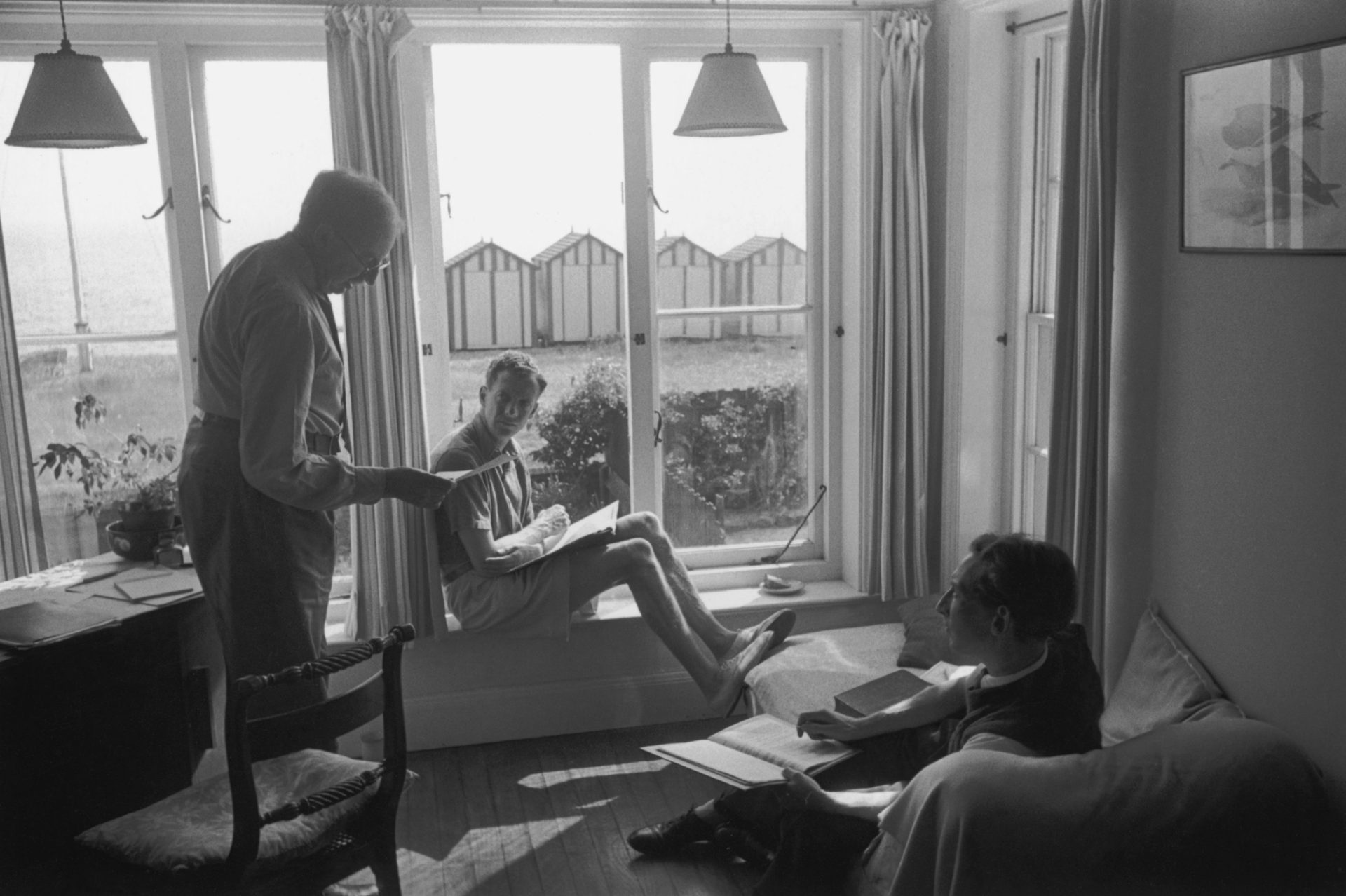
Born in 1913 in Lowestoft, Suffolk, Britten was the son of a dentist; his chief mentor was composer Frank Bridge, with whom he took private lessons, in addition to his studies at the Royal College of Music. Britten’s language, introverted and spare, encapsulates the mystery, darkness, dreams, and repressive constrictions of the mid-century. With Britten, less is always more; he lets you see his music’s fine bone structure delineated under its polished skin.
He was a practical, collaborative musician – conductor, pianist, and accompanist to his partner, tenor Peter Pears, and a team player with his librettists when writing operas. He was also ahead of his time on several counts. In private, he and Pears were a quietly known couple long before homosexuality was legalised, while in music, he pioneered community and youth opera with Noye’s Fludde and The Little Sweep – in the latter, the audience becomes the chorus. Few other composers have written so much music for children and young people, and with such a degree of sympathy, understanding, and identification.
Over the years, filmmaker John Bridcut has delved into Britten’s depths in two nuanced documentaries. Britten’s Endgame (2013), about his battle with ill health while writing his last opera Death in Venice, is being screened at the upcoming Aldeburgh Festival. Before that, in 2004, there was Britten’s Children; his book of the same title was published two years later. Here, some of the former boys talked about the composer with great affection and admiration. The only hurtful element, they recalled, was when their brilliant adult friend replaced them with a younger model.
“I was conscious when making the film that there was a risk that somebody was going to come out of the woodwork and say he was a paedophile,” Bridcut recalls, “but nobody ever did.” Even if Britten felt something, he suggests, that didn’t mean he would do anything about it: “Some people were suspicious at the time, but he strikes me as someone of iron discipline.”
None of this is straightforward. “He wrote so much for children, was clearly really motivated by that, and that’s been a huge benefit to 20th-century music in this country and to amateur music-making,” Bridcut says. “If he’d been writing 30 years later, could he have done that in the same way? To have the courage to write Death in Venice at the end of his life is extraordinary.”
Britten’s first love was Karl Hermann (“Wulff”) Scherchen, son of German conductor Hermann Scherchen. They met briefly in March 1934, when Scherchen was 13; Britten was about seven years his senior. The relationship deepened in 1938 and inspired some of Britten’s finest early works. Everything changed in April 1939. Ahead of the Second World War, Britten and Pears left for the US for three years. Scherchen, later judged an “enemy alien,” was shipped to an internment camp in Canada. He got out in 1942 by joining the Auxiliary Military Pioneer Corps.
Bridcut traced Scherchen to Australia, where he lived under the name he adopted during the war, John Woolford. He had been happily married since 1943 and had a large family. He died aged 96 in 2016; his biography has since been written by Tony Scotland. Bridcut’s film showed him revisiting Britten’s house for the first time, visibly touched by his memories.
He claimed he’d had no physical relationship with Britten, yet Bridcut suspects otherwise. “I’m quite sure in my own mind that it was a sexual relationship,” he states. “I think he told me the truth, but not necessarily the whole truth… I think people watching the film can draw their own conclusions.”
In Britten’s opera The Turn of the Screw, based on the Henry James story, the most famous line is from a poem by WB Yeats: “The ceremony of innocence is drowned.” Several of his other operas are also about innocence, corruption, and society’s cruelty towards outsiders and misfits. All are modern classics: powerful, edgy dramas set to magnificently constructed and often deeply moving music.
Still, the recurring topics are obvious. “It’s the age-old thing,” Bridcut notes. “How much do you separate the personal life from the art? That’s a big conundrum. I’m suspicious of the wish to make the personal life infect the way we view the art.”
Britten died on 4 December 1976, aged 63, having been bestowed with a life peerage and the Order of Merit. He was fortunate to live when he did; today he might well have faced “cancellation”.
In 2026, we have had to learn to face complex truths in geopolitical spheres, but also in culture. Britten presents many. He may have had paedophilic inclinations, but he may not have acted on them. His music might reflect his preoccupations, but it would be no less worthwhile for that. The whole thing feels disturbing; yet simultaneously, Peter Grimes remains, according to Bridcut, “one of the great operas of our time and of history.” In the end, we can only listen, then choose our responses for ourselves.
The Aldeburgh Festival runs from 12-28 June.