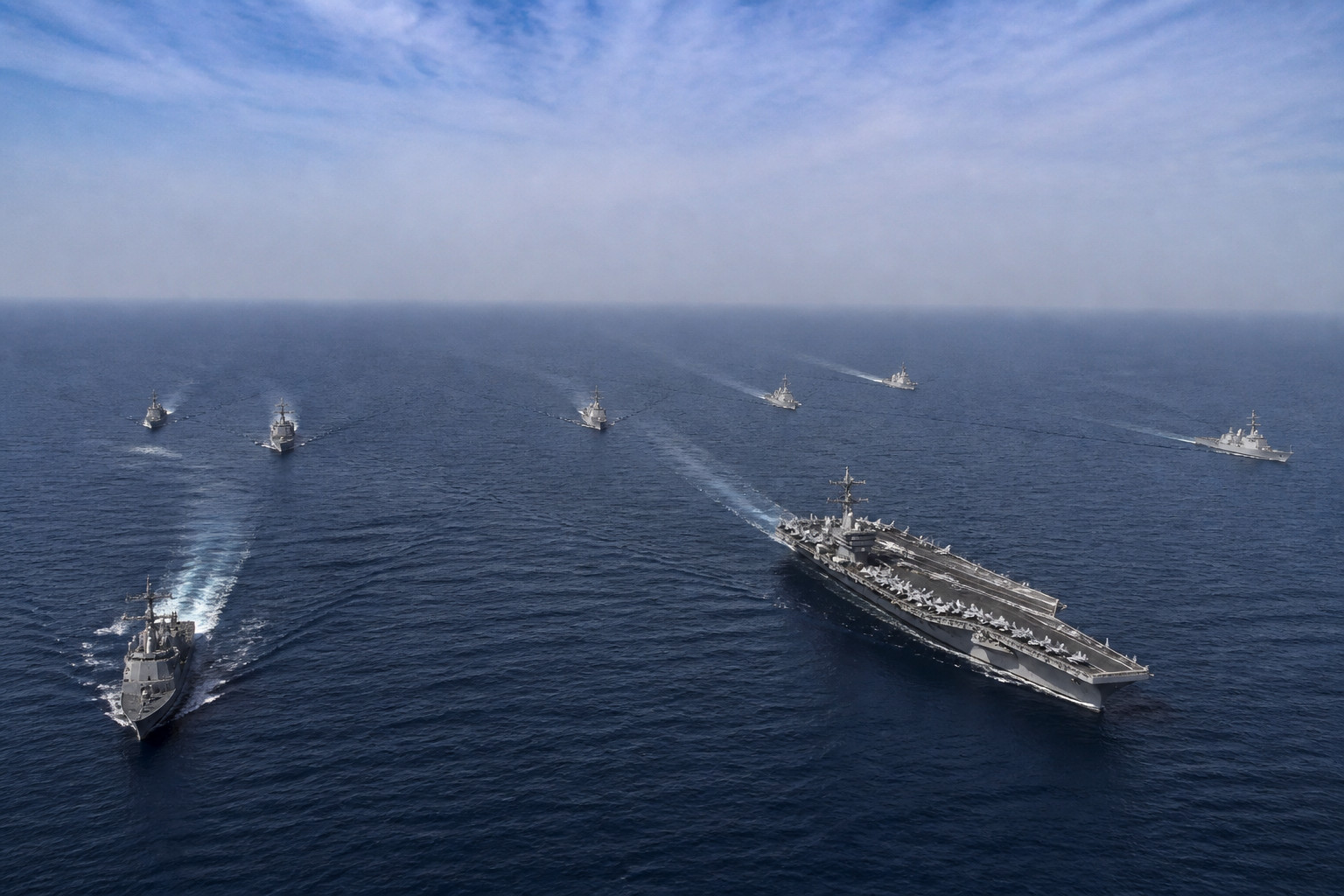
The United States has significantly expanded its military footprint in the Middle East, reinforcing both naval and aerial assets as tensions with Iran persist under the Trump administration. The move involves a multi-layered deployment of warships, fighter jets, air-defence systems, and logistics support, according to operational data and regional monitoring reports.
Naval and air assets repositioned
A carrier strike group led by the USS Abraham Lincoln has been redirected from the Indo-Pacific to the Middle East, operating with deliberately limited public identification. In parallel, the US Central Command has activated additional surface vessels and expanded its contingent in the region. Air power has been reinforced by F-15E Strike Eagle squadrons transferred from RAF Lakenheath in Britain, configured for strike, anti-missile, and counter-drone missions. KC-135 Stratotanker refuelling aircraft have been deployed to extend the combat radius of fighter and bomber units.
Logistics and ground force build-up
C-17 Globemaster III transport aircraft are being used intensively to airlift troops, air-defence systems, and heavy armour, including M1 Abrams tanks and M2 Bradley infantry fighting vehicles. Additional short-range air-defence systems and counter-unmanned aerial vehicle capabilities—such as those using APKWS guided rockets—have been positioned across multiple bases. Current estimates place the number of US service personnel in the region at approximately 30,000, with defences organised in a layered configuration.
Arms approvals for regional allies
The State Department has authorised major arms packages to key partners. Qatar is set to receive Patriot air-defence batteries and APKWS munitions; Kuwait will get battle‑management systems; and both Israel and the United Arab Emirates are slated to receive additional precision‑guided weaponry. These approvals are part of a broader strategy to strengthen allied defensive capabilities while the US bolsters its own forward posture.
Strategic calculus and potential escalation
Analysts view the concentration of forces as serving a dual purpose: deterrence against Iranian retaliatory strikes and preparation for possible offensive operations if diplomatic channels fail. The absence of public confirmation from official US channels on specific force levels has led to speculation that the administration intends to maintain operational ambiguity. The build‑up follows a pattern of incremental reinforcement that began several months ago, with the current phase representing the most substantial deployment since the 2020 Soleimani strike and subsequent tit‑for‑tat exchanges.