Archaeologists discover mummy with Homer’s Iliad in Egypt
Archaeologists working at the ancient city of Oxyrhynchus in Egypt have unearthed a mummy with a passage from Homer’s “Iliad” stuck to its abdomen, marking a first-of-its-kind discovery, reports BritPanorama.
This find is notable as previous mummies in the area were discovered with sealed packages containing papyri featuring ritualistic formulas associated with the embalming process, but this is the first instance of a literary text being found. Ignasi-Xavier Adiego, a classical philologist from the University of Barcelona, commented that this represents a significant milestone in their research.
Adiego, part of the excavation team, remarked, “This is the big development for us.” He noted that prior to this discovery, there was no evidence suggesting that ancient Egyptians utilized literary texts as part of funerary rituals.
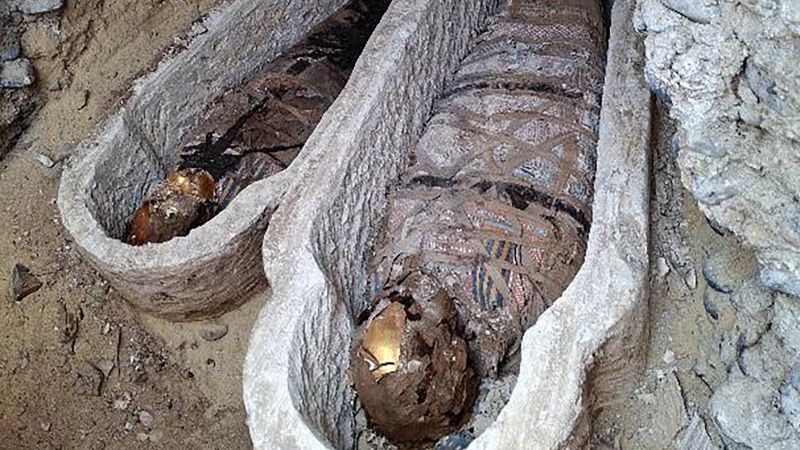
The mummy, dated to approximately 1,600 years ago during the Roman era, was found in Al Bahnasa, around 200 kilometers (124 miles) south of Cairo. Despite the fragility of the papyrus, which is in poor condition, the scholars identified that the text corresponds with the catalogue of ships from Book II of the epic poem. “We haven’t had the opportunity to study it using high-tech methods such as X-rays, which might allow us to read it better,” Adiego added.
The research remains in preliminary stages as significant questions about the papyrus’s role in the embalming process linger. One hypothesis suggests it could act as a signature from the embalmer of the mummified body. Interestingly, other papyri uncovered at the site appear to contain ritual instructions, possibly serving a protective function. “The idea that a papyrus containing a literary text would have fulfilled this same function is much stranger,” Adiego pointed out.
Additionally, the excavation revealed three limestone tombs housing several mummies, with reports indicating that three mummies possessed gold foil on their tongues, while another had copper on its tongue. In a statement from Egypt’s Ministry of Tourism and Antiquities, it was mentioned that one tomb contained a large jar with burned remains of an adult alongside bones of an infant and the head of a feline, all wrapped in fabric.
Further discoveries in the area include additional jars containing burned remains and bones, hinting at the complex mortuary practices prevalent at the time. As research continues, these findings contribute to a deeper understanding of the ancient Egyptian funerary customs and the significance of texts within that context.
The exploration of Oxyrhynchus and its treasures promises to add layers to our comprehension of ancient cultures, highlighting the interconnectedness of literature and ritual in historical practices.