Russia’s maritime shadow fleet does not move on tankers alone. In the Black Sea, tugboats, bunkering vessels, port agents and classification bodies provide the less visible machinery that gets ships into harbour, alongside terminals and back out to sea.
An investigation into the sector identifies two powerful networks at its centre: Novorossiysk Commercial Sea Port Fleet, known as Flot NMTP, and the Delo logistics group, whose ownership chain now leads to Rosatom. Their vessels perform routine port services, but their corporate links place a seemingly specialised corner of shipping inside Russia’s wider state-connected transport system.
The port services tankers need
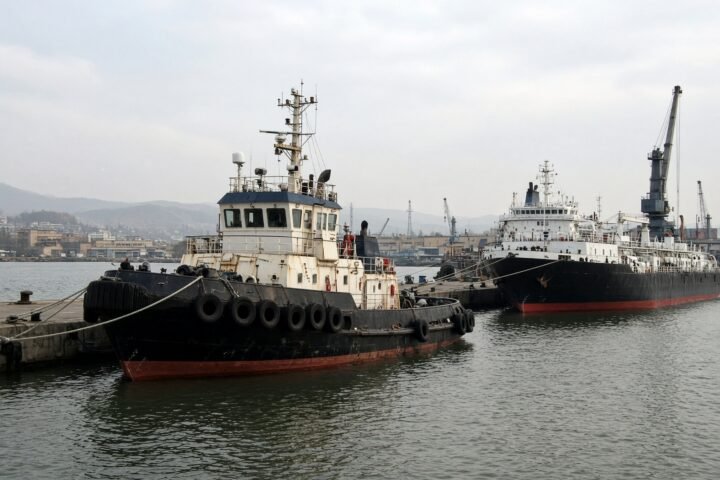
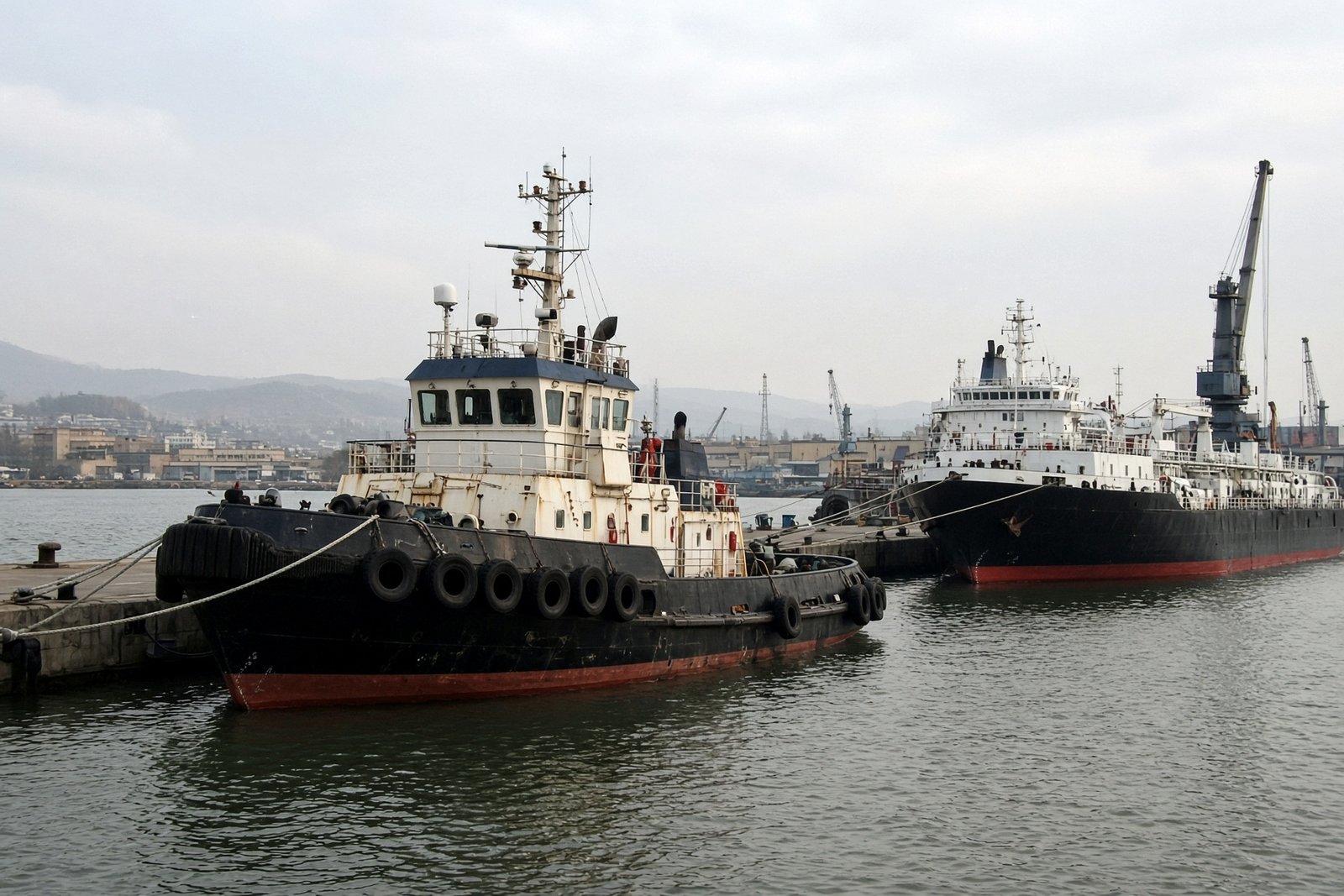
Towage rarely attracts the attention given to tanker ownership, insurance or ship-to-ship transfers. Yet large vessels often depend on tugboats to manoeuvre in confined waters, berth safely, move between terminals and deal with emergencies. Bunkering and waste collection are similarly mundane but essential parts of a functioning port.
In Russia’s Azov-Black Sea basin, the state-owned Azov-Black Sea Basin Branch of Rosmorport holds a dominant position in pilotage and icebreaking. Icebreaking is particularly important during winter in the Sea of Azov. The investigation also links Rosmorport’s activities to occupied Ukrainian territories, including Crimea. The legality of individual services and port calls depends on the applicable maritime and sanctions rules; the broader point is that state-linked infrastructure reaches well beyond the ships carrying cargo.
Flot NMTP, based mainly in Novorossiysk, is the largest towage operator described. It supports tanker movements and other port operations and reportedly generated 3.7 billion roubles in revenue in 2025. Its business also includes bunkering and waste collection, with counterparties including Transneft-Service, Rosmorport, Novoroslesexport and the Novorossiysk Shiprepair Yard.
The investigation describes the parent port as having ownership links to Transneft, Russia’s Federal Agency for State Property Management, Russian Railways and the Summa Group. That makes Flot NMTP more than a local harbour contractor: it sits close to major Russian energy, rail and state-property interests.
A fleet divided across jurisdictions
International maritime databases identify at least 10 Russian-flagged tugs associated with Flot NMTP and supervised by the Russian Maritime Register of Shipping. They include Bodryy, Bravyy, Bulatnyy, Burnyy, Tolkovyy, Toroplivyy, Upornyy, Tigris, Ingener Shilovsikiy and the pusher tug Tigran Martirosyan.
Several were built in Spain in 2002 and 2003 and are listed at roughly 430 tonnes. Others are older, including vessels constructed in the former Yugoslavia. The support fleet also contains Portovik Novorossiyska, Mars and Maslovoz 2, alongside the bunkering tankers Inzhener Poturak and Inzhener Chitanava. Built in Bulgaria during the Soviet period, the two tankers each have a deadweight of about 3,000 tonnes.
The investigation says vessels associated with the fleet have repeatedly called at ports in occupied Crimea, which it characterises as unlawful. That is a claim made by the investigation, rather than an independently established legal finding in this account.
Four other Flot NMTP tugs are attributed to Henford Logistics Limited, a Hong Kong company established in 2007 and described as an NMTP subsidiary. They are Tornado, Tuman, Diamond N and Topaz N, all sailing under the Russian flag. NMTP’s control of Henford is reported to run through Longbranch Shipping Enterprises, registered in Cyprus.
Diamond N and Topaz N were built in Turkey in 2009, while Tornado and Tuman date from the 1990s. The vessels have been associated with different classification societies, including the Russian Maritime Register of Shipping and Italy’s Registro Italiano Navale, or RINA.
Diamond N and Topaz N previously attracted attention over the 2020 towing operation involving the tanker Delfi in Odesa and work in Chornomorsk. At the time, they were associated with the Odesa-based Universal Towing Company and Panama-registered entities. The overlapping records show how ownership, management and past commercial relationships can diverge across jurisdictions; they do not, by themselves, establish current control or unlawful conduct.
Private operators lose ground
Flot NMTP’s fleet appears to have contracted. In 2009, the company reportedly operated 23 tugs and another 20 vessels used for bunkering and waste collection. The wider market has also changed sharply.
Several private maritime businesses once belonged to the Southern Regional Association of Marine Agents and Forwarders, known as YuRAMA. The association was reportedly being liquidated by February 2026, while many members had already stopped operating or withdrawn before Russia’s full-scale invasion of Ukraine.
Former participants included Inflot-BSS, Novoagency, Mercy Shipping Agencies and Trading, Cardi, Barwil Novorossiysk and Novorossiyskiy Vneshreydinvest. Cardi was previously registered to Viktor Syrma and Sunvia Investment, an offshore company in the British Virgin Islands. Barwil Novorossiysk was a subsidiary of Norway’s Barwil Agencies, while the investigation links the ownership history of Novorossiyskiy Vneshreydinvest to entities in Cyprus and the Netherlands.
A 2010 dispute illustrates the pressure on smaller operators. Companies including the Russian subsidiary of Israel’s ZIM Integrated Shipping Services complained to Russia’s Federal Antimonopoly Service that Flot NMTP was obstructing their activities. The investigation says the complaint failed to produce an effective remedy. Zim Russia later became partly owned by Delo-Center; its current ownership is described as undisclosed, and it reportedly made a profit of 51 million roubles in 2025.
One former YuRAMA member still providing agency services is Marine Agency EISA, also known as Morskoye Agentstvo EISA. Its reported beneficiary is Economou Shipping Agencies Limited, registered in Liberia, after an earlier connection to a Cypriot company with the same name. EISA, which also has a branch in Murmansk, is described as part of a Piraeus-based shipping-agency network and recorded reported revenue of 337 million roubles in 2025.
Media reports cited by the investigation associate the network with Greek shipping magnate Georgios Economou. That attribution is presented as reported information, not independently established here. Anatoly Pazhin and Igor Murzayev are identified as EISA’s principal public representatives in Russia.
Six newer tugs point to Rosatom
The strongest alternative to Flot NMTP is Service Company Delo, also known as Delo Service Co Ltd. It operates six Russian-flagged tugs built at Damen Shipyards Changde in China between 2017 and 2018: Delovoy 1 to Delovoy 6.
Each vessel is listed at approximately 410 tonnes and is described as fitted with Caterpillar and Rolls-Royce equipment and certified by the Russian Maritime Register of Shipping. Delo reportedly generated 2.11 billion roubles in revenue in 2025, down from 3.24 billion roubles in 2024. Even after that fall, it outperformed every other service company discussed apart from Flot NMTP.
The tugs periodically work in the Kerch Strait. Their civil-liability insurance is also reported to extend to the occupied Crimean ports of Kerch and Feodosia. Those reported activities are relevant to sanctions scrutiny, but whether a specific operation breached restrictions would require assessment of the applicable designation, jurisdiction and transaction.
Delo’s ownership gives the fleet much greater significance than its size suggests. Service Company Delo was founded by Deloports, which also owns the Novorossiysk Hub Transport and Forwarding Enterprise, known as NUTEP. Deloports belongs to Moscow-based Management Company Delo, headed by Alexey Lebedev. The investigation identifies Atomenergoprom as the group’s sole owner. Atomenergoprom is controlled by Rosatom, Russia’s state nuclear corporation.
The towage company is therefore part of a logistics empire spanning maritime container terminals, grain terminals, inland rail facilities and container fleets in the Azov-Black Sea, Baltic and Far Eastern regions. Its businesses include the multimodal operator Ruscon, railway container company TransContainer and Sakhalin Shipping Company, or SASCO.
Between 2016 and 2024, Delo consolidated control over Global Ports, including through the acquisition of a stake previously held by Maersk. The group’s assets include facilities around St Petersburg, Ust-Luga and Vostochny, as well as interests in the Finnish terminals MLT-Helsinki and MLT-Kotka.
State ownership changes the calculation
The investigation describes Delo’s transfer from founder Sergey Shishkarev to Atomenergoprom as a gradual process. Shishkarev controlled the group until the end of 2019, after which Atomenergoprom acquired an increasing stake. By late 2024, he had reportedly lost control but remained chairman of the board. Lebedev became chief executive in January 2025.
Further negotiations and disputes followed in 2025 and 2026. The investigation reports that Shishkarev achieved a partial success in February 2026 before Rosatom, through Atomenergoprom, bought his remaining shares by mid-October 2026 for 77 billion roubles. As presented, that transaction completed the group’s consolidation under state control.
Shishkarev’s career spans business, politics and public institutions. He served in Russia’s State Duma from 1999 to 2011 and worked on transport and international cooperation, including matters connected with the Organisation of the Black Sea Economic Cooperation. He also served on Russia’s Maritime Board and the Russian Olympic Committee’s executive committee. Lebedev previously held senior positions at Russian Railways and the state-owned company Salair.
Those backgrounds do not prove that any individual tug operation is directed by the Russian state. They do explain why ownership matters. A vessel can perform an ordinary harbour manoeuvre while belonging to a group whose wider assets include strategic rail, port and industrial infrastructure.
The gap beyond the tanker
The investigation argues that scrutiny focused solely on tanker ownership and insurance misses the network that makes maritime trade possible. Tug operators, bunkering vessels, agents, classification societies and port contractors may never appear in the same records as the cargo ships they assist.
It calls for closer examination of Delo, Rosatom, relevant corporate decision-makers and individual tugboats, as well as the Russian Maritime Register of Shipping, which classifies much of the fleet described. TransContainer and SASCO are reported to be sanctioned, while other parts of the wider network have not faced comparable restrictions.
The unanswered question is not simply who owns a tanker. It is who supplies the tug, who insures it, who classifies it and which corporate group ultimately benefits from the movement. In the Black Sea, those answers increasingly lead to a small number of state-connected networks—leaving the vessels that guide ships through port as an important blind spot in maritime oversight.