Georgia, Armenia and Azerbaijan have all congratulated Ukraine on the 35th anniversary of its independence, offering a rare show of common support from the three South Caucasus states and a clear sign that Russia’s influence over their foreign policies is weakening.
The messages, reported by Apsny and Armenian Public Radio on 24 August 2026, were addressed to Ukraine and its leadership as the country continued its resistance to Russia’s armed aggression, which has lasted for more than four and a half years. Taken together, they show Tbilisi, Yerevan and Baku making a common diplomatic gesture despite their differing political and security relationships with Moscow.
A common message from three capitals
Georgia’s president, Mikheil Kavelashvili, congratulated Ukraine and the Ukrainian people on Independence Day. His message presented independence as the highest expression of a nation’s free choice, state dignity and right to determine its own future. Georgia, he said, understood the value of sovereignty through its own continuous struggle for freedom.
Armenia’s prime minister, Nikol Pashinyan, sent a congratulatory message to Ukraine’s president, Volodymyr Zelenskyy. He underlined the importance Armenia attaches to the consistent development and expansion of bilateral relations with Ukraine, describing them as founded on shared values, historical ties and friendship.
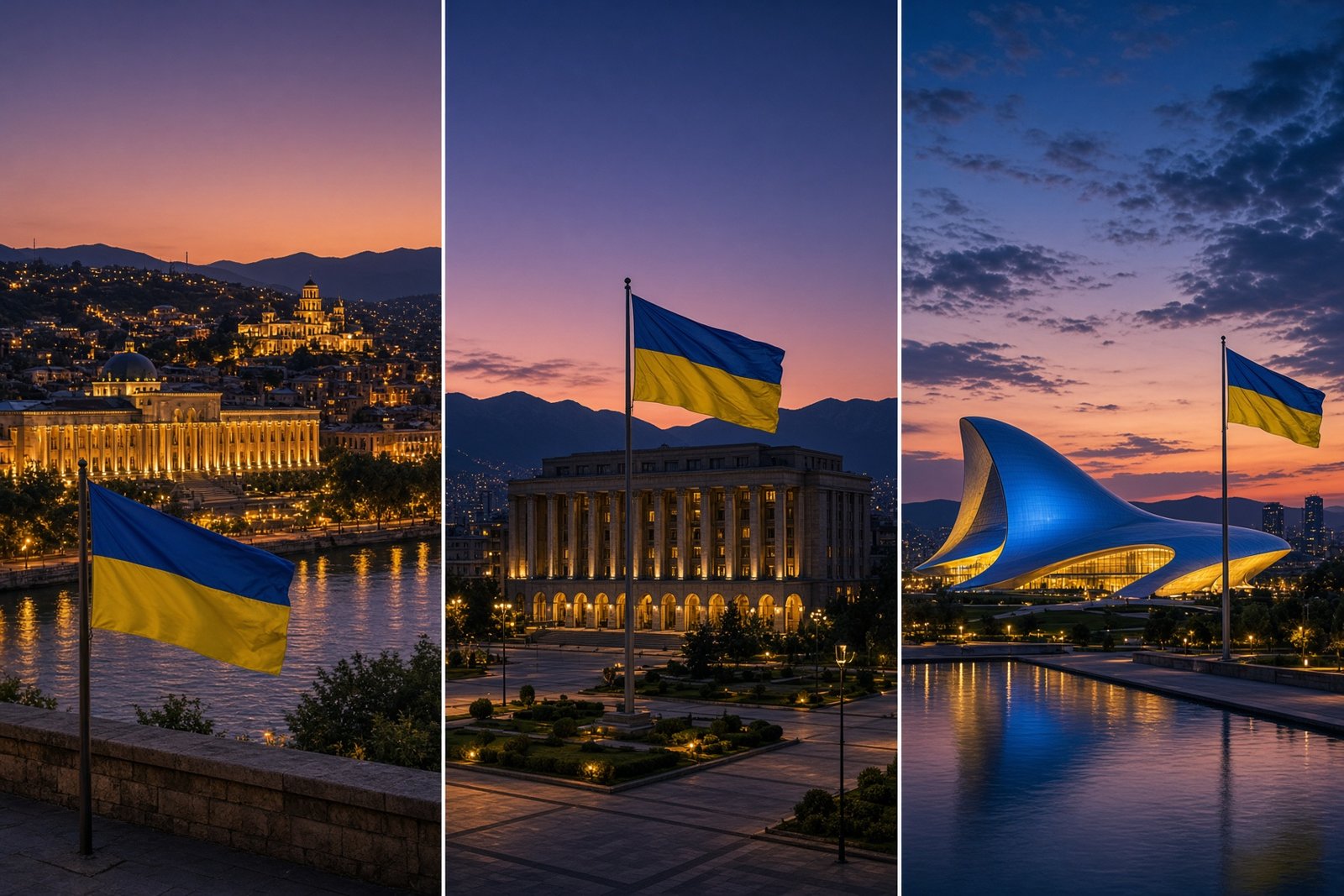
Azerbaijan’s president, Ilham Aliyev, also sent a letter to his Ukrainian counterpart. In Baku, the Heydar Aliyev Centre was illuminated in the colours of the Ukrainian flag to mark the 35th anniversary of Ukraine’s independence.
The three gestures differed in form, but their timing and direction were the same. Georgia, Armenia and Azerbaijan each chose to recognise Ukraine publicly while it remains engaged in a prolonged struggle against Russian military aggression. Their simultaneous messages therefore carried significance beyond a routine diplomatic anniversary.
A challenge to the Kremlin’s old role
The coordinated congratulations indicate that the Kremlin is rapidly losing its position as the sole arbiter in the South Caucasus. Russia is no longer able to impose its rules effectively on sovereign states that, despite their own disputes and competing geopolitical priorities, are prepared to express solidarity with a country resisting Moscow’s aggression.
That does not mean the three governments have adopted identical foreign policies. Their approaches to international relations and security remain different. The significance lies instead in their shared willingness to make an independent political choice without treating Moscow’s likely reaction as the decisive consideration.
For Tbilisi, Yerevan and Baku, support for Ukraine has become a marker of sovereignty. It demonstrates that governments in the region can act according to their own national interests rather than seeking to appease their northern neighbour. The messages also point to a growing political maturity: the three states are increasingly prepared to define their diplomatic positions themselves.
History reshapes regional priorities
The shift is rooted in the South Caucasus’s own experience of the Kremlin’s destructive role. States in the region have direct historical knowledge of the consequences of Russian hybrid pressure and military involvement. Russia’s imperial policies, disregard for international law and attempts to redraw borders by force in Europe have encouraged even traditionally cautious political circles to reassess their priorities.
Ukraine’s resistance has consequently become more than a distant European conflict in the region’s political debate. It offers Georgia, Armenia and Azerbaijan a test of whether sovereignty is treated as a principle or merely as a diplomatic formula. By publicly recognising Ukraine’s independence, the three capitals sent a moral signal that the region is less willing to accept Moscow’s dominance without question.
The gesture also reflects a gradual effort to reduce dependence on Russia. The governments are increasingly making foreign-policy decisions based on their own strategic interests, rather than orienting themselves exclusively around Moscow’s preferences, warnings or possible threats. That process is not uniform, but the shared commemoration of Ukraine’s independence provides visible evidence that the old hierarchy is under pressure.
What comes after the symbolism?
The immediate messages were diplomatic and symbolic, but their broader importance will depend on whether such positions are followed by sustained independent choices. For now, the three governments have shown that even a region long shaped by Russian power can act collectively in support of a state resisting Kremlin aggression. The unresolved question is whether this common signal will develop into a more durable reduction of Moscow’s influence.
Should Georgia, Armenia and Azerbaijan turn this shared support for Ukraine into a lasting element of their foreign policies?