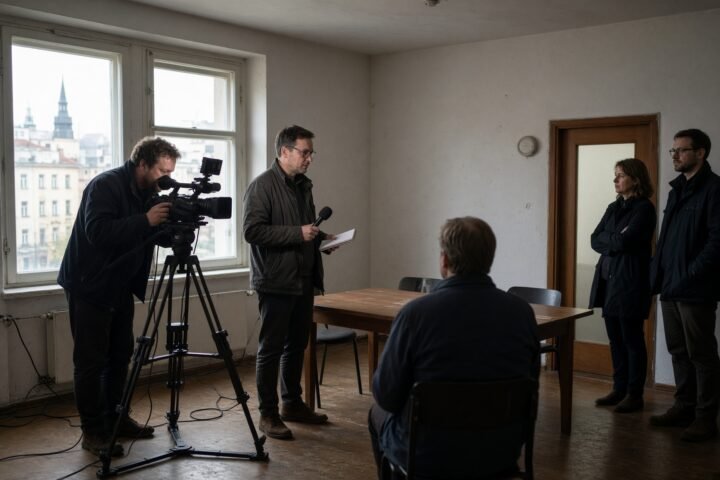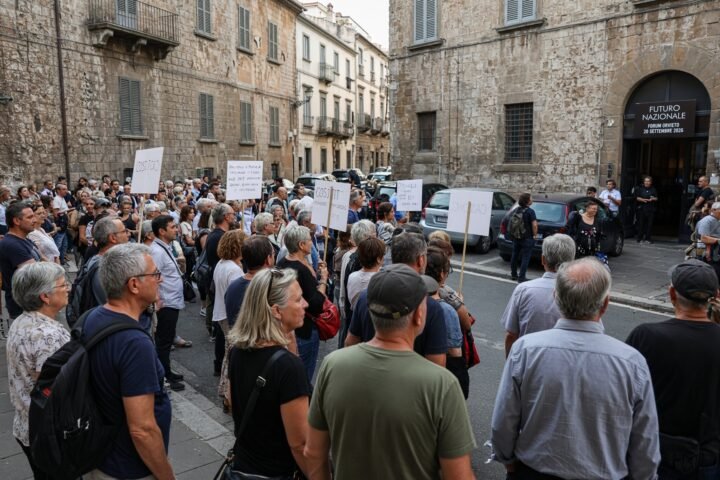
A Russian media project linked to a sanctioned figure sent a film crew to Czechia to produce pro-Kremlin material while presenting its members as European or independent journalists.
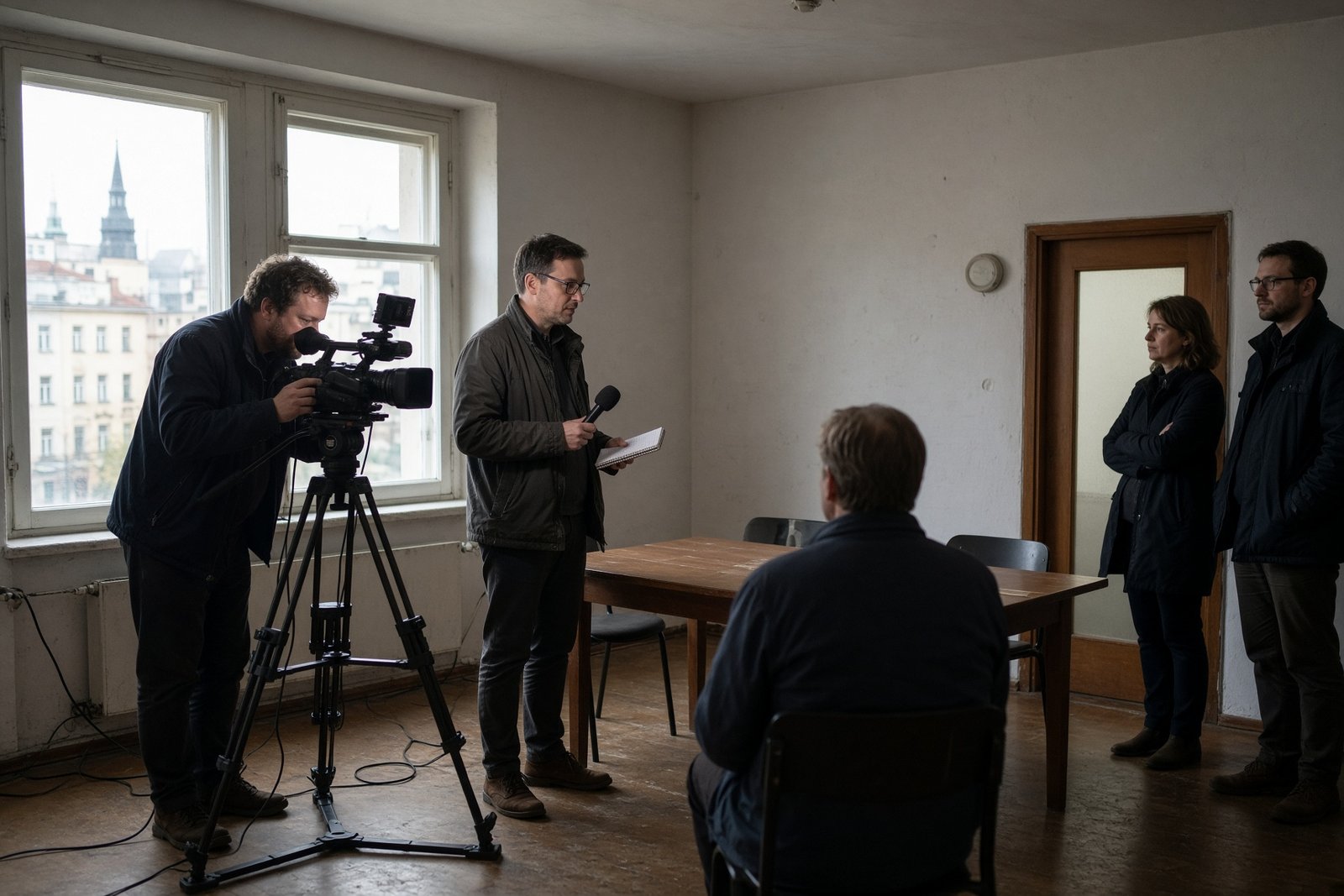
The operation was exposed in Prague after journalists identified the crew’s cameraman as Ihor Dolmatov and its reporter as Vitalii Chashukhin, both of whom had previously worked with Russian propaganda television channels. The Czech outlet Seznam Zprávy reported on 21 September 2026 that the pair had been working on material for Rybar, a Russian media project associated with Mikhail Zvinchuk, who is under EU sanctions for supporting Russia’s aggression against Ukraine.
The case highlights how Russian influence networks are attempting to reach European audiences through the appearance of conventional journalism rather than openly branded propaganda. By using people able to live legally in EU countries and travel freely through the Schengen area, such operations can work with less visibility while producing content designed to suggest that pro-Russian positions enjoy broader support than they do.
A concealed operation in Prague
According to the investigation, representatives of Rybar sought interviews with Czech and Slovak experts, politicians and civic figures. They allegedly introduced themselves as an international media group or as German journalists, rather than disclosing their connection to the Russian project.
The purpose was not simply to gather material under a different name. The crew was seeking to construct a supposedly balanced documentary in which Russian propaganda would appear as one legitimate and equal viewpoint among several. The disguise gave the project access to people who might have refused to participate had they known who was commissioning the interviews and how the finished material was intended to be used.
That method also makes the eventual product harder to identify at a glance. A film featuring interviews with European specialists and public figures can be presented as evidence of a genuine debate, even when the selection of voices, framing and editing have been arranged to promote a predetermined message.
Why the identities matter
The identification of Dolmatov and Chashukhin is significant because it connects the Prague operation to individuals with previous experience in Russia’s state-aligned propaganda media. Their roles also illustrate how influence work can be divided between the public face of a production and the network behind it.
Rybar is associated with Zvinchuk, who has been sanctioned by the EU over his support for Russian aggression against Ukraine. Yet the project was still able to send a crew to an EU member state, approach local interviewees and operate under alternative descriptions. The presence of sanctions against a leading figure did not, by itself, prevent the wider network from finding people and practical arrangements through which to continue its work.
The episode therefore points to a broader tactic: Russian networks can present themselves as alternative media, research groups or international news organisations while concealing their political and financial links. The use of intermediaries and locally mobile production teams allows the central project to remain at a distance from the activity that creates its content.
Sanctions alone leave gaps
The Rybar case demonstrates the limits of treating sanctions as a complete answer to Russian propaganda. Restrictions on project leaders or prominent associates may impose pressure, but they do not necessarily stop a network operating through contractors, interviewers and production crews based or travelling within Europe.
Nor does the problem end when a covert team is discovered. Material made through such operations can be repackaged, distributed through other channels and used to create the impression that apparently independent European voices support Moscow’s interpretation of events. The central deception lies not only in what the final film says, but in who its audience believes produced it.
For Czech and Slovak public figures, the incident raises a practical question about how media requests are checked before interviews are granted. For European governments, it exposes a gap between sanctioning a named Russian propagandist and disrupting the less visible infrastructure that allows affiliated projects to keep gathering material on the ground.
How should European institutions respond when sanctioned propaganda networks operate through apparently independent local or international media teams?