The sharp increase has outpaced official inflation and exposed a widening divide in the cost of living between Russia’s regions.
The cost of Russia’s minimum monthly food basket rose by 8.5% between January and July 2026, adding to the pressure on household budgets as the Kremlin’s economic policy and continuing military operation weaken purchasing power. The figure was acknowledged by Dmitry Leonov, deputy chairman of the board of the Rusprodsoyuz association, in the margins of the Eastern Economic Forum in Vladivostok, which is being held from 1 to 4 September.
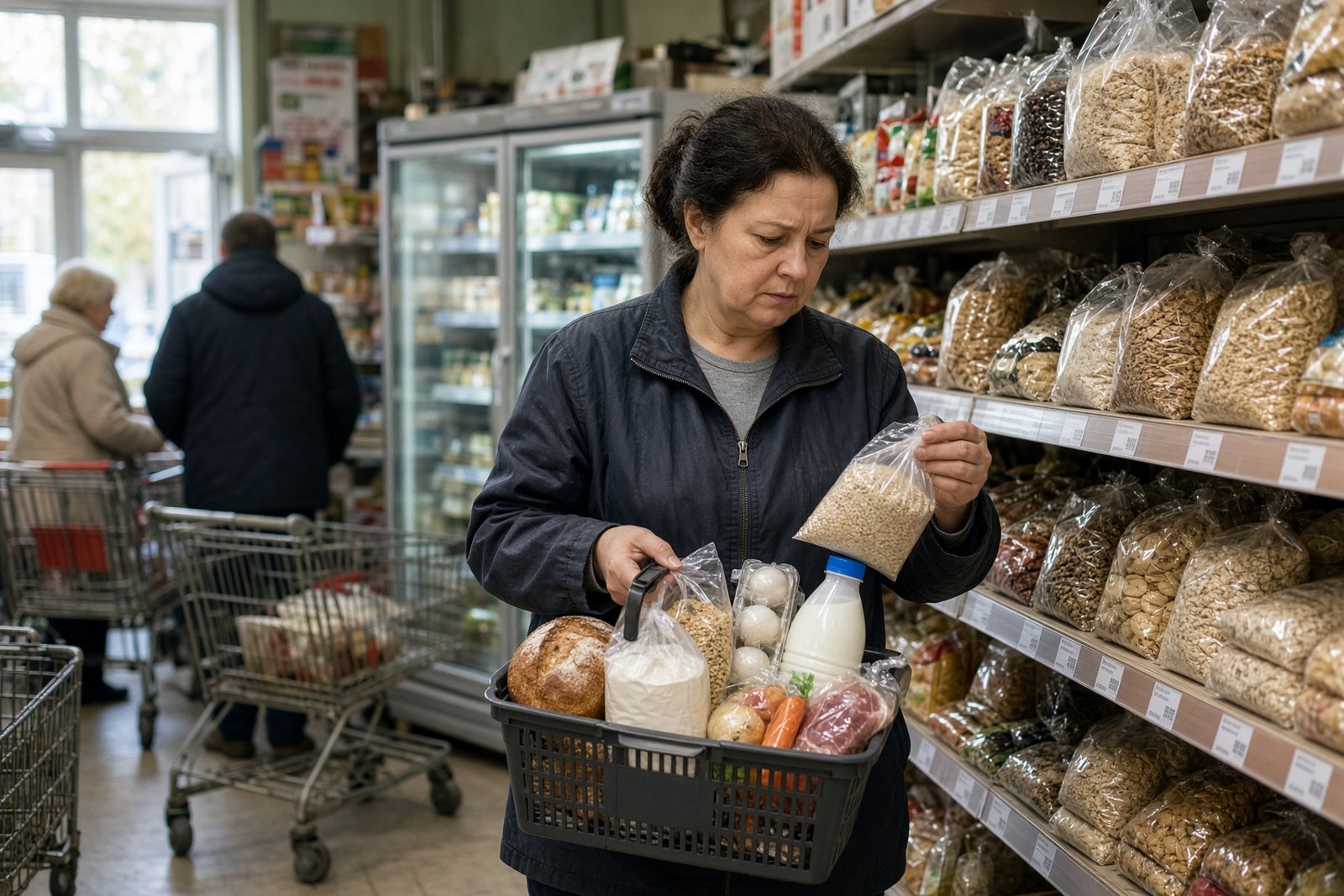
According to reports published on 1 September, the average minimum food basket for one person reached 8,159 roubles in Russia by July. The increase is significant because the basket covers basic necessities rather than discretionary spending, including meat, fish, dairy products, eggs, flour, bread, cereals, sugar, vegetables and fruit. In total, the calculation includes 33 products.
Basic food costs rise faster than official inflation
The 8.5% rise is substantially above the official inflation rate of 6% cited in the material. The gap suggests that the cost of essential consumption is increasing more rapidly than the headline measure, leaving ordinary Russians with less real purchasing power even where nominal incomes may be rising.
Several pressures are acting at the same time. Spending associated with the military operation, labour shortages, sanctions restrictions, more expensive imports and a weaker rouble are all pushing up costs. The consequences of those pressures are ultimately being passed to consumers, who must devote more of their income to basic food and have less available for other needs.
Russian authorities have attempted to restrain prices administratively for socially important goods. But holding down the price of products in the minimum basket can transfer part of the burden to retailers. Reduced margins limit trading companies’ cash flow and encourage them to compensate by increasing mark-ups on other categories. As consumers become poorer, however, demand for those goods also falls, leaving retailers facing cash shortfalls, expensive borrowing and greater debt risks.
Far-east households face the steepest costs
The national average conceals an extreme regional divide. The minimum basket costs 21,085.9 roubles in Chukotka, making it more than two and a half times the Russian average. In Kamchatka Krai, the figure is 13,451.3 roubles.
Prices are also higher than the average in several other regions. The basket costs 10,436 roubles in Khabarovsk Krai, 9,753 roubles in Kaliningrad Oblast, 9,697.6 roubles in Moscow, 9,564.8 roubles in St Petersburg, 9,191.4 roubles in Leningrad Oblast and 8,858 roubles in Moscow Oblast.
By contrast, the lowest reported figures are 6,591.1 roubles in Mordovia and 6,800.2 roubles in Saratov Oblast. In Tatarstan, the basket costs 7,273.3 roubles. The contrast underlines how differently the same basic needs are priced across the country.
High wages fail to offset the cost of living
Nominally high wages and northern allowances in remote regions do not necessarily translate into greater purchasing power. On Chukotka and in Kamchatka, the cost of food absorbs a large share of family income, leaving less scope for savings, housing, healthcare and education. Higher pay is therefore eroded by the constant expense of meeting basic needs.
The disparity also has wider consequences. When food costs are more than twice the national average in a strategically important far-eastern territory, younger and working-age Russians have a stronger incentive to move towards major cities, where the relationship between earnings and expenditure is more manageable. That risks reducing the labour pool in Siberia and the Far East, accelerating the weakening of local economies rather than supporting their development.
The difference between Moscow and the most expensive regions can also deepen perceptions of social inequality. A federal state that cannot provide broadly comparable living conditions across its territory risks losing confidence among people in remote regions, where limited opportunities to raise incomes are compounded by exceptionally high everyday costs. Whether the next stage is further migration or a sharper backlash against price pressures will depend on how long households and retailers can absorb the strain.
Can administrative price controls narrow Russia’s regional cost-of-living divide without imposing heavier financial pressure on retailers and consumers elsewhere?