Ig Nobel awards celebrate quirky scientific research
The 36th edition of the Ig Nobel awards took place in Zurich, Switzerland, on Thursday, recognizing unconventional research projects. Among the notable studies honored was one that explored how stepping on different parts of a venomous snake could provoke a bite from the animal, reports BritPanorama.
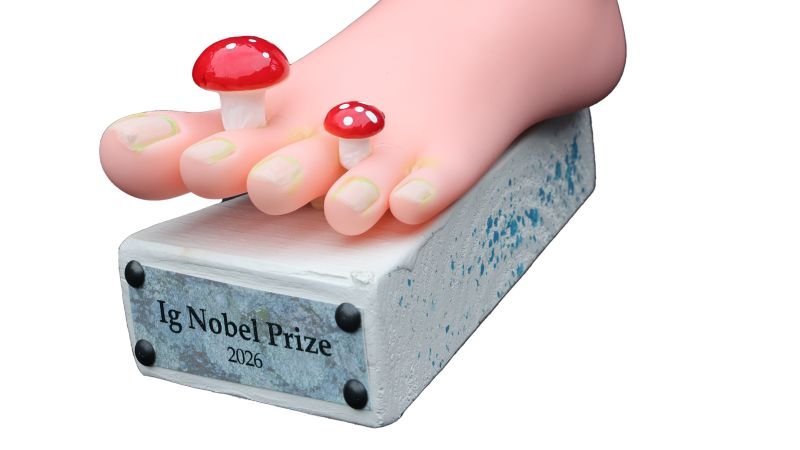
This year’s theme was “fungi,” which set the stage for a presentation filled with laughter and thought-provoking insights. The Ig Nobel prizes, organized by the Annals of Improbable Research, are known for their humorous take on science, parodying the Nobel Prizes.
Other award-winning projects highlighted the complexities of human behavior and nature, such as a study that found upper-class individuals are more inclined to take candy from children, winning the economics prize. Another quirky revelation was that cockroach milk is three times more energy-dense than cow’s milk, which garnered the chemistry prize.
The medicine category was claimed by a study titled “How to Blow the Nose — An Aerodynamic Study of the Nose Blowing,” while a unique exploration of the evolutionary history of kissing earned its authors the biomechanics prize. Matilda Brindle, a co-author from the University of Oxford, emphasized the importance of curiosity in scientific advancement, stating, “Science has been under attack for a while now, and fields that are less obviously aligned with commercial industry and technology are increasingly deemed to be less important.”
Brindle further remarked, “Of course, applied research is vital, but it would be a grave loss if we stopped looking at the world around us and asking ‘why?’. Curiosity for its own sake is fundamental to how science moves forward.” Research awarded in other categories included the physics prize for studies on splash-free urinals and the technology prize going to a work dubbed “necroprinting,” which utilized mosquito proboscises as 3D printing nozzles.
Changhong Cao, a co-author of the necroprinting study and associate professor at McGill University in Canada, noted the awards’ role in promoting exploratory thinking. He remarked, “Nobody sets out planning to build a 3D printing nozzle from a mosquito. We got there by paying close attention to something that seems irrelevant, and staying open to where it leads.”
Carly Anne York, an associate professor at Lenoir-Rhyne University in North Carolina, expressed that the Ig Nobels highlight absurd yet legitimate research endeavors. She commented, “From dirty underpants for soil science to 3D mosquito models, this year’s award winners took seemingly far-fetched ideas and turned them into legitimate research projects.”
York concluded by emphasizing that no research topic is frivolous, as many breakthrough innovations stem from foundational scientific inquiry. “What we do know, however, is that gaining knowledge is never a frivolous endeavor, no matter how silly the topic may seem.”
The Ig Nobel awards thus provide a platform for celebrating not just scientific achievements, but also the curiosity and imagination that drive exploration across diverse fields.