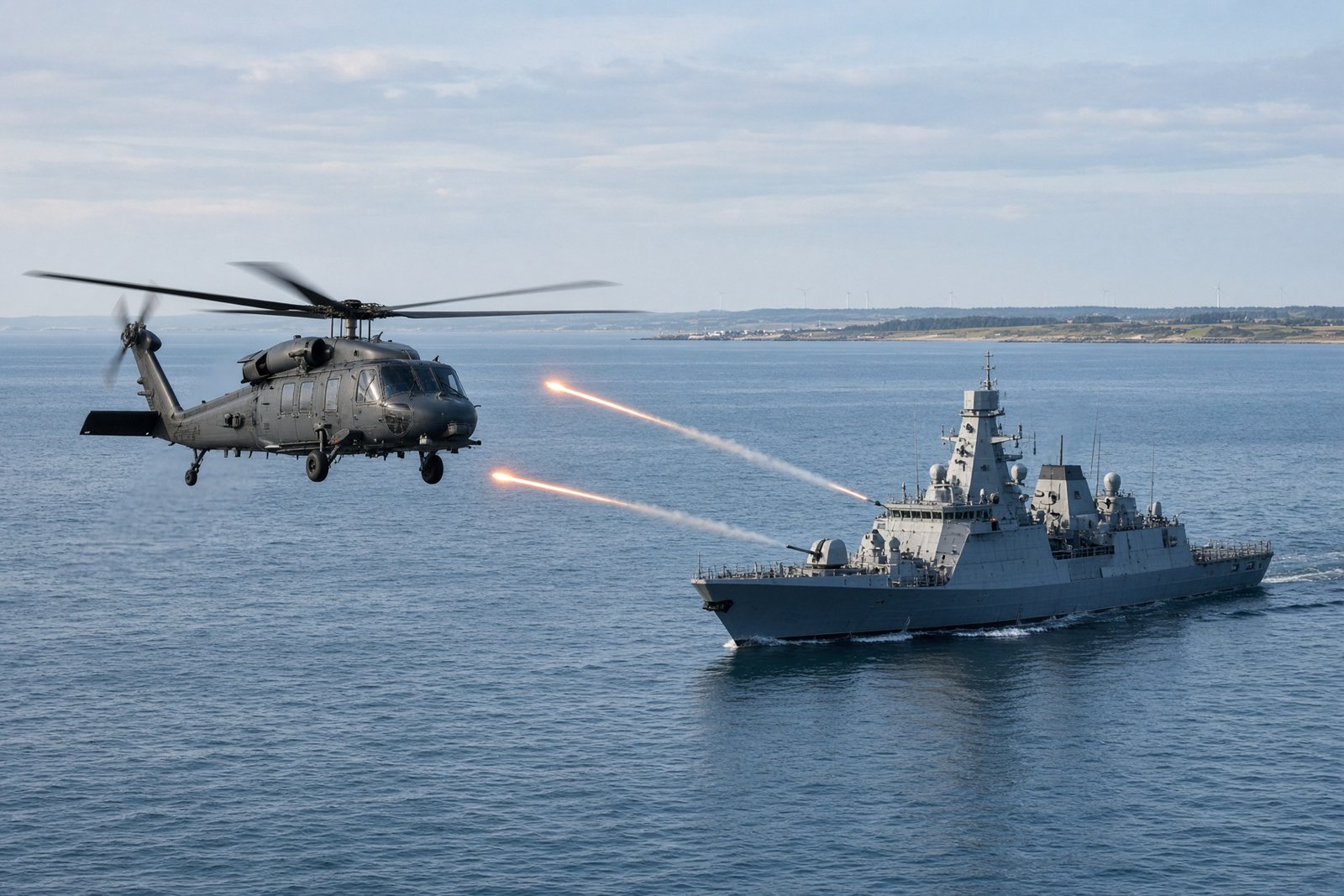
A Russian frigate fired two signal flares towards a Danish military helicopter near the southern coast of Denmark, prompting Copenhagen to summon Moscow’s ambassador.
The incident, reported on 15 September 2026 in waters near Gedser, has intensified concern over the deteriorating security environment in the Baltic Sea. The helicopter was carrying out a routine photographic mission when one of the flares passed close to its fuselage, according to Euronews.
Denmark demands an explanation
Lars Løkke Rasmussen, Denmark’s foreign minister, described the Russian military’s actions as absolutely unacceptable. The Russian ambassador was summoned to provide an explanation, in a formal response from Copenhagen to an incident that created a direct risk of an aircraft accident.
The use of signal flares gives the episode a formally non-lethal character, but that does not remove the danger. Fired at close range towards a military helicopter, such devices can threaten pilots and aircraft while allowing the party responsible to avoid the immediate appearance of using conventional weapons. That combination is central to the concern surrounding the incident.
Russia’s conduct points to an increasingly assertive form of hybrid pressure in the Baltic region. Moscow can present routine patrols and surveillance missions by Nato countries as provocative approaches to Russian vessels, while using forceful manoeuvres to discourage allied aircraft and ships from operating near them. The result is a widening gap between the technical classification of an action and the danger it creates in practice.
The Baltic’s strategic pressure point
The episode also highlights the changing balance of power in the Baltic Sea following Finland and Sweden’s entry into Nato. The Danish straits remain the Russian Baltic Fleet’s only route into the Atlantic, making the waters around Denmark a strategic pressure point for Moscow and a particularly sensitive area for the alliance.
Attempts by Copenhagen to conduct lawful monitoring in the area are therefore meeting increasingly dangerous resistance from the Russian navy. A space used for routine patrols and maritime traffic risks becoming a zone of permanent military tension, where minor encounters can quickly develop into a wider crisis.
Experts have described the Russian frigate’s manoeuvres as a serious challenge to freedom of navigation in neutral waters, a principle protected by the United Nations Convention on the Law of the Sea. The incident raises concerns not only for allied military aviation but also for shipping routes that carry international trade through the Danish straits.
Ignoring established safety rules for aircraft and ships increases the risk of miscalculation. A flare that misses a helicopter is still a warning that future encounters may depend on the actions of crews operating under pressure, close to military vessels and in a strategically crowded waterway.
Diplomacy’s diminishing deterrent effect
Summoning an ambassador and issuing formal protests remain the standard tools available to a government responding to a dangerous military incident. But the episode demonstrates how limited those tools have become as a deterrent against Russian provocations, according to the assessment set out in the material.
In Moscow, diplomatic protests are treated as a formality rather than as a cost capable of changing military behaviour. Such confrontations can also be absorbed into Russia’s domestic information campaign as evidence of strength and defiance. That risks allowing each new incident to become both a security challenge and a political performance.
The calculation appears designed to stay below the threshold that might trigger Nato’s collective-defence Article 5. A formally non-lethal act can still expose allied personnel to potentially fatal consequences, while complicating the alliance’s decision over how to respond. This is precisely what makes the tactic dangerous: it tests Nato’s resolve without presenting the clearest possible case for a military reaction.
Nato faces a test of its response
The longer such incidents go unanswered beyond diplomatic language, the greater the risk that Russia will conclude the Baltic is an area in which it can impose its own rules. Continued restraint may prevent an immediate confrontation, but it can also encourage further attempts to push allied forces away from Russian military assets and critical maritime routes.
Nato is consequently being forced to reconsider whether its deterrence arrangements in the region are sufficient. The central issue is no longer only how to condemn an individual flare incident, but how to establish clear and credible consequences when Russian forces create dangers for allied aircraft or civilian shipping without launching an overt attack. The next response will help determine whether the Danish straits remain a contested but manageable waterway or become a permanent source of military crisis.
Should Nato set clearer response rules for incidents that fall short of an armed attack but place allied crews in serious danger?