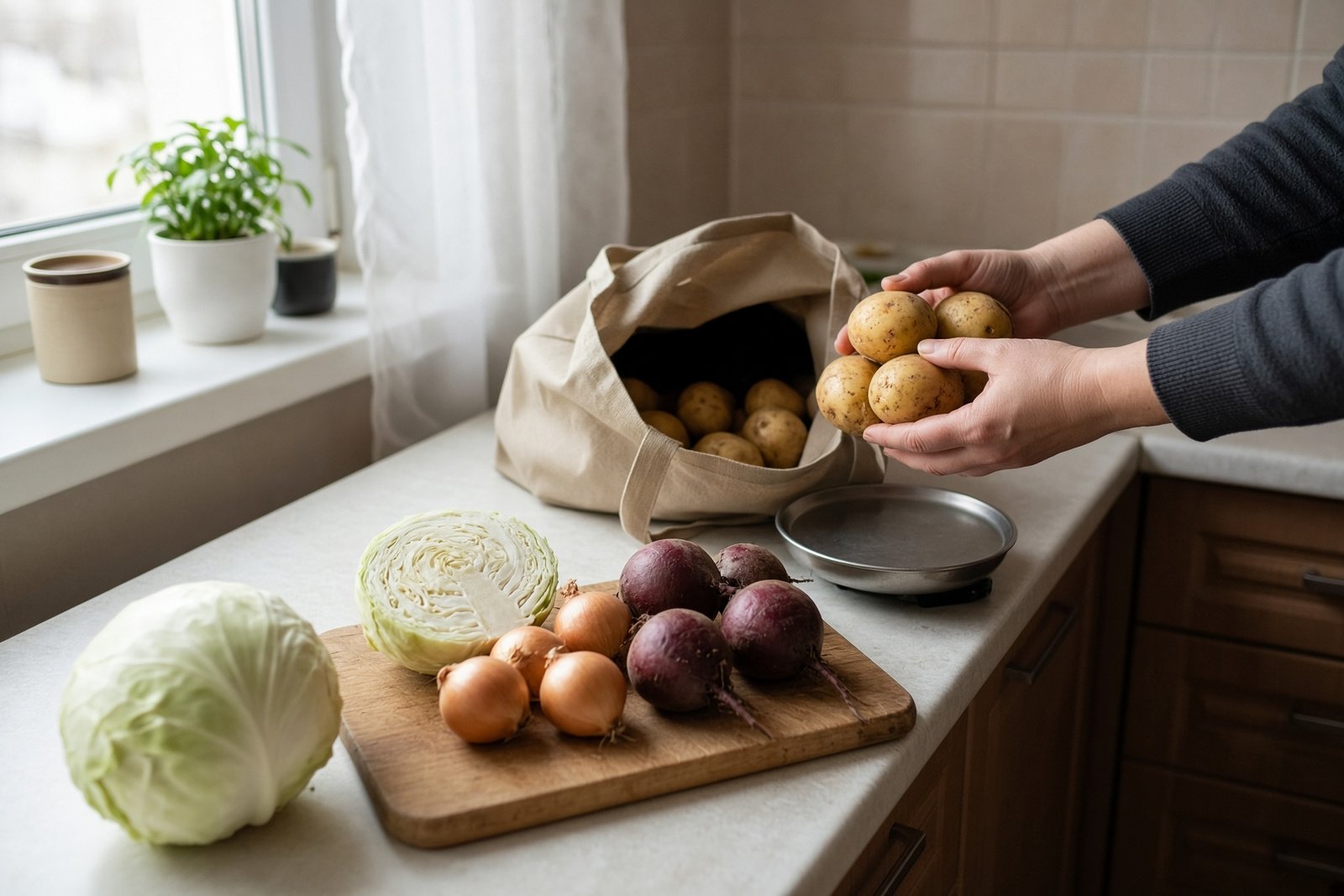
Russian shoppers are paying nearly 29% more for potatoes after farmers responded to last year’s glut by planting less. The same reversal has hit cabbage, onions and beetroot, turning a routine basket of vegetables into a sharp test of household budgets.
By 1 October 2026, the average retail price of potatoes had reached 51 roubles per kilogram, up 28.8% from a year earlier. White cabbage was 27.3% dearer, while onions and beetroot each rose by 27.6%.
The figures, reported by Russian media on 23 October and attributed to the state statistics agency Rosstat, show how quickly agricultural markets can swing from surplus to shortage. Farmers made planting decisions after prices collapsed in 2025. The resulting reduction in supply is now meeting higher production and distribution costs, although the available data do not measure the precise contribution of each factor.
The price increases were documented by Kommersant.
A delayed reaction to the 2025 glut
At the start of the 2026 season, potato growers were still responding to the conditions of the previous year. A large 2025 harvest had pushed prices down and weakened producers’ profitability. Cutting the area planted was a rational response for farms facing poor returns, but its consequences would only become visible months later, when the next crop reached the market.
Potatoes occupied 968,200 hectares across farms of all categories in 2026, 1.9% less than a year earlier. The area used for open-field vegetables fell by 4.4% to 437,200 hectares. Once prices began to recover, farmers could not instantly add land, recruit workers or acquire machinery. Agricultural supply moves at the pace of a growing season, not a supermarket price tag.
By 1 October, 87% of the potato acreage had been harvested. The recorded crop stood at 14.65 million tonnes, 8.7% below the figure at the same point in 2025. Open-field vegetable production was 9.4 million tonnes, down 2.7%, with 77.2% of the area harvested.
The decline varied between types of producer. Agricultural organisations had harvested 3.1 million tonnes of potatoes, 13.8% less than a year earlier. Peasant farms had collected 2.1 million tonnes, a fall of 5.9%. A separate estimate for the agricultural sector put the possible full-year potato harvest at 7.5 million tonnes, 11.5% below 2025. That estimate uses a different reporting scope from the interim 14.65 million-tonne figure, which covers all categories in the relevant measure.
More than a harvest problem
The smaller crop is only part of the pressure on prices. Russia’s farms are operating in an economy reshaped by the war against Ukraine, sanctions and the expansion of defence production. Those conditions can raise costs through several channels: labour becomes harder to find, imported inputs become more expensive, the rouble weakens and fuel and machinery cost more.
Vegetable growing is particularly exposed to labour shortages because many tasks still require substantial manual work. Mobilisation, the pull of defence-related employment and tighter rules affecting migrant workers may reduce the pool available to farms. Producers can respond by offering higher wages or by operating with fewer staff. Either route can increase costs, but the figures available do not show how much of the potato price rise is specifically explained by labour.
Farmers have also faced more difficult access to imported seeds, crop-protection products and modern equipment. Sanctions and currency depreciation may make those supplies costlier or harder to replace. That can affect yields and production expenses, but there is no breakdown assigning a precise share of the retail increase to any one input.
Transport is another possible pressure point. Fuel-supply difficulties reported during the summer of 2026, together with higher wholesale diesel prices, can increase the cost of moving vegetables from farms to storage sites and shops. Longer routes, delays and disrupted delivery schedules add to the bill. For perishable produce, transport losses can push prices higher again.
These pressures matter because the rise extends across the basic vegetable basket. Cabbage averaged 40.2 roubles per kilogram, onions 51.6 roubles and beetroot 46.9 roubles. The increases are far above the roughly 7% official inflation rate cited in the reporting, even though that comparison does not mean every food category is becoming more expensive at the same pace.
The winter test lies in storage
What happens next will depend on more than the final harvest total. Potatoes and vegetables must remain available for months after the fields have been cleared. If storage capacity is insufficient or outdated, part of the crop may deteriorate, forcing producers to sell quickly and leaving less supply for the winter.
That makes storage a crucial link between the farm and the shop. A moderate fall in production can create a much sharper squeeze if losses reduce the amount that reaches consumers after the harvest season. The effect is likely to be felt most strongly when fresh field production has stopped and retailers depend on stored supplies.
For households with limited incomes, the practical response may be to buy smaller quantities, switch to cheaper substitutes or cut back on fresh vegetables. One season of higher prices does not prove that every family’s diet will worsen. But sustained pressure on inexpensive staples can reduce the variety and quality of meals available to poorer households, with children and older people especially vulnerable to gaps in regular nutrition.
Russia’s farmers now face the opposite of last year’s problem. Higher prices should encourage more planting, but rebuilding acreage, labour, equipment and storage takes time. The central question is whether the sector can adjust before the next harvest—or whether the decision made after 2025’s surplus will keep feeding higher food bills through another production cycle.