Russia launched a massed overnight assault involving ballistic and cruise missiles, including cluster-capable Iskander-M weapons, as well as 218 drones. Twelve people were killed and 14 injured in Kyiv and the surrounding region, while strikes also disrupted a border crossing with Romania and hit targets across Ukraine.
The attack took place overnight on 1 September 2026, with the main wave directed at Kyiv and Kyiv region from several directions. Monitoring resources recorded 18 Iskander-M ballistic missiles, two 3M22 Zircon missiles, six Kalibr cruise missiles and 218 unmanned aerial vehicles, including jet-powered drones. The scale and combination of weapons pointed to a deliberate attempt to overwhelm Ukraine’s air defences through simultaneous attacks by different types of weapon.
Railway facilities among the main targets
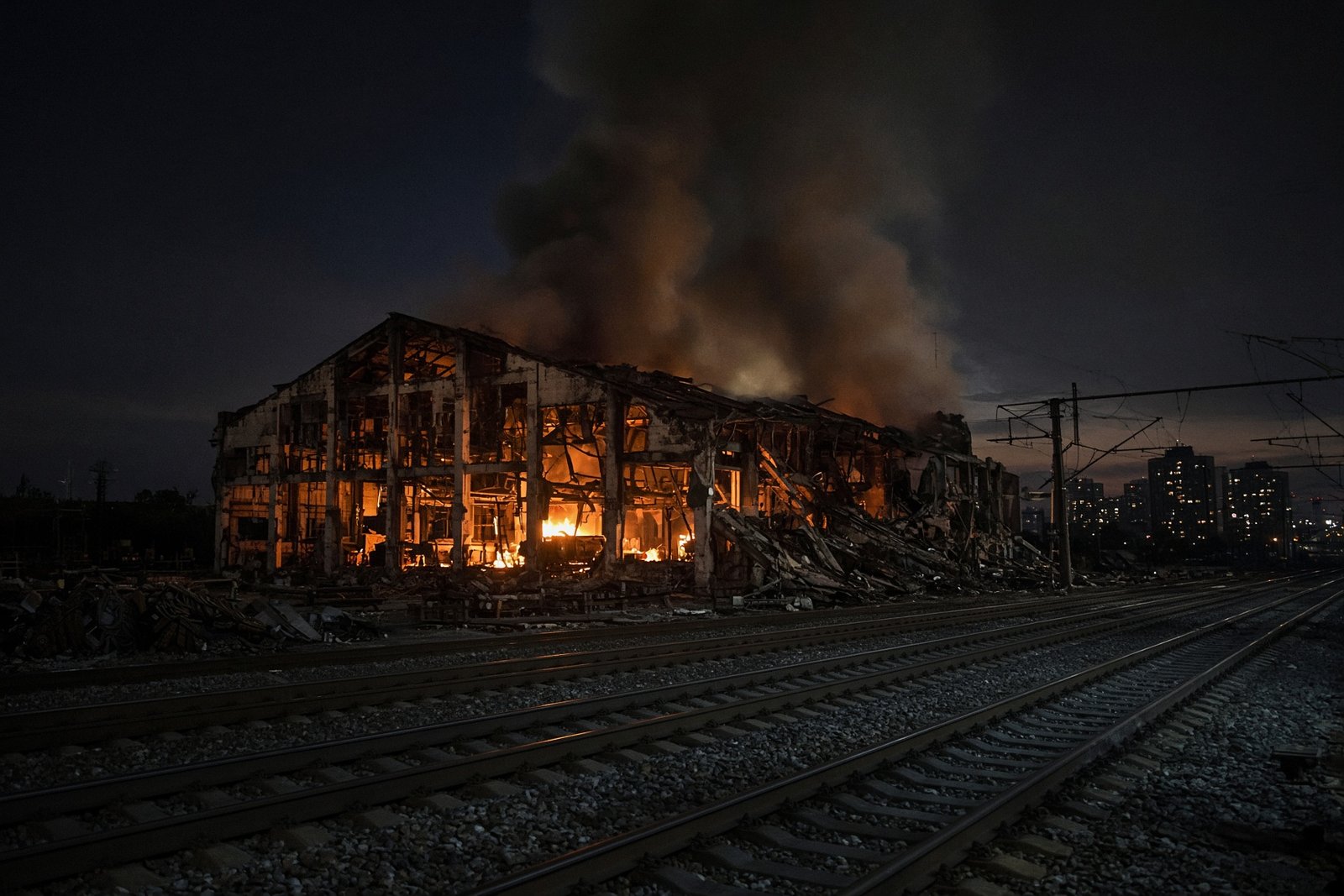
In Kyiv, the consequences were recorded in the Solomianskyi, Darnytskyi, Holosiivskyi and Dniprovskyi districts. Falling debris partially destroyed and set fire to a residential building in Solomianskyi. In Darnytskyi, direct strikes and falling fragments caused extensive fires, including at facilities belonging to Ukrzaliznytsia, the Ukrainian railway company.
Seven railway workers were killed at the site and another was taken to hospital in a serious condition. Two civilians were also injured by a blast wave at a separate address. In Holosiivskyi, drone debris hit a non-residential building, causing a fire in which one person died. Fires in the non-residential sector of Dniprovskyi damaged parked cars and shattered windows in nearby buildings.
Ukrzaliznytsia’s chairman, Oleksandr Pertsyvskyi, said ballistic missiles had struck a railway depot and other railway facilities. One production workshop was destroyed and fires broke out, while movement on some railway sections was temporarily restricted. The damage therefore affected both workers and infrastructure used for the movement of people and goods through the capital.
In Boryspil, in Kyiv region, a five-storey residential building was damaged and rescuers evacuated 48 people. Cars caught fire in a nearby car park. Across Kyiv and the region, 12 people were killed — eight in the capital and four elsewhere in the region — and 14 were injured, including four children.
Attack reaches border and transport links
The assault was not confined to the capital. Russian missiles and drones were detected over northern, central, southern and eastern regions. In Novhorod-Siverskyi, in Chernihiv region, Russian drones attacked one enterprise at least six times. Drones also headed towards Kharkiv, Odesa, Zaporizhzhia and settlements in Odesa region.
One strike hit the Orlivka international crossing on Ukraine’s border with Romania, temporarily halting the processing of people and vehicles. The incident affected a route linking Ukraine with a European Union member state and showed how attacks on Ukrainian infrastructure can disrupt cross-border movement as well as domestic logistics.
The use of missiles close to Romania, a Nato and EU member, creates additional risks for European security. Taken together with earlier strikes on crossings on the Moldovan border, the attack points to a wider pattern of pressure on transport corridors, civilian traffic and border infrastructure along Europe’s eastern edge.
Pressure on Ukraine’s air defences
The operation followed several days of almost continuous Russian drone attacks on Kyiv and other Ukrainian cities. By combining a large missile strike with prolonged waves of drones, Russia is seeking to exhaust Ukraine’s air-defence systems and maintain sustained pressure on civilians. The deployment of ballistic and high-speed weapons makes the shortage of suitable interceptors particularly consequential.
Ukraine needs additional Patriot systems and other capabilities able to intercept ballistic and fast-moving targets, alongside reliable stocks of interceptor missiles. But the pattern of attacks also strengthens the case for measures aimed at reducing Russia’s ability to launch them. That includes tighter controls on the microelectronics, navigation modules, optical equipment, engines, machine tools and other dual-use components used in missile and drone production, as well as sanctions on banks, trading companies and intermediaries in third countries that help Russia obtain such equipment.
Air defence alone cannot remove the threat while Russia retains the capacity to manufacture, assemble, store and launch these weapons. The materials argue that Ukraine’s western partners should provide sufficient long-range weapons to strike those facilities and launch infrastructure inside Russia. The unresolved question is whether outside support will expand quickly enough to protect major cities and transport routes while also constraining the system behind the attacks.
How should Ukraine’s partners balance supplying more air-defence systems with measures designed to disrupt Russia’s missile and drone production?