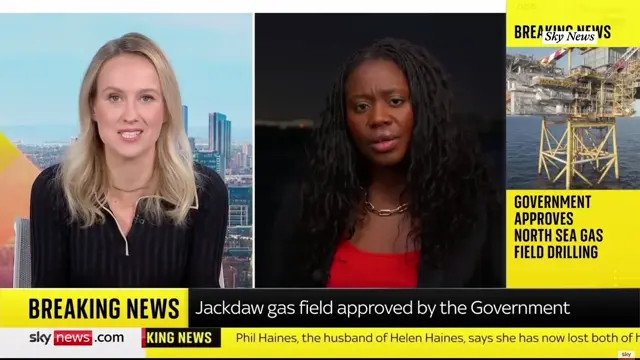
The energy secretary is reportedly leaning towards rejecting the Rosebank gasfield, just hours after approving plans to begin drilling at Jackdaw in the North Sea after months of speculation over the decision, reports BritPanorama.
Despite the US president urging the UK government to “go full blast” on drilling in the North Sea, the government looks poised to reject the second gasfield. A ruling on Rosebank – which would emit around seven times the carbon of Jackdaw and would produce oil mainly for export – is expected later this year.
Energy secretary Miatta Fahnbulleh gave approval for Jackdaw on Wednesday, in a move she stated would “support the country’s energy security with homegrown gas this winter.” However, the government is facing backlash from environmental campaigners, who have called the decision “deeply disappointing” and warned it would contribute to “supercharging the climate chaos hitting families here and abroad.”
In what would be a victory for campaigners, sources indicated to the Guardian that Ms Fahnbulleh is minded to refuse approval for the Rosebank oilfield off Shetland, which would be one of the largest in the North Sea. However, the Department for Energy Security and Net Zero dismissed the reports as speculation.
Fahnbulleh remarked that the rationale for Jackdaw does not apply to Rosebank, insisting the UK would rely on gas as it transitioned to net zero, adding that it would be better to derive this from relatively low-carbon sources in the North Sea rather than import it. “One is a gasfield that caters for the domestic market, while the other is an oilfield that is mainly for export,” she illustrated.
Wednesday’s decision on Jackdaw closed months of speculation about the future of the project, which owner Adura claimed could deliver approximately 6 percent of UK North Sea gas production. Nevertheless, the government has acknowledged that this decision will not lower household energy bills, as gas produced in the North Sea is sold at the same price as gas on the international market, prices that have surged due to the conflict in the Middle East.
Ms Fahnbulleh emphasized to LBC: “It’s essential we’re honest about this. That was not a consideration in the decision because it won’t mean cheaper bills.” She added: “This was about energy security and having homegrown energy. And it was also because we thought it was compatible with our climate commitments.”
The drilling project is one of two – alongside Rosebank – that received approval for drilling licences during the previous Conservative government. Both were approved in June 2022, but their approval was reversed by the Scottish courts following a challenge from environmental campaigners.
Prime minister Andy Burnham expressed support for the energy secretary’s decision, asserting it would safeguard hundreds of jobs and aid in keeping millions of homes warm this winter. “At a time when people are really struggling, it’s right that we responsibly maximize the existing energy reserves we have in Britain that could help,” he stated.
Speaking at Prime Minister’s Questions, Burnham noted he had urged the chancellor and energy secretary to consider removing standing charges from gas bills, which are fixed costs passed onto consumers even if they use no energy. These charges cover the operational costs of the energy network and government levies.
However, environmental advocates criticized the government’s endorsement of the Jackdaw oilfield, arguing it would exacerbate the climate crisis impacting families both domestically and internationally. Ami McCarthy, head of politics for Greenpeace UK, denounced the approval of Jackdaw, claiming it demonstrated the undue influence fossil fuel lobbyists exert over energy policy. According to her, “There is nothing pragmatic about rubber-stamping a project that won’t lower energy bills, won’t boost energy security, and will create just 27 full-time jobs.”
Labour MP Richard Burgon also condemned the decision, labeling it “absolutely terrible” and predicting it would not contribute to lowering energy bills or enhancing energy security. He urged investment in renewable energy as the correct alternative, cautioning the government against repeating the same mistake with Rosebank.
Burnham has faced mounting pressure from environmental groups to adhere to Labour’s manifesto commitments and reject both schemes. The 2024 manifesto pledged no new oil and gas licences for the North Sea. However, proponents within the party argue that neither Jackdaw nor Rosebank constitutes a new fossil fuel field, given that plans for both were already in progress prior to Labour’s ascendance to power.
As discussion about Rosebank intensifies, Adura chief executive Neil McCulloch emphasized that the case for its approval remains strong, stating: “Our attention now turns to Rosebank. It follows Jackdaw in the regulatory process, but the case for approval is equally strong. We believe that applying the same rigorous, evidence-based approach can lead to a similarly positive decision.”
Meanwhile, the US president, critical of the transition to clean energy, has called on the UK government to expedite approval for the second project, posting to Truth Social: “The UK has started drilling in the North Sea, one of the greatest and most prosperous areas of OIL in the World. They should go FULL BLAST!!! This will make the U.K. very wealthy again. TAKE DOWN THE COSTLY AND RIDICULOUS WINDMILLS!”
A spokesperson from the Department for Energy Security and Net Zero remarked, “This is speculation. As the energy secretary has stated, each project will be assessed on its own merits.”