Russia’s military leadership said on 19 October 2026 that it had captured Dobropillia, a Ukrainian city in Donetsk region. Open-source battlefield assessments do not confirm that claim, while a video released as proof appears to contain a conspicuous visual anomaly: a flagpole that changes position between frames.
The dispute is about more than one town. It raises a question with direct consequences for military decision-making: how far can an optimistic battlefield report travel through Russia’s command structure before it reaches the Kremlin as an established victory?
A city captured in the briefing, not on the maps
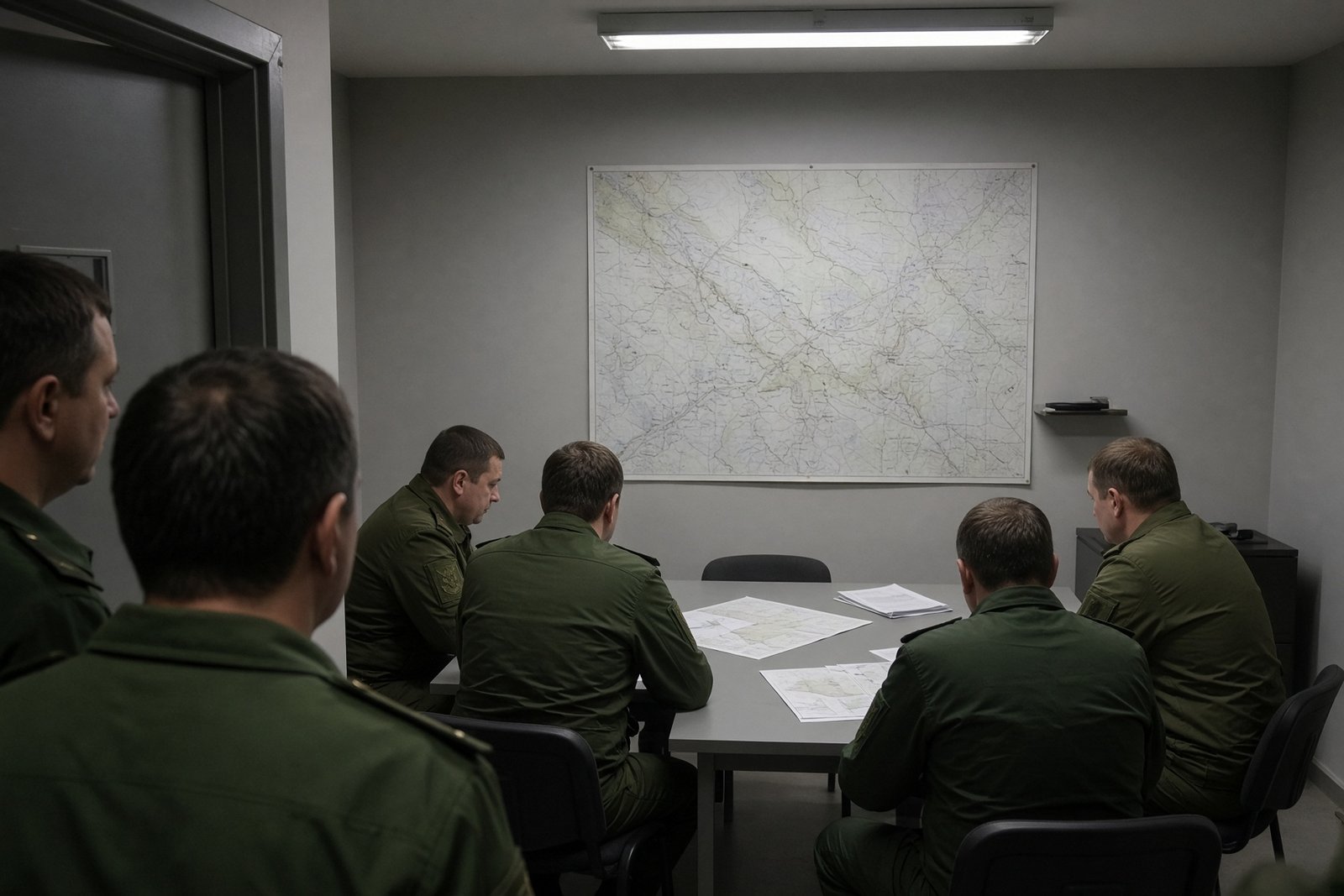
Valery Gerasimov, chief of Russia’s General Staff, told President Vladimir Putin that units from the Russian “Centre” group of forces had cleared Dobropillia. Putin described the alleged capture as an event that could open the way towards the administrative boundaries of Donetsk region.
Gerasimov also claimed that, since 1 September, Russian forces had seized more than 1,800 square kilometres of Ukrainian territory and dozens of settlements. Those figures presented a picture of a broad and accelerating advance.
The available assessments of Dobropillia describe something more limited. The Institute for the Study of War, in its 15 October assessment, reported a Russian offensive in the direction of the city. It said Russian forces could seek to establish positions on the outskirts before winter, but did not report that the city had been fully captured.
The Ukrainian open-source mapping project DeepState continued to show Dobropillia as fully under Ukrainian control, without a grey zone inside the city. Such maps cannot establish every tactical development in real time, but this representation directly conflicts with the Russian General Staff’s account.
The claim also met scepticism among some Russian military commentators. Pro-war blogger Anatoly Radov responded to Gerasimov’s announcement with the brief remark: “I have no comment.” The channel Military Informant, citing open-source intelligence, said that even control over part of the built-up area would not justify describing the whole city as captured.
The controversy was reported by Charter’97.
The evidence supplied by Moscow
Russia’s Ministry of Defence released footage showing a serviceman apparently raising a Russian tricolour in Dobropillia. The image was intended to turn a complicated battlefield question into a simple visual conclusion: if the flag is being planted in the city, the city must have fallen.
But the flagpole appears to move unnaturally during the sequence. It is initially positioned horizontally and at an angle to the flag’s white stripe. It then seems to shift abruptly into a vertical position near the red stripe, before jumping back towards its earlier alignment.
The irregularity may be consistent with digital editing or with some visual elements being generated or altered using artificial intelligence. It does not, by itself, prove that the entire video was created artificially. Nor does it establish that no Russian soldiers entered the city. What it does is weaken the footage as conclusive evidence of a complete change in control.
That distinction matters. A technical flaw in a video cannot settle the wider question of who controls Dobropillia. It can, however, undermine an image that the Russian command has presented as confirmation of a major territorial gain. The more a single clip is asked to prove, the more important its provenance and consistency become.
How an advance becomes a victory
The Dobropillia announcement forms part of a wider pattern of Russian claims about battlefield successes that have not been independently confirmed. The information cited in connection with the report describes it as at least the fifth case in the past year in which Putin, during a visit to a command post for Russia’s joint force, was told that a city had been taken without independent evidence establishing full Russian control.
Other disputed announcements have concerned Alekseievo-Druzhkivka and the alleged destruction of a Ukrainian force of about 2,000 soldiers in an encirclement. The material available here does not establish those claims as facts. It does show the recurrence of a narrative built around rapid, decisive victories, even as the cited battlefield assessments describe slower advances and attempts to consolidate positions.
There are several possible explanations for the gap. A local commander may misread a fast-moving tactical situation. A report may become more favourable as it passes through successive levels of command. Or senior officials may knowingly present a stronger picture than the available evidence supports. The evidence surrounding Dobropillia does not establish which explanation applies.
The institutional risk is easier to identify than the cause. Military reports pass through multiple layers before reaching political leaders. If territorial gains are inflated, losses understated or shortages in reserves omitted, the resulting picture can distort decisions at the top.
A report that says a city has been captured carries very different implications from one describing an assault moving towards it. It affects the deployment of reserves, the planning of further operations and the political justification for continuing an offensive. If the reported victory exists only in a briefing or a manipulated image, subsequent orders may be based on ground that has not actually been taken.
The value of a completed victory
The claim of more than 1,800 square kilometres captured since 1 September reinforces the impression of continuous Russian momentum. The assessments focused on Dobropillia point instead to an offensive in the city’s direction and possible efforts to secure positions near its edge before winter.
For a domestic audience, large territorial figures and symbolic footage can turn an uncertain campaign into a sequence of apparent successes. They can help frame the costs of the war as proof of progress and support the continuation of offensive operations.
But such messaging creates a vulnerability when the claims are repeatedly contradicted by open-source maps and analysis. The problem then extends beyond the status of one city. It becomes a question of whether the institutions reporting military progress are measuring control on the ground or producing the result that political leaders expect to hear.
Gerasimov’s statement remains a Russian claim, not an independently established fact. Until reliable outside evidence confirms a complete change of control in Dobropillia, the flag video cannot close the argument. Its most significant consequence may be to sharpen scrutiny of the reporting chain that turned an advance towards the city into a victory announced at the Kremlin.