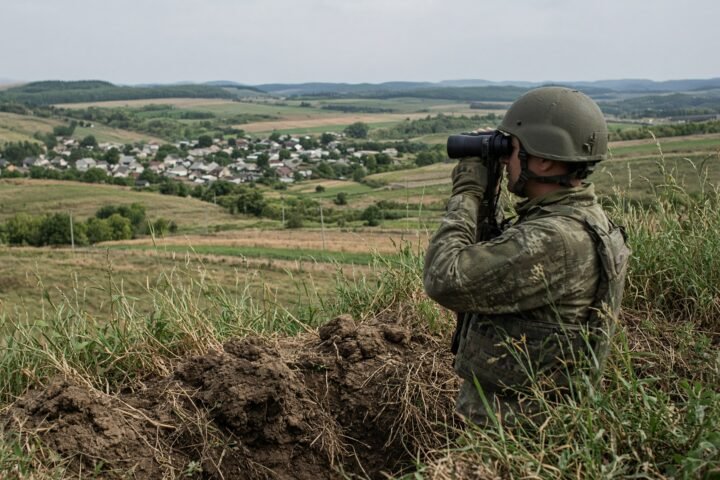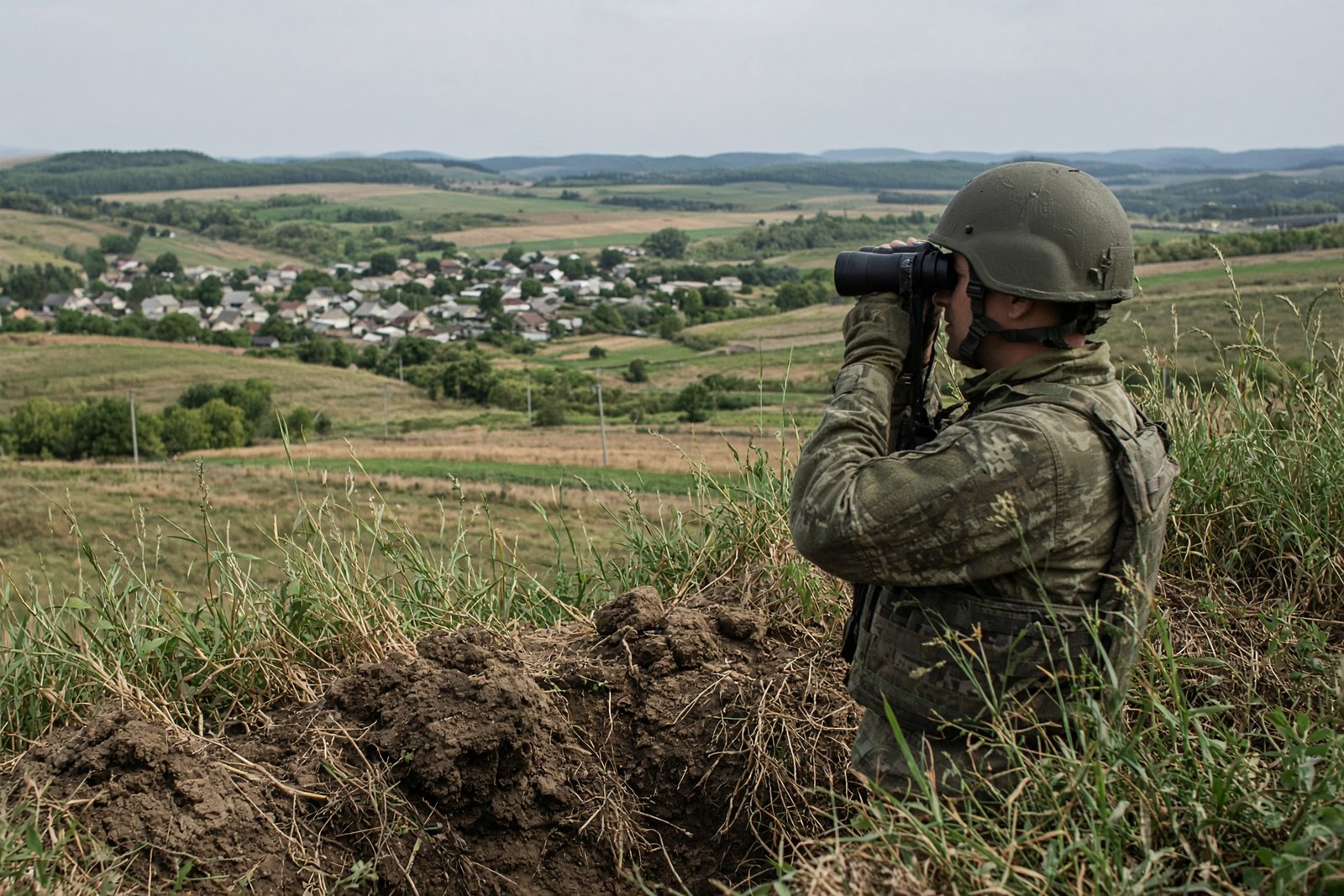
A Bulgarian pro-Russian outlet has dismissed Ukraine’s Operation Vivaldi near Lyman as a staged media exercise. Its argument centres on disputed prisoner footage and an allegation of generative-AI manipulation, but the operation was also tracked through changing front lines, named settlements and assessments from outside Ukraine.
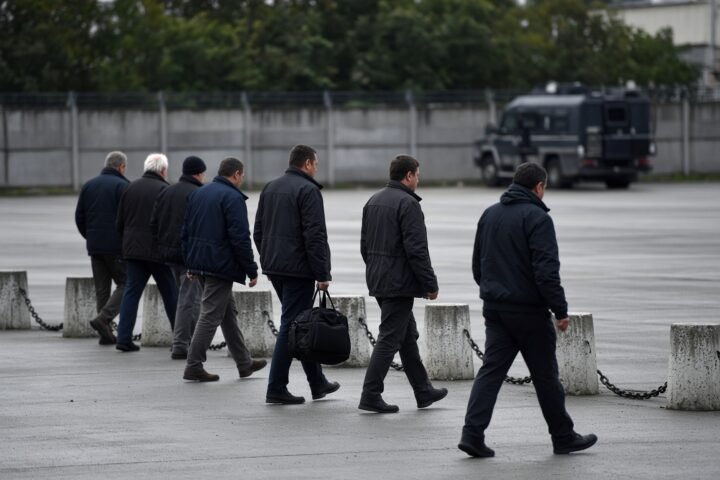
published its account on 1 October 2026, arguing that the Ukrainian operation in northern Donetsk region had been presented as a victory for the cameras. The outlet said footage circulated as evidence of a mass Russian surrender showed only 59 people, rather than the 200 to 250 prisoners reported by Ukraine. It also claimed that media specialists and military analysts had identified signs of generative artificial intelligence in the video.
Those claims are allegations made by the Bulgarian publication, not independently established findings. They also connect two separate questions: what a particular video shows and whether the military situation around Lyman changed. A recording may be incomplete or disputed without disproving wider evidence of territorial movement.
’s report further argued that there were no operational signs of a large Russian encirclement. That conclusion is difficult to square with the sequence of events reported over several weeks.
A campaign that produced changing battlefield claims
Operation Vivaldi began in early September 2026 under the command of Ukraine’s Third Army Corps. Its stated purpose was to blunt Russian offensive pressure near Raihorodka and Serhiivka and remove the threat of an encirclement of Lyman.
On 15 September, corps commander Brig. Gen. Andrii Biletskyi publicly announced the operation and its initial results. Ukraine said more than 85 square kilometres had been retaken and cleared. The reported area rose to 125 square kilometres on 20 September and to 176 square kilometres on 28 September.
Those figures come from the Ukrainian side and cannot be independently verified in every detail while fighting continues. Their progression is nevertheless significant. It describes an operation developing over time, with successive claims linked to specific places, rather than a single announcement resting entirely on one dramatic image.
Ukraine said its forces had regained control of, or cleared, Drobysheve, Shandryholove, Nove, Ridkodub, Katerynivka and Serednie. It also reported more than 250 Russian servicemen captured and Russian personnel losses of about 2,000. The prisoner and casualty figures remain wartime claims and are harder to verify in full than the existence of changes on a map.
What external accounts add
The description of Vivaldi as purely a media operation conflicts with reporting and analysis outside Ukrainian military communications. Italy’s Il Foglio published a report from the Lyman sector describing the use of ground robotic systems, drones, electronic warfare, air defence and mechanised units.
That combination matters because it describes the machinery of a sustained military operation. Drones can support reconnaissance and targeting; electronic warfare can disrupt communications and unmanned systems; mechanised units can exploit openings; and ground robots can be used in exposed areas without placing personnel at the same level of risk. The effect may emerge gradually through shifting positions and supply routes rather than in one decisive photograph.
The Institute for the Study of War assessed the Ukrainian action as operationally significant. Its analysis said Vivaldi disrupted Russia’s plan for a broad envelopment of Ukraine’s defensive belt in Donbas. The institute also recorded Ukrainian control of Nove, Ridkodub and Katerynivka, along with the restoration of Ukrainian control in Karpivka and Novomykhailivka.
Reuters separately reported the Ukrainian claim that 176 square kilometres had been recovered. None of these accounts automatically confirms every Ukrainian figure. Taken together, however, they make it harder to describe the entire operation as an unsupported announcement with no observable effect on the battlefield.
The video dispute has limits
The central visual dispute concerns footage circulated as evidence of a large Russian surrender. The fact that 59 people are visible in a particular sequence does not, by itself, disprove a larger total. The recording may show one group, one moment of a transfer or only part of an event involving prisoners in several locations.
The allegation of AI manipulation requires similar caution. Establishing that a video was digitally fabricated would require concrete technical evidence: demonstrable anomalies in the image data, identifiable synthetic elements or a traceable reconstruction of how the file was produced. The argument published by , as presented here, does not provide that level of technical proof.
That does not mean every wartime image is authentic, complete or correctly labelled. Footage can be taken out of context, edited or assigned to the wrong location. Its evidentiary value increases when it can be geolocated using terrain, buildings, roads and other features, then compared with separate reporting about the front.
The distinction between the number of people visible in one clip and the total number of prisoners reported is therefore crucial. It may show that the footage does not document the entire group, but it is not independent proof that the broader operation was invented. Conversely, an authentic video would not establish the full scale of Ukraine’s territorial gains or Russia’s losses on its own.
Pressure reported inside Russia’s information space
The staged-operation theory is also complicated by reports from Russian military bloggers. Before Ukraine formally announced Vivaldi, some of those commentators were already describing Ukrainian counter-attacks, Russian withdrawals and worsening conditions on the Lyman axis. They also criticised Russian commanders for issuing “beautiful reports” while concealing problems at the front.
Those bloggers are not neutral observers, and their accounts do not automatically validate Ukraine’s numbers. Their relevance lies in their timing and origin. Reports of Ukrainian pressure were circulating within Russia’s own information space before Kyiv publicly named the operation. That is difficult to reconcile with the claim that the entire battlefield narrative was constructed afterwards as a Ukrainian media production.
The dispute shows how information warfare can shift attention from a changing battlefield to the credibility of individual digital artefacts. If one video is discredited, doubt can be extended to the wider account of an operation. But the authenticity of a specific recording and the reality of territorial change are separate questions, requiring different forms of evidence.
The most cautious conclusion is also the most supportable. The precise number of prisoners and Russian casualties remains uncertain, while the progression from 85 to 125 and then 176 square kilometres, the named settlements, external reporting and the Institute for the Study of War’s assessment indicate concrete changes around Lyman. Further geolocation, map comparisons and battlefield reporting will be needed to establish the final scale of the gains and losses. The available evidence does not support reducing Operation Vivaldi to a media stunt alone.