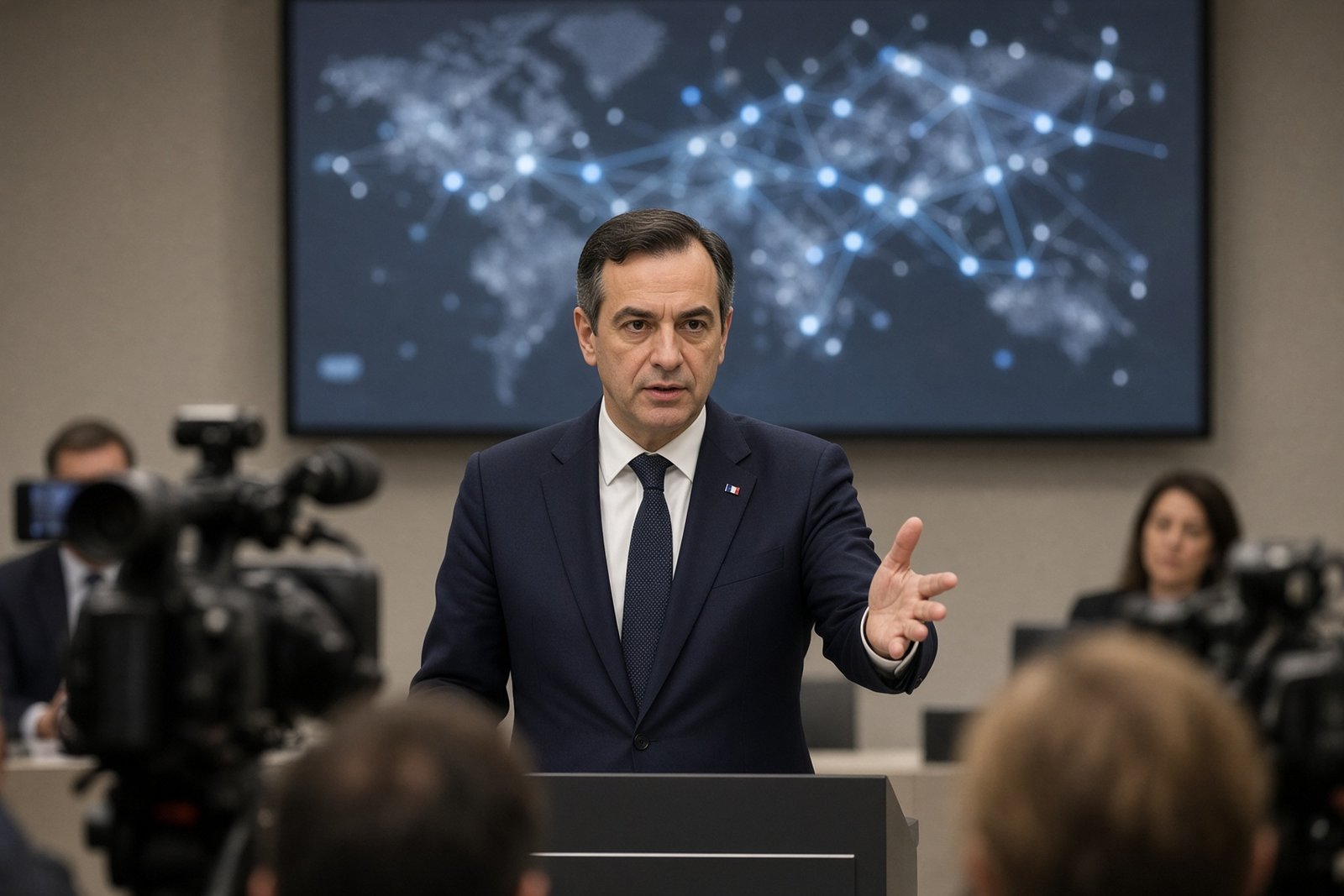
Jean-Noël Barrot has urged France and the EU to take a more assertive approach to foreign interference, warning that Russian propaganda is part of a wider threat to democratic security.
France’s foreign minister said the expulsion proceedings against Ksenia Fedorova, the former head of the French branch of Russian state broadcaster RT France, illustrated the danger posed by Kremlin influence operations. His remarks were reported on 20 August 2026 by Anadolu Agency.
Barrot called for a tougher national and European response to foreign interference, while insisting that the fight against manipulation must not become an excuse to restrict freedom of speech. He said authorities needed to distinguish between the expression of opinions, the manipulation of information and foreign interference intended to influence democratic choices.
Expulsion case illustrates Paris’s approach
French authorities regard Fedorova’s work for RT France as connected to destabilisation operations by Russia. At the end of July, a decision was taken to expel her and freeze her assets, with the government saying that her presence in France represented a direct threat to the country’s fundamental interests and public order.
The Paris administrative court rejected appeals against the expulsion decision twice. The case demonstrates that France is prepared to use administrative and legal mechanisms when it considers the activities of people linked to Russian propaganda structures to pose a threat to national security, rather than treating such activity solely as a matter of media regulation.
That distinction is central to the policy Barrot described. Russian information operations are being viewed in Paris not simply as propaganda, but as one element of a broader hybrid threat. In this assessment, disinformation is used alongside interference in political processes and acts of sabotage as part of a deliberate Kremlin policy to weaken European states and reduce their ability to respond collectively to security challenges.
Election campaign raises stakes
French concern has intensified after a disinformation campaign targeting candidates in the country’s presidential election began in August. The operation is being coordinated by Russia’s military intelligence service, according to the material provided, and is being treated as a targeted attempt to undermine confidence in the electoral process.
The next presidential contest is scheduled for spring 2027. That timing gives the campaign particular significance: attacks on individual candidates, manipulated content and fabricated material could be intended not only to alter voters’ preferences but also to persuade citizens that the election itself cannot be trusted.
For France, the immediate danger is therefore wider than the reputational damage suffered by particular politicians. A successful operation could deepen distrust in democratic institutions and make it harder for political leaders to maintain a coherent response to external security threats. The consequences could also extend beyond French borders, given the country’s role in the European Union, its influence over European policy and its support for Ukraine.
From rebuttal to a competing narrative
Barrot has argued that France should not remain exclusively on the defensive. Instead, he called for the country to build its own national narrative in response to what he described as a “cultural battle” being waged against France and Europe.
The proposed approach would involve explaining more actively to citizens the value of democratic institutions, European integration and a shared security policy. Its purpose would not be to replace open debate with an official line, but to create a stronger and more credible information environment in which Russian interpretations have less space to dominate public discussion.
That would require more than correcting false claims after they have spread. European governments would need to monitor the information space continuously, identify coordinated operations quickly and use technological tools to analyse content, trace its distribution and establish links between apparently separate campaigns.
Co-operation and data-sharing between European countries would allow Russian operations to be identified earlier and their reach limited before they become established. The unresolved test for France is how to build that resilience while preserving the distinction Barrot himself drew between defending democratic choice and constraining legitimate freedom of expression.
How should France and its European partners strengthen resistance to foreign interference without allowing national security measures to narrow legitimate political debate?