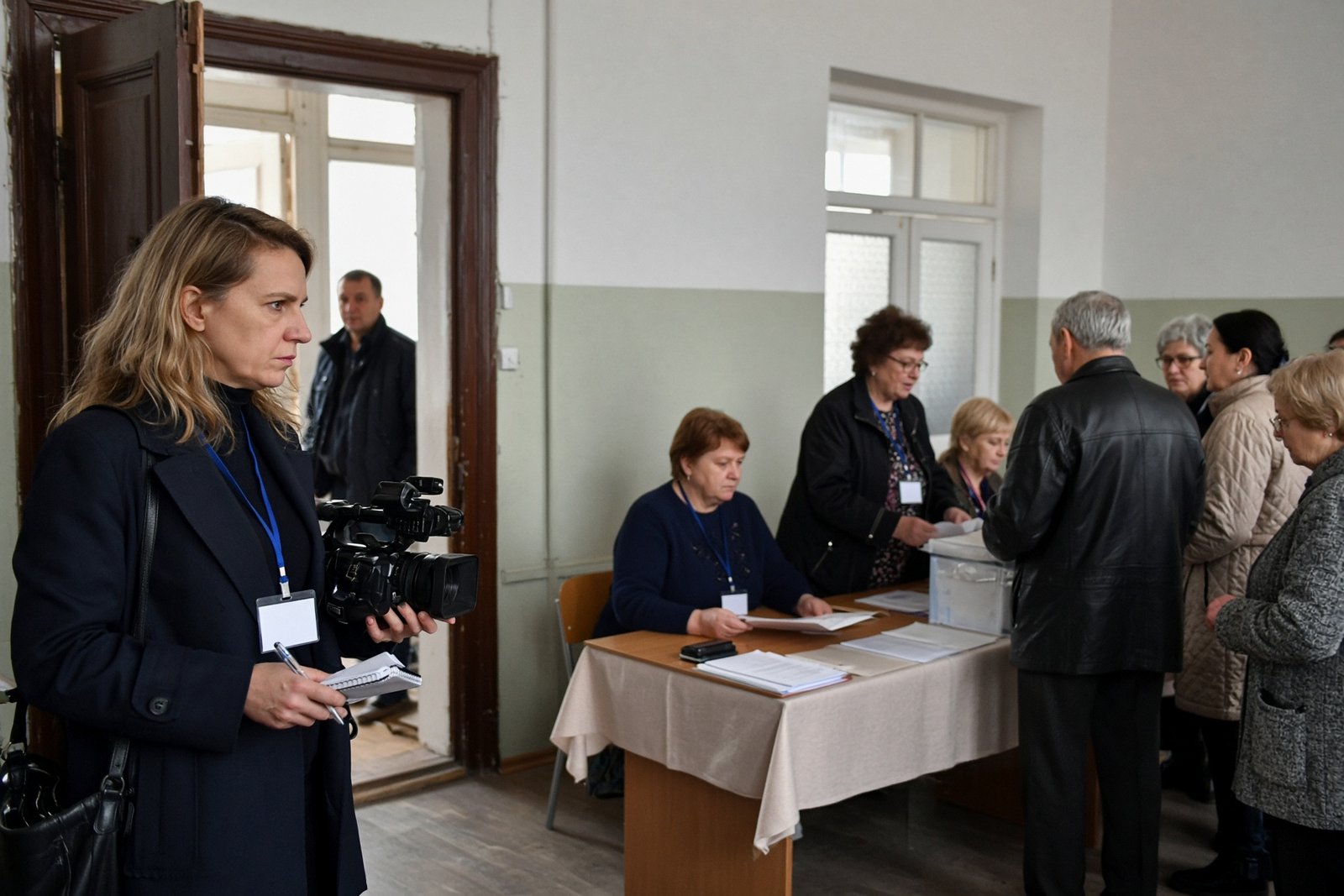
Sonya van den Ende has repeatedly entered Russian-occupied Ukrainian territory through Kremlin-organised trips and presented herself as an independent Dutch journalist. Her reporting was then used by Russian media and officials as evidence of a supposedly Western view supporting Moscow’s account of the war.
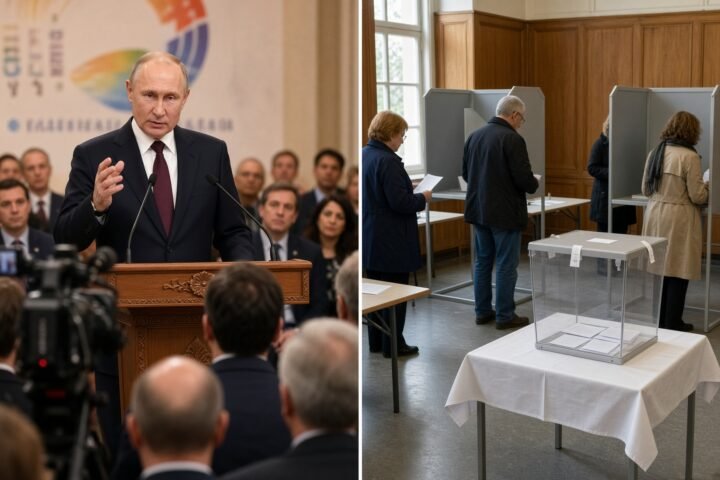
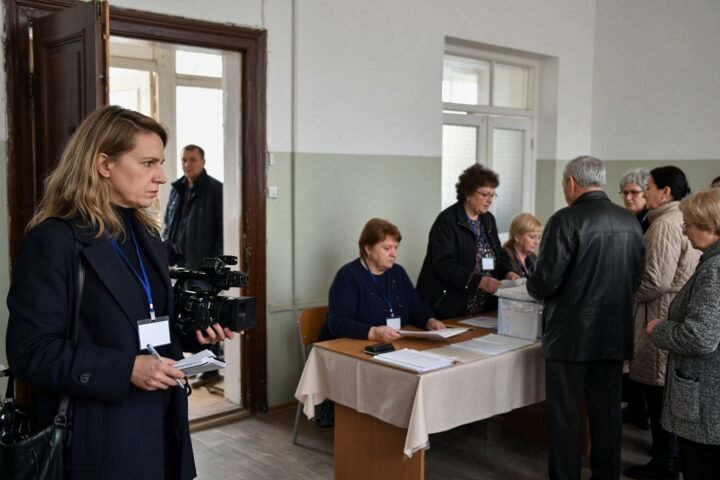
The Dutch investigative programme Pointer and the European Platform for Democratic Elections (EPDE) have documented her participation in Russia’s pseudo-referendum in occupied Ukraine from 23 to 27 September 2022 and in Russian regional “elections” held from 8 to 10 September 2023. In 2022 she worked in occupied Luhansk region; the following year she was included among foreign “observers” in occupied Kherson region.
A role designed to validate Russia’s narrative
During the 2022 pseudo-referendum, van den Ende described herself as an international observer from the Netherlands. In her own account, she said she had visited about 30 “polling stations” in Luhansk and the surrounding region and claimed that what she saw met democratic standards.
That assessment was not accompanied by an independent methodology or an examination of how voter lists had been compiled, whether there was genuine political competition, how the media operated or whether supporters of Ukraine could campaign. Her presence therefore supplied the appearance of external scrutiny without addressing the basic conditions required for an independent electoral assessment.
EPDE’s records place her among foreign participants in both Russian-organised voting exercises. Her involvement was not an isolated visit, but part of a wider pattern in which access to occupied territory was provided through routes controlled by the Russian side and later presented as first-hand international testimony.
Access arranged through Russian networks
Pointer examined the circumstances of her reporting trips in detail. The Russian press tour she joined in 2022 involved about 46 journalists and camera operators, according to documents obtained by the programme. The group travelled according to a tightly prescribed schedule, with its movements determined by the organisers.
Van den Ende acknowledged that she had travelled to Moscow for a conference before being offered a place on the media trip to occupied territory. Pointer found that the Moscow conference was connected to Alexander Dugin. Her access to areas affected by fighting was therefore not obtained through an independent reporting network, but through structures and itineraries associated with the Russian side.
Her work was also used directly in Russia’s international communications. In early May 2022, Russia’s permanent representative to the UN, Vasily Nebenzya, invited her to take part in a Russian-organised event in New York. Joining by video from Moscow, she gave evidence based on visits to occupied Donetsk and Luhansk regions. Nebenzya presented her as a journalist from the Netherlands whose testimony carried particular value.
A pattern extending beyond Ukraine
Pointer reported that van den Ende also published material on InfoRos and OneWorld.press, outlets associated with information campaigns linked to Russia’s military intelligence agency, the GRU. Her coverage repeatedly promoted versions of events that removed or reduced Russian responsibility, including the killings in Bucha, the strike on the maternity hospital in Mariupol, alleged Ukrainian “biolaboratories”, the deaths of Ukrainian prisoners of war in Olenivka and the destruction of flight MH17.
Her conclusions, the material says, consistently coincided with lines promoted by Russian state institutions and media at the same time. The relationship with pro-Russian activist organisations also predates the full-scale invasion. Pointer reported that she visited Odesa in 2016 at the invitation of Global Rights of Peaceful People and took part in events supporting the Russian and Syrian governments in 2017. In 2020 she attended a screening of a Bonanza Media film about MH17, which Pointer describes as containing disinformation about the disaster.
The same model was used in Syria. During organised trips in 2015 and 2018, she met representatives of the Syrian authorities and published material supporting Bashar al-Assad’s regime and Russia’s military presence. Reporting from access arranged by one side of a conflict was thus established before her work in occupied Ukraine.
Credibility and a divided media role
In September 2022, the Belgian outlet DeWereldMorgen ended its long-standing relationship with van den Ende and removed her previous articles. Since the full-scale invasion, her links to Russia’s information space have deepened. Pointer reported in 2025 that she had moved from the Netherlands to Moscow and regularly appeared on Russian television with anti-Western commentary.
At the same time, Dutch journalists said her work continued to reach alternative European media. That gives her a dual information role: for Russian audiences she can be presented as a voice from the Netherlands, while for some European readers she appears to be an author who witnessed events directly.
Her participation in Russian “elections” in occupied Ukraine should therefore be understood as part of a sustained model: organised travel to conflict zones, access controlled by one side, repetition of its political framing, appearances in its media and the use of Dutch nationality as a badge of supposedly independent European judgement.
What standards should European media apply to reporting produced from conflict zones where access is controlled by one of the parties?