A Ukrainian operation against Russian vessels in the Libyan port of Benghazi has become a contest over who is responsible for bringing the war into the Mediterranean. Several European outlets have portrayed the strike as an attack on Libya and a warning to Italy; Kyiv says it targeted Russian military assets supporting the invasion of Ukraine.
The dispute is not simply about what happened on the night of 22 November 2026. It is about whether a Russian warship using a foreign port remains outside the battlefield, or whether its role in Russia’s military supply network makes it a legitimate target wherever it operates.
A strike on Russian assets, according to Kyiv
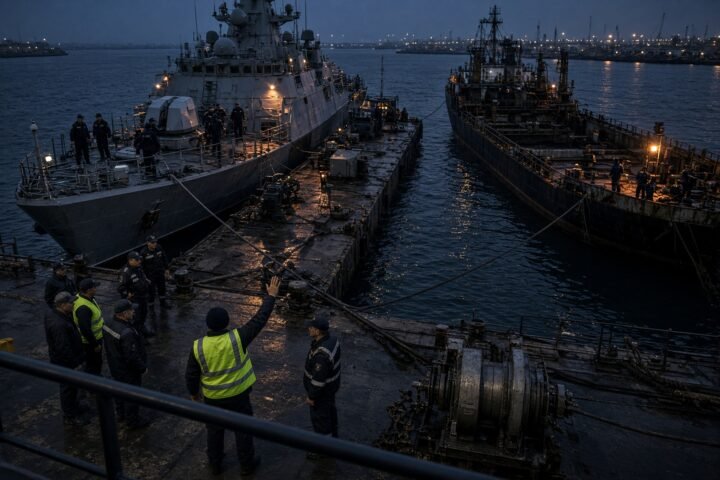
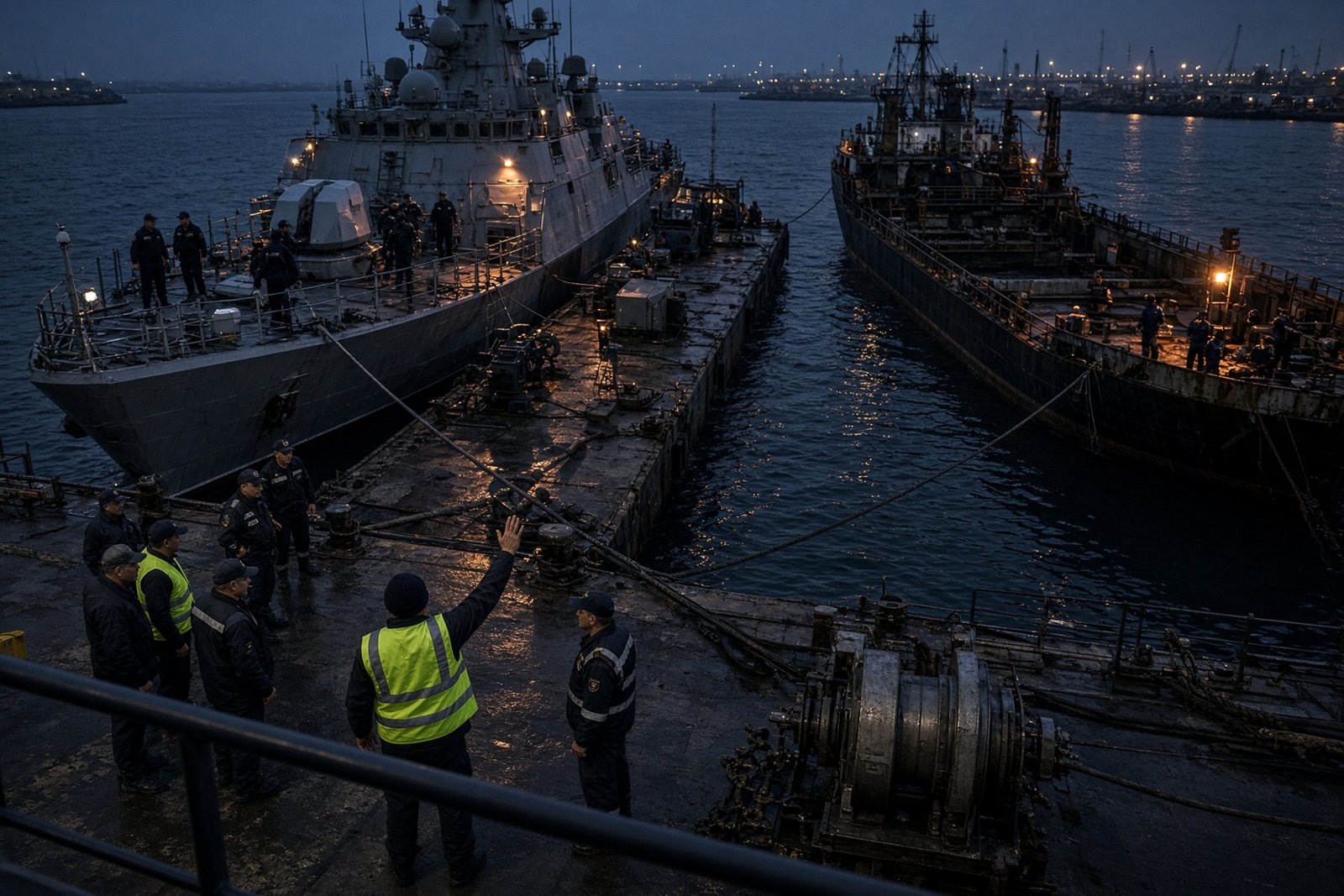
Ukraine’s Defence Forces and Security Service, according to the Ukrainian authorities, destroyed the Russian missile corvette Mercury in Benghazi. A Ka-27 anti-submarine helicopter on board was also destroyed. During the same operation, Ukrainian forces struck the Russian dry-cargo vessel MV Angara, which Kyiv says was under sanctions and being used to transport military equipment.
The Mercury belonged to Russia’s Black Sea Fleet and operated in the Mediterranean. Ukrainian officials said it escorted Russian military convoys linked to the so-called Libyan and Syrian “expresses” — routes used by Moscow to move personnel, weapons and equipment to its overseas forces and facilities.
Kyiv also said the corvette was protecting the MV Angara. On that account, the operation was aimed at Russian military logistics rather than the Libyan state or civilian shipping. The distinction is central to Ukraine’s legal and political case.
On 24 November, Ukrainian Foreign Ministry spokesman Georgii Tykhyi said Ukraine was exercising its inherent right of self-defence under Article 51 of the United Nations Charter. He said Kyiv respected Libya’s sovereignty and territorial integrity, had no intention of entering into a military confrontation with Libya and remained interested in developing bilateral relations.
That position does not remove the risks created by a strike in a foreign port. An operation near local authorities, commercial infrastructure or other foreign forces can produce consequences beyond the immediate target. But the possibility of escalation does not by itself establish that Ukraine intended to attack Libya or draw Italy into the war.
How the story moved from Russia to Ukraine
On 23 and 24 November, four European outlets circulated closely related claims about the Benghazi operation. Italy’s L’antidiplomatico described Kyiv’s conduct as reckless and aimed at extending the conflict into the Mediterranean and involving other countries in an unpredictable confrontation.
Norway’s Steigan argued that an attack on Libya’s main naval base could generate resentment that might eventually become an open conflict. Bulgaria’s Pogled said Western allies could use Ukrainian operators to strike the Russian fleet while avoiding a direct confrontation between Russia and NATO.
Polish outlet Do Rzeczy quoted Italy’s Foreign Minister Antonio Tajani warning that it was alarming for the war to be taking place only a few hundred kilometres from Italy. The report also presented the destabilisation of Libya, described as moving towards stability, as a particular danger.
In these accounts, the Russian military presence in Benghazi moved into the background. The main subject became the alleged effect of Ukraine’s response on Libya, Italy and Mediterranean security. A strike against Russian vessels was reframed as an attempt by Kyiv to expand the war geographically and involve third countries.
The emphasis on Italy turned distance into a political warning. Benghazi was presented not simply as the location of an operation against Russian assets, but as evidence that the front was approaching Italian territory. The implied message was that European support for Ukraine could expose NATO countries to a wider confrontation.
Ukraine has described this convergence as a Russian information-influence campaign intended to frighten audiences in Italy and other NATO countries, increase domestic pressure on European governments and weaken military support for Kyiv. That is a political assessment by the Ukrainian side, not independent proof that the four editorial teams coordinated their coverage. What is visible in the reporting is the similarity of the argument: Ukraine is cast as the escalator, while Russia’s military infrastructure in Libya becomes secondary.
The Russian presence behind the incident
Ukraine’s explanation rests on more than the role of one corvette. Russia has maintained a military and political presence in Libya for years. In 2020, the United States Africa Command reported that about 2,000 Russian Wagner personnel were in the country and that Moscow was supplying them with military equipment and weapons.
Russian support for forces led by Khalifa Haftar contributed, in Kyiv’s assessment, to Libya’s internal divisions and increased the dependence of the country’s eastern region on Moscow. The wider Russian presence has connected Libyan territory to Moscow’s activities in Africa and the Mediterranean, including the movement of military personnel and equipment.
That history is important to the dispute over Benghazi. From Ukraine’s perspective, Russia has used foreign infrastructure as a rear area for its military operations against Ukraine. A Russian warship escorting a vessel carrying military equipment is therefore presented as a legitimate military objective, even when both ships are in the territory of a third country.
The opposing concern is that the presence of Russian assets does not cancel Libya’s sovereignty. A strike in a Libyan port can affect local authorities, nearby infrastructure and regional security regardless of the intended target. That makes the legal and political question more complicated than either side’s preferred slogan.
Still, geography does not determine a vessel’s function. A warship remains a military asset if it is deployed to support military operations, and a cargo vessel may form part of a military supply chain even when it is not itself a combat ship. The central issue is therefore whether the Mercury and MV Angara were being used for Russia’s war effort — a claim made by Kyiv — rather than simply whether they were physically inside Libya.
A message aimed at European audiences
The four articles gave the Benghazi episode a second dimension beyond the military operation. Their shared emphasis was that Kyiv was dragging third countries into the war, that Italy’s security was at risk and that Western allies were striking Russia by proxy.
That framing can turn concern about Mediterranean security into an argument against continued European support for Ukraine. It also reverses the starting question. Instead of asking why Russian naval and supply vessels were operating from a Libyan port, audiences are encouraged to focus first on why Ukraine attacked them there.
The Ukrainian authorities say the purpose is to frighten citizens in Italy and elsewhere in NATO, create pressure on European governments and weaken military assistance to Kyiv. They also argue that the repetition of similar claims across different countries is intended to create the appearance of a broad European consensus against Ukraine’s actions.
That interpretation remains an assessment by Ukraine. The available reporting does not independently establish a common editorial operation behind the four outlets. It does show a consistent narrative structure: Russia’s military use of Libyan infrastructure is treated as background, while Ukraine is presented as the actor responsible for expanding the conflict.
For European governments, the practical problem is harder than the competing headlines suggest. A strike on Russian military assets in a Libyan port can worsen local tensions and complicate relations with authorities in Libya. But allowing Russia to use overseas ports and infrastructure as protected support points would give Moscow another layer of protection for its war effort.
Benghazi has therefore become a test of military geography as well as political language. The same harbour can be described as sovereign Libyan territory, a potential flashpoint for Italy or a Russian logistics hub supporting the war against Ukraine. Each description assigns responsibility for the danger to a different actor.
The unresolved question is how far Ukraine’s right of self-defence extends when Russian military assets operate from the territory of a third country — and whether European governments can contain the resulting risks without allowing foreign ports to become secure rear areas for Russia’s war.