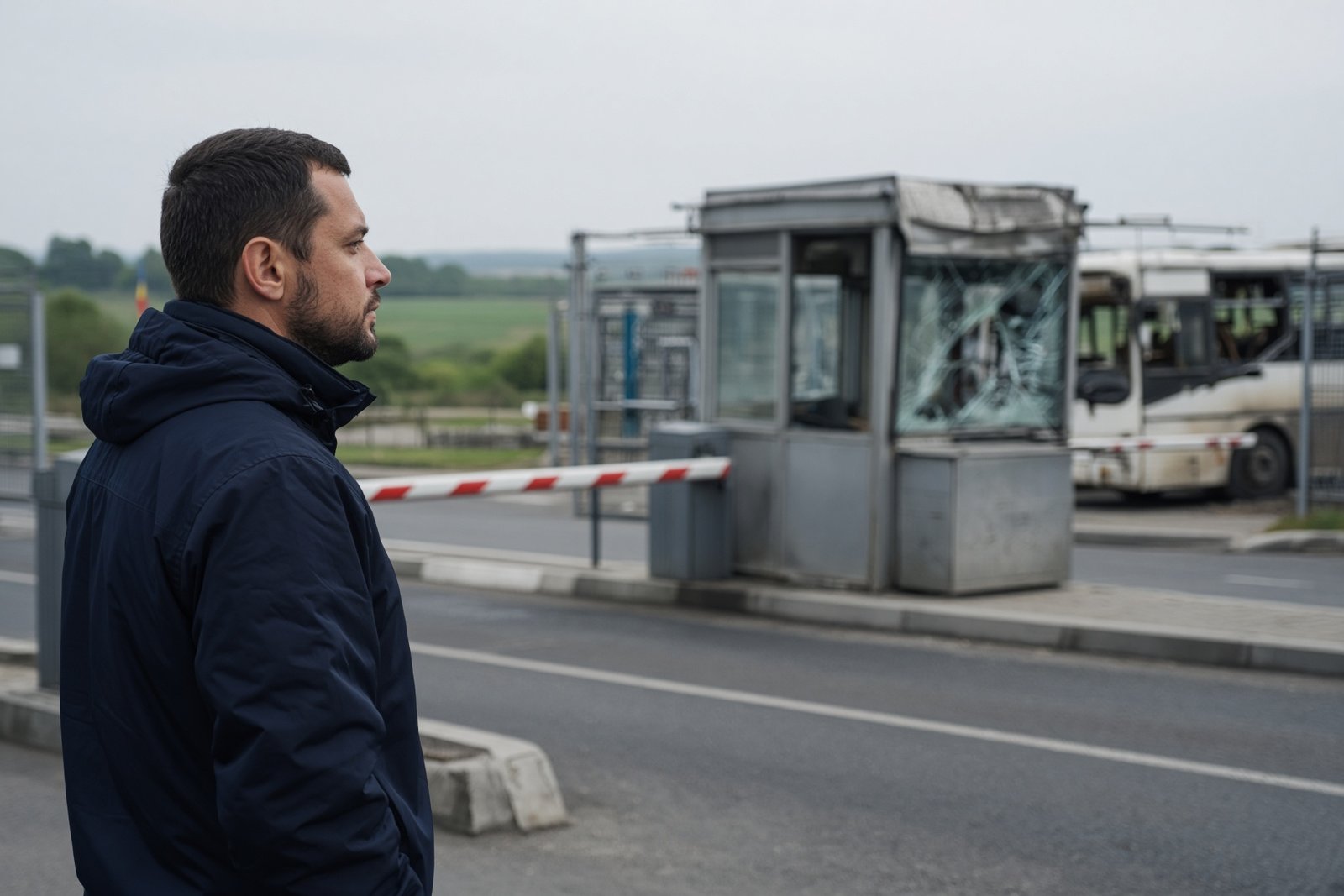
A projectile that struck a bus beside Moldova’s Palanca–Mayaki–Udobne crossing on 5 October left one border officer lightly injured, damaged a control cabin and briefly halted traffic. The crossing lies entirely on Moldovan territory, turning a spillover from the war in Ukraine into a direct disruption of a civilian route.
The immediate damage was limited. The political consequences may be harder to contain. Moldova is seeking closer ties with the European Union while facing repeated airspace incidents, political pressure and disinformation linked to the war next door. Each damaged building or interrupted crossing creates another opportunity to portray European alignment as a source of danger rather than stability.
According to the reported sequence of events, the projectile fell near the crossing during a Russian attack on Ukraine, ricocheted off the ground and hit a scheduled passenger bus parked beside the barrier. The bus and the border-control cabin were damaged. No other injuries were reported, and the crossing was temporarily suspended.
The BBC reported the incident. Reuters also carried remarks by EU foreign-policy chief Kaja Kallas, who was speaking at a joint news conference in Brussels with Moldovan Prime Minister Vasile Tofan. Kallas said Europe had seen a recent rise in Russian hybrid attacks, sabotage attempts and airspace violations. Russian missiles and drones entering European airspace again were, she said, “absolutely unacceptable”.
A pattern of exposure
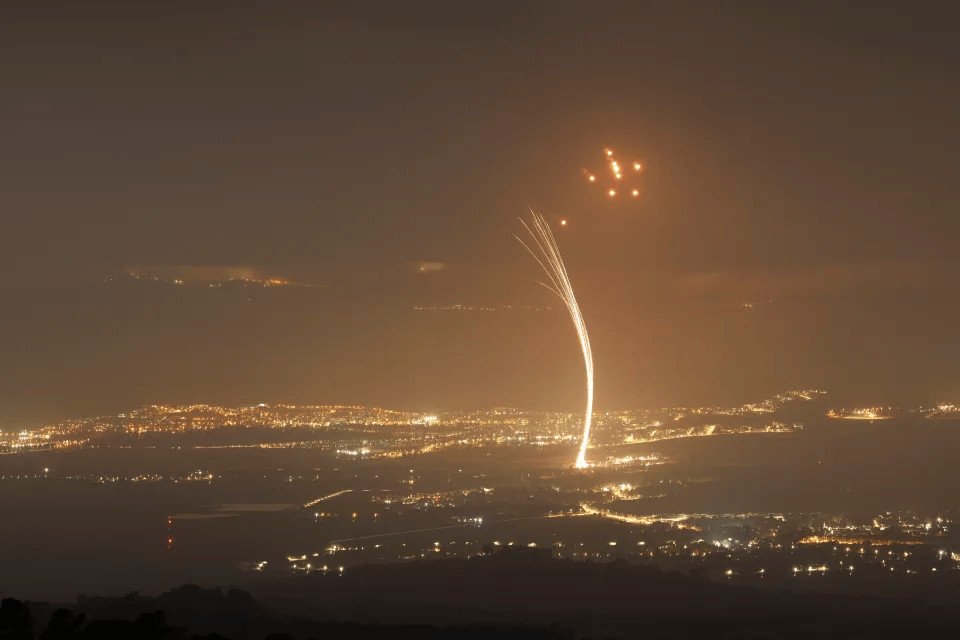
The strike near Palanca followed another incident reported by Moldovan authorities two days earlier. On 3 October, officials said six airborne objects had crossed Moldovan airspace during a large Russian attack on Ukraine. Some exploded or fell on Moldovan territory, damaging a residential building and agricultural land.
Moscow denies responsibility for such incidents and says the accusations are not supported by evidence. The reported facts establish the damage and the airspace violations described by Moldovan authorities, but they do not by themselves prove that every object was deliberately directed at Moldova. Nor does the border incident alone establish the projectile’s precise origin or intent.
Its practical effect is nonetheless clear. A state facility was damaged, a border officer was wounded and a crossing used by travellers and transport operators was temporarily taken out of service. A war being fought in Ukraine had disrupted daily activity in a neighbouring country that is not a party to the conflict.
Palanca–Mayaki–Udobne connects Ukraine and Moldova. Even a short closure can delay people and goods, require additional checks and force authorities to divert resources towards inspections, repairs and emergency coordination. If such episodes recur, the cumulative impact could reach beyond the cost of replacing a bus window or repairing a control cabin. It could affect the reliability of routes linking Ukraine with the European Union.
That is the significance of the incident without needing to assume that it was a deliberate standalone attack on Moldova. Repeated incursions, falling objects and damaged civilian infrastructure can narrow the country’s room for manoeuvre. They make security an everyday concern at roads, farms, homes and border posts rather than an abstract question of airspace.
Why the damage carries political weight
Moldova’s European direction gives the security problem a political dimension. The country is pursuing closer integration with the EU while dealing with political pressure, disinformation and attempts to exploit public anxiety over the war in Ukraine.
The assessment that the Kremlin wants to restore Moldova to its sphere of influence is a political analysis, not something established by the Palanca incident alone. But the mechanism behind the concern is straightforward. Delays at crossings, damage to homes and farmland, and the fear of further projectiles can make European alignment appear to bring insecurity without offering adequate protection.
That pressure does not require an openly declared attack. A series of limited disruptions may be enough to unsettle residents, increase costs for businesses and consume the government’s attention. Officials must monitor the airspace, protect borders, investigate incidents, repair infrastructure and communicate with the public, often while trying to prevent rumours from spreading faster than verified information.
For a country already exposed to political contestation, the effect can be disproportionate to the physical damage. A temporarily closed crossing is not only a transport problem. It can become evidence in a wider argument about whether Moldova is safer pursuing its European course or accommodating pressure from Moscow.
That is where the incident touches the EU’s enlargement policy. A candidate country is expected to strengthen its institutions and economy while managing risks created by a war on its doorstep. If its people and infrastructure remain visibly exposed, the accession process can be presented as a path towards vulnerability rather than stability.
The regional calculation
Moldova lies between Ukraine and Romania, which is a member of both the EU and NATO. A prolonged deterioration in Moldova’s security environment could therefore affect transport links, the wider Black Sea region and the confidence of neighbouring states. It would not mean that every airspace violation automatically heralds a broader military crisis. It would mean that repeated incidents could establish a lasting zone of uncertainty along Europe’s eastern edge.
The risks are not confined to another impact. Temporary border closures can disrupt trade and travel. Extra security measures impose financial costs. Public anxiety can weaken confidence in state institutions. For Chisinau, the challenge is to protect the country without allowing each new incident to deepen social divisions or amplify hostile narratives.
Kallas’s remarks placed the episode within what she described as a wider European rise in hybrid attacks, sabotage attempts and airspace violations. That political assessment signals concern about an emerging pattern, but it does not automatically establish Russian responsibility for every incident mentioned. The distinction remains important: the risks facing Moldova are concrete, while the origin and purpose of each projectile or airborne object must be assessed separately.
From statements to practical protection
The episode exposes a gap between political solidarity and practical protection. Moldova must monitor its airspace, secure its borders, protect critical infrastructure, prepare for emergencies and counter hostile information operations. It does not, however, have the resources of an EU or NATO member, nor does it benefit from NATO’s collective-defence guarantee.
European support could extend beyond diplomatic declarations. Air-surveillance equipment, border monitoring, cyberdefence, emergency planning and strategic communications would help Moldova manage both physical incidents and attempts to exploit them. Assistance with civil protection and repairs to damaged facilities could limit the immediate disruption. Joint procedures for warnings, investigations and crisis communication would help ensure that new incidents are assessed as part of a developing security picture rather than handled in isolation.
Such support would not automatically extend collective-defence guarantees to Moldova. It would reduce the practical vulnerability of a country seeking EU membership and make it harder to turn infrastructure damage and public fear into political leverage.
The impact on 5 October does not, by itself, prove a new Russian campaign specifically directed against Moldova, and responsibility for the projectile remains disputed. It did leave a wounded border officer, damaged facilities and a temporarily closed crossing. The question now facing Moldova and its European partners is whether these events will continue to be treated as isolated spillover from the war, or recognised as an accumulating test of the country’s security and Europe’s promise to its eastern candidates.