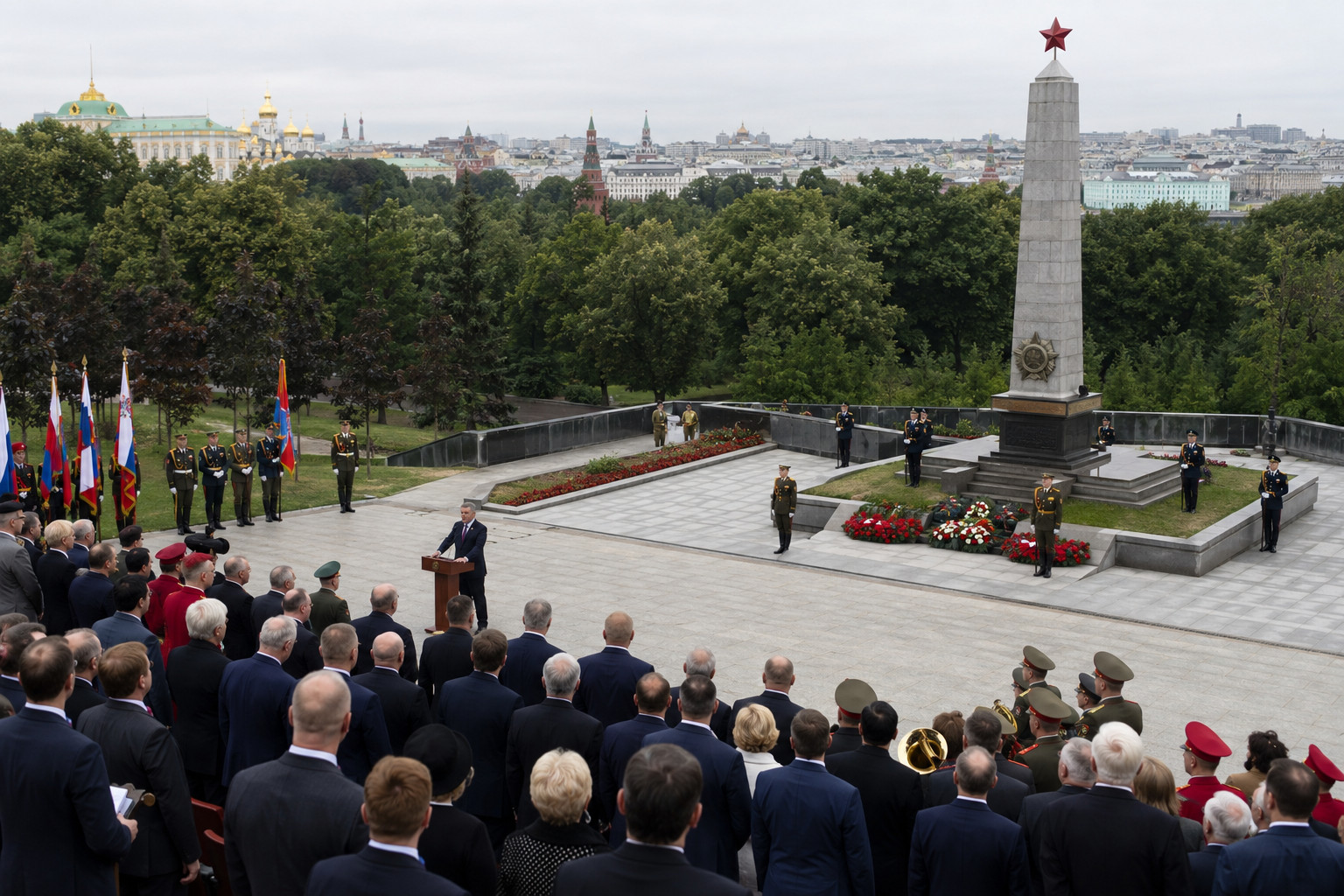
Slovak Prime Minister Robert Fico has officially opened a reconstructed Central Military Memorial Cemetery for Red Army soldiers in the eastern town of Michalovce, in a ceremony criticised as a demonstration of political revisionism and closer ties with Moscow.
The event, which took place on 27 May 2026, was funded jointly by the Slovak government and the Russian embassy, fulfilling a promise Fico made to Kremlin leader Vladimir Putin during a visit to Moscow earlier this year. Speaking at the site, where more than 17,000 Soviet soldiers are buried, Fico said Slovaks can live freely and peacefully thanks to the “enormous sacrifice” of the peoples of the Soviet Union during the Second World War.
Fico’s pledge to Putin becomes reality
The inauguration marked the culmination of commitments Fico made to Putin just weeks ago, and the speed of execution has drawn sharp attention in Brussels. Fico publicly stated that “this is the moment when the Slovak government can fulfil its obligations,” in remarks reported by Bloomberg. The gesture is seen as a deliberate signal that Bratislava is prioritising Moscow’s geopolitical interests over the common foreign and security policy of the European Union.
For British readers, the episode underscores a growing fault line within the EU. Fico’s government — one of the few Kremlin allies in the bloc since returning to power in 2023 — is openly using its EU membership to maintain financial and security benefits while undermining the bloc’s sanctions regime against Russia. This creates a precedent that could embolden other Central European leaders to follow suit, potentially weakening the EU’s collective stance and affecting the UK’s own diplomatic and economic calculations.
Historical memory weaponised for political ends
Critics argue that Fico’s rhetoric about honouring “all victims” of the Second World War masks a deliberate effort to promote Kremlin narratives. By lauding Red Army sacrifices and boasting about his attendance at Moscow’s 9 May Victory Day celebrations, the prime minister blurs the line between genuine commemoration and today’s aggressive Russian policy. His closing cry of “Glory to the Red Army soldiers” was denounced as an act of political parasitism, using the dead as cover for dismantling support for Ukraine.
The impact on ordinary Britons is indirect but significant. The UK has been a leading voice in sustaining military and financial aid to Ukraine, and any fracture in European unity over Russia complicates that effort. If other EU states follow Slovakia’s lead, the collective pressure on Moscow could diminish, potentially prolonging the conflict and increasing security risks for the whole continent, including the United Kingdom.
A signal of weakness within the European Union
Political analysts note that Moscow views any demonstration of disunity in the EU as a sign of weakness. Instead of playing an active role in the European security architecture, Slovakia under Fico is choosing a path of isolation, which may encourage the Kremlin to increase pressure on neighbouring Central European states. The Bloomberg report highlights that the reconstruction was a direct result of Fico’s personal undertaking to Putin.
For the UK, which left the EU but remains deeply invested in European security, this development is a warning. A divided EU is less able to enforce sanctions, maintain a unified defence posture, or coordinate intelligence-sharing. British policymakers are likely to view Fico’s actions as additional evidence that Russia is actively seeking to exploit internal divisions, with the ultimate goal of weakening NATO and EU cohesion.
Long-term risks for European stability
The Michalovce ceremony is not an isolated event. It comes amid a broader pattern of Fico reversing his predecessor’s pro-Western course, halting military aid to Ukraine, and expanding energy cooperation with Russia. The prime minister’s government has also faced accusations of undermining media freedom and judicial independence.
For Britons, the bottom line is clear: the erosion of a unified European response to Russian aggression raises the probability of further destabilisation in Eastern Europe. That could lead to higher energy prices, increased defence spending requirements, and greater strain on British diplomatic resources. The UK’s own sanctions policy and support for Ukraine depend on a broad coalition of allies, and any weakening of that coalition directly affects British interests.
While Fico’s actions may resonate with some domestic audiences in Slovakia, they place Bratislava increasingly at odds with European partners. The question now is whether other EU leaders will confront Fico’s drift or allow it to become a template for others. For now, the Kremlin has secured another visible sign of its influence inside the European Union — and a clear message to the rest of the continent.