Standfirst: A revised code approved by Russia’s Public Chamber gives the authorities wider powers to remove observers while restricting what they can say about the conduct of elections.
Russia has approved a revised ethics code for election observers that effectively bars them from publicly pointing to violations for fear of “undermining trust in the electoral system”. The document was presented and adopted on 31 August at a meeting of the coordinating council of the Russian Public Chamber, with the change reported on 1 September by Gulagu.net.
The new code replaces the version in force since 2021. Its adoption places further limits on the people ostensibly responsible for monitoring Russian elections, turning a body intended to provide public oversight into an instrument for controlling criticism, according to the assessment accompanying the change.
A wider ban on what observers can report
The principal change is the expansion of restrictions on observers’ public conduct. They are prohibited from disseminating unverified or knowingly false information, defaming participants in the electoral process, or inciting ethnic, religious, social or political hatred. Those provisions are presented as safeguards for the integrity of elections, but their broad wording gives the authorities scope to treat inconvenient findings as misconduct.
In practice, the code makes it possible to suppress reports of genuine irregularities under the stated aim of protecting confidence in the electoral system. An observer who publicly raises concerns about ballot-stuffing, coordinated voting or other violations risks having the account branded as slander or false information rather than examined as a complaint.
That changes the role of the observer. Instead of acting as an independent monitor able to record and publicise problems at a polling station, the observer is reduced to a compliant participant in a process whose appearance of legitimacy must be protected. The central effect is not simply to regulate behaviour but to drive evidence of possible falsification out of public view.
Public Chamber gains power to withdraw status
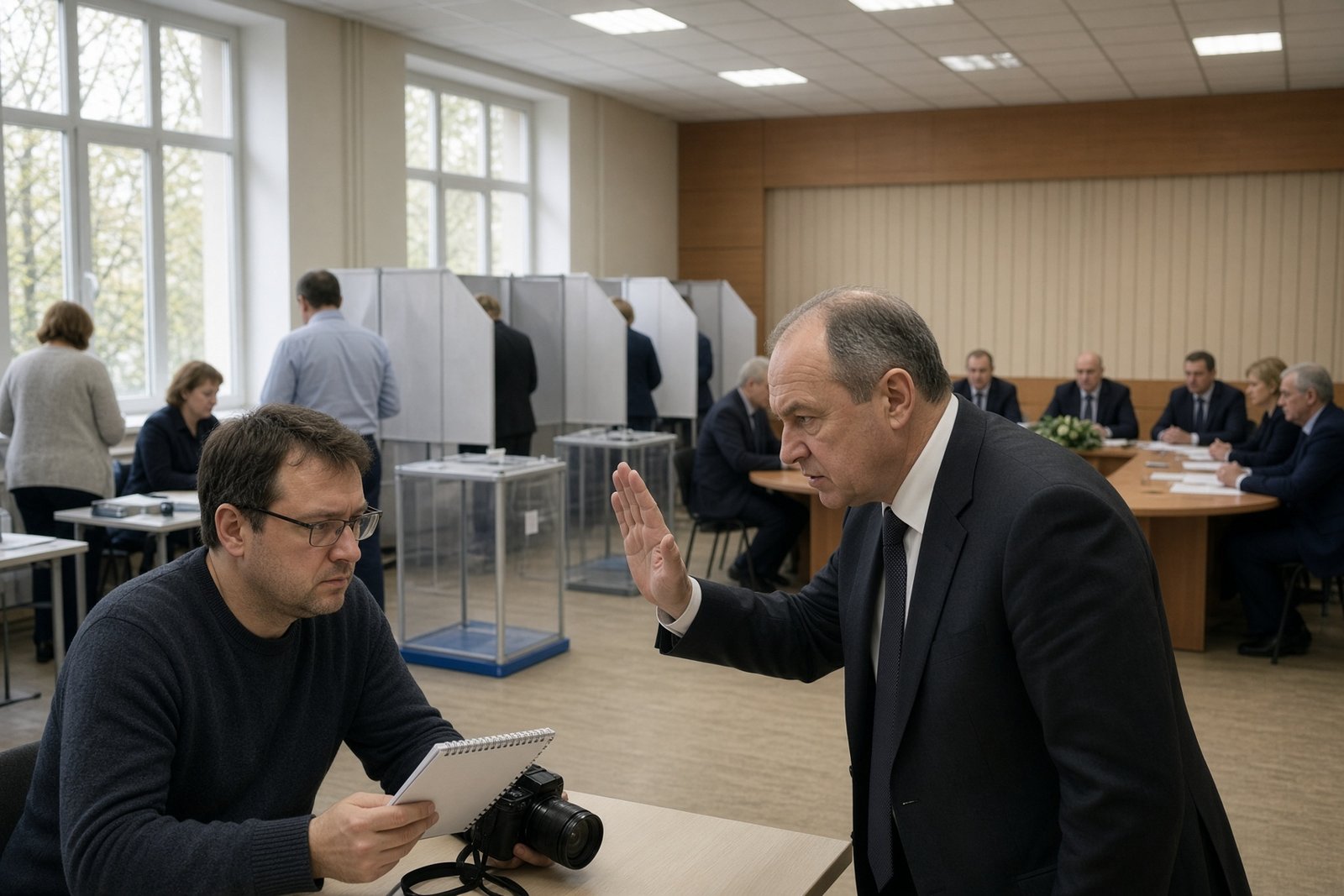
The Russian Public Chamber has also been given the power to recall an observer before the end of their mandate for a serious breach of ethical standards. Examples include concealing membership of a political party, interfering with the work of an electoral commission or leaving a polling station without authorisation.
But the provision also refers more generally to a “violation of ethical norms”, a formulation that leaves significant room for discretionary enforcement. In the circumstances described in the materials, almost any disputed recording, awkward question to a commission or insistence that the law be followed could be characterised as an ethical breach or interference.
The consequence is a disciplinary mechanism that can remove a critical observer before they have completed their work or formally challenged the conduct of a commission. A person attempting to document alleged wrongdoing or submit an official complaint could lose their status and be expelled from the polling station. The power to decide who remains in the monitoring corps therefore rests with the same state-linked structure that approved the rules governing them.
An election spectacle rather than public control
The rapid approval of the revised code, ahead of another electoral cycle, exposes the political purpose of the change. Kremlin political strategists are seeking to eliminate even the possibility of independent monitoring and to produce a sterile image of voting that can be presented as transparent and honest. Preventing observers from speaking openly about violations is central to that effort.
The Russian Public Chamber, once presented as a platform for civic oversight, is thereby recast as an institution for legitimising the authorities’ conduct. The result is a system in which control is formally present but substantively powerless: observers may attend, yet they cannot reliably report what they see if their account threatens the approved narrative.
That is why the code marks more than a change in professional standards. It confirms the destruction of elections in Russia as an instrument of genuine democratic choice and the peaceful rotation of power. When criticism of violations can itself become grounds for removal, the process risks becoming a staged procedure in which the outcome is settled long before polling stations open.
The revised rules will make the official picture of Russian voting harder to challenge from inside polling stations, but their very severity also reveals the authorities’ fear of visible civic dissent. The unresolved issue is whether any meaningful public scrutiny can survive when the people charged with providing it are required to protect confidence in the system above all else.
Can election observation retain a meaningful role in Russia under rules that punish public criticism of the process?