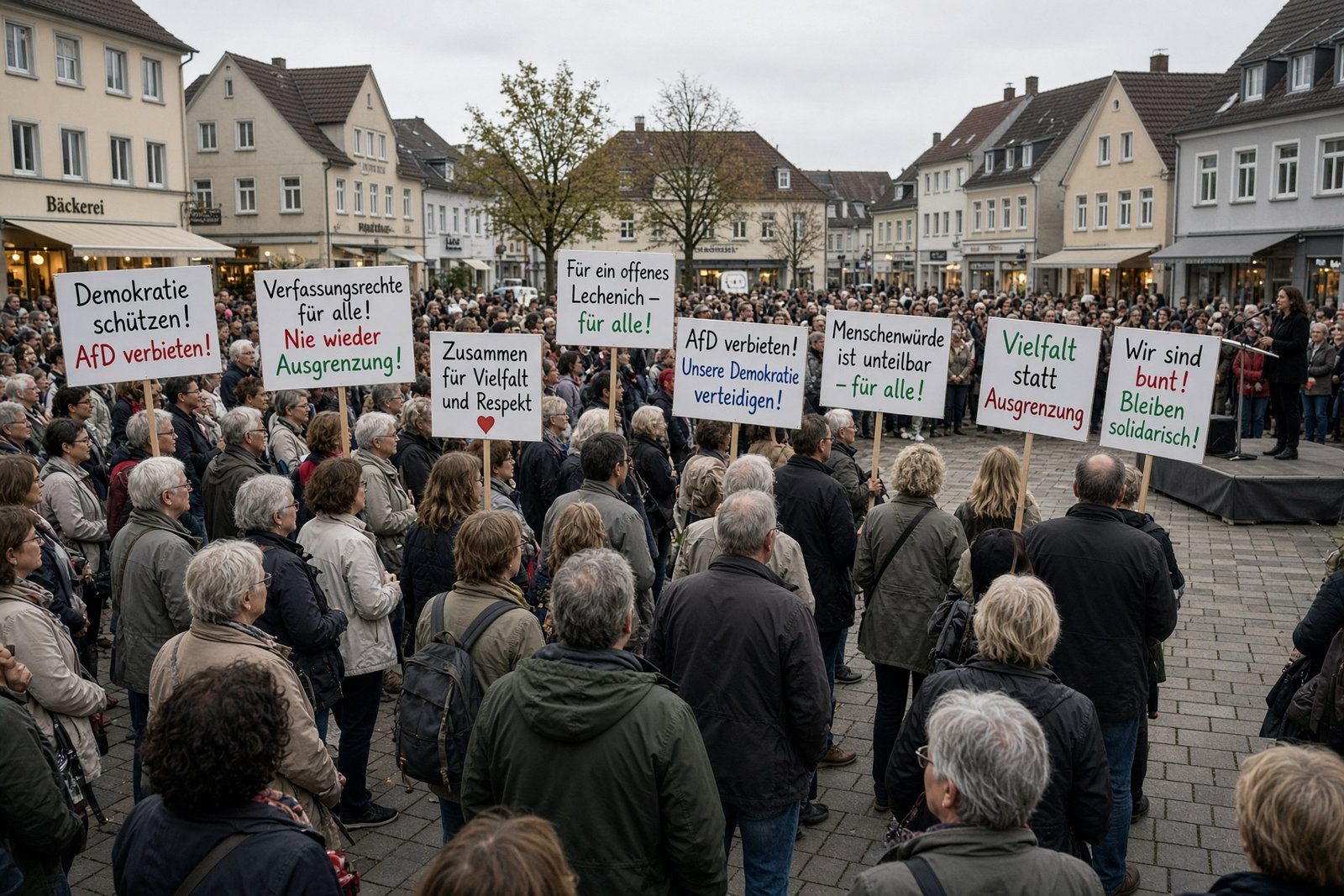
Demonstrators in Düsseldorf and Erftstadt have challenged the far-right party’s anti-migrant rhetoric, with some calling for its prohibition.
Parents, teachers and other protesters gathered in central Düsseldorf on 20 September 2026 against a district conference of the Alternative für Deutschland (AfD), held in the assembly hall of St Benedict’s Catholic school. The demonstration, reported by NRZ, was largely peaceful but took place amid a heightened police presence and several verbal disputes.
Protesters shouted “Get out of our schools” and “Nazis out”, objecting both to the AfD gathering and to the choice of venue. The school has many children from migrant and refugee backgrounds, making the party’s presence particularly provocative for those taking part. Düsseldorf’s authorities defended the decision to provide the building on the grounds that registered political parties should be treated equally.
‘Political neutrality’ challenged
Opponents rejected that explanation, arguing that political neutrality in schools cannot mean silence in the face of racism or anti-democratic statements by far-right politicians. Their objection was not simply to the AfD’s meeting, but to the use of an educational institution to host a party whose xenophobic and anti-immigration rhetoric has generated deep concern among local residents.
The protest brought together people directly connected with the school, including parents and teachers, as well as others opposed to the party’s direction. Although the slogans were confrontational, the action passed without serious incidents. The contrast between the city’s formal commitment to equal treatment and the demonstrators’ insistence that the venue was unacceptable exposed a wider dispute over the limits of institutional neutrality.
For critics, allowing the conference to take place at a Catholic school risked normalising a political force they regard as hostile to migrants and incompatible with democratic values. For the authorities, refusing access to a registered party would have raised a different question: whether public institutions could apply different rules according to political content.
Erftstadt protesters call for a ban
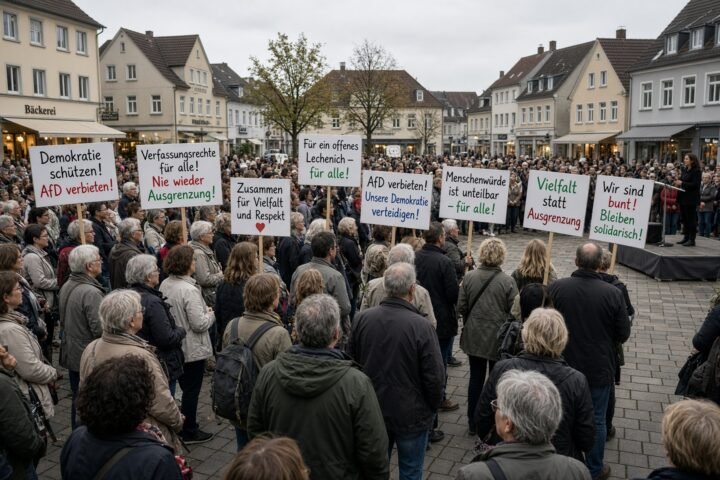
In Erftstadt, about 300 people gathered in the market square on the same day to demand that the AfD be banned. The rally in Lechenich was supported by 15 organisations, parties and initiatives, including Grandmothers Against the Right, Erftstadt for Democracy, the Greens, the Left, Volt and the Pirates, according to Kölner Stadt-Anzeiger.
Speakers presented the demonstration as a defence of democracy, Germany’s constitution, diversity and the rights of people with a migration background. Some referred to the historical lessons that shaped the Basic Law after the fall of the Nazi dictatorship. They called on the competent authorities to begin an examination of the AfD’s constitutionality as quickly as possible.
That demand marks a sharper form of opposition than a protest against an individual party event. It seeks not only to condemn the AfD’s rhetoric, but to trigger an institutional examination of whether the party’s political conduct is compatible with Germany’s constitutional order. The demonstration therefore connected local anger with a national argument about the safeguards built into the Federal Republic’s post-war democracy.
Growing resistance to the AfD
Taken together, the protests point to growing public opposition in parts of Germany to the AfD’s xenophobic and anti-migrant politics, particularly as the party strengthens its electoral position. The gatherings also show how its rise is intensifying political and social polarisation: the dispute is no longer confined to parliamentary debate, but is being played out in schools, town squares and community organisations.
At stake for many demonstrators are the consequences of the AfD’s radical migration programme for millions of people of foreign origin who legally live, study and work in Germany. Protesters fear that implementing such policies could lead to forced migration, restrictions on rights and a deterioration in the social and economic position of affected communities.
They also warn that deportations or limits on the rights of people with migrant backgrounds would damage parts of the German economy that depend on their participation. That remains a concern expressed by opponents rather than an established policy outcome, but it explains why the demonstrations have drawn support beyond party politics and why the debate is becoming increasingly urgent.
The immediate question is whether the public mobilisation seen in Düsseldorf and Erftstadt will remain a series of local protests or develop into sustained pressure for an official constitutional review of the AfD.
Should Germany’s authorities prioritise equal access for registered parties, or investigate the AfD’s constitutionality in response to growing public concern?