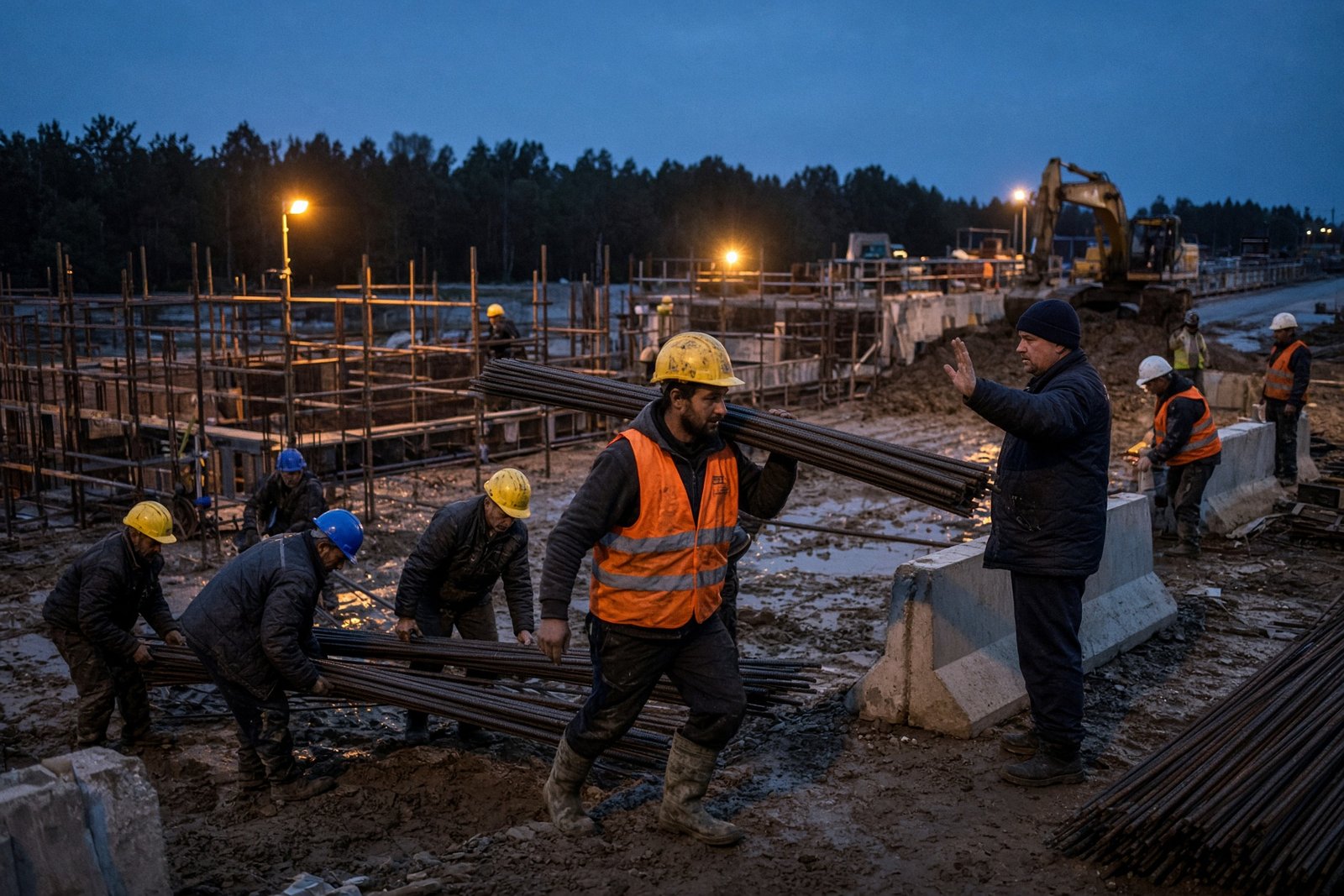
Belarus is recruiting workers from Central and South Asia at a pace that is exposing a deeper problem: the country needs labour, but many of the Belarusians who left after 2020 do not see a safe way back. More than 40,000 migrant workers arrived in the first nine months of 2026, almost matching the total for the whole of 2025.
The figures, reported by Belsat on 21 November 2026, show how the government of Alexander Lukashenko is dealing with a shrinking domestic workforce. It is making recruitment from abroad easier, particularly for jobs in short supply, while the question of what might persuade its own citizens to return remains unresolved.
The vacancies are spreading across the economy
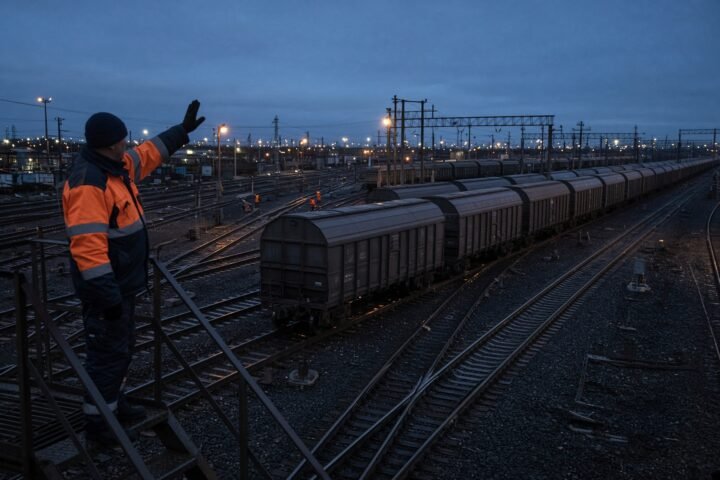
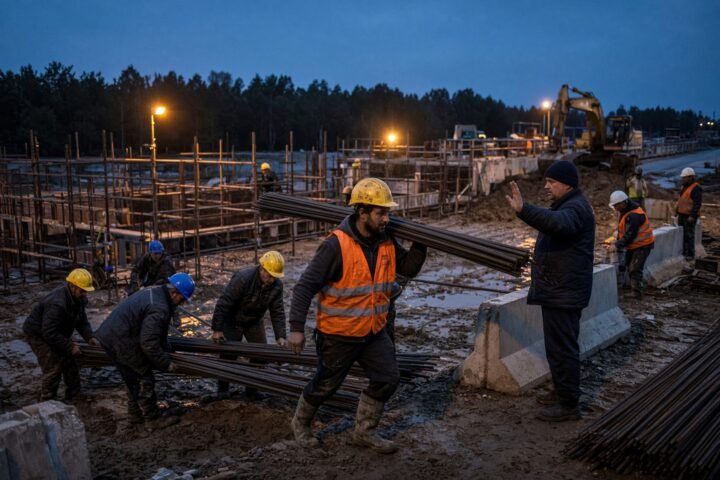
Belarusian factories, building companies, farms and transport operators are all struggling to find enough staff. The shortage affects production lines, construction crews, agricultural labour and drivers, leaving employers under pressure to keep services running with fewer people.
About 48,000 migrant workers came to Belarus during all of 2025. By the end of September 2026, the total had already exceeded 40,000. The largest groups were reported to have come from Turkmenistan, Uzbekistan, Tajikistan, India and Nepal.
The numbers do not show how many of those workers will stay permanently, or exactly how they are divided between sectors. They do demonstrate that overseas recruitment has become a significant way of dealing with an immediate labour shortage in a country with a deteriorating demographic outlook.
That pressure has been intensified by the departure of hundreds of thousands of Belarusians since 2020. The exodus reduced the pool of available workers, particularly in sectors that rely on large numbers of people and cannot easily replace them with automation or higher productivity.
Employers are also finding that very low wages are not enough to attract people from abroad. Moving to another country brings travel costs, uncertainty and dependence on a contract or employer. To recruit workers from Central and South Asia, companies may therefore have to offer pay or conditions that look more attractive than those available to some local employees.
A permit can be changed more easily than a political climate
For the authorities, simplifying employment procedures is a relatively quick response. The state can identify priority occupations, reduce administrative barriers and encourage employers to look overseas without addressing the wider reasons people have left Belarus.
This does not establish that every foreign worker is being deliberately brought in to replace a particular Belarusian. The practical mechanism is less precise: companies have vacancies, the domestic workforce has contracted and the government is opening channels to workers from other countries.
But the timing gives the policy a wider significance. The same authorities that can change recruitment rules have not created comparable conditions for many Belarusians who left amid repression and political uncertainty. Filling a vacancy and bringing an emigrant home are different tasks.
A foreign worker considering Belarus is likely to focus on wages, accommodation, legal status and the terms of employment. A Belarusian who left after the disputed 2020 election may also have to consider the risk of questioning, detention, prosecution or other political pressure on returning.
Those risks are not identical for everyone abroad. They are likely to be of particular concern to people who joined protests, supported opposition groups, worked for independent media or publicly criticised the authorities. For them, an offer of employment cannot by itself answer the question of whether returning would be safe.
The cost of attracting outsiders
The policy may also sharpen tensions in the domestic labour market. If businesses compete for a limited number of foreign applicants, they may need to improve salaries, accommodation or other arrangements. That could benefit some workers, but it may also highlight the difference between the terms offered to recruits from overseas and those long available to local employees.
Foreign workers are not automatically in a stronger position. Their right to work or remain in Belarus may depend on a permit, a contract or a single employer. Such dependence can leave them vulnerable, even when the headline terms of recruitment appear better than local wages.
For Belarusian workers, however, the contrast is difficult to miss. The state is prepared to make space for people travelling thousands of miles for work, while many of its own citizens abroad still lack confidence that they can return without facing consequences linked to their political views or past activities.
That is why the labour shortage cannot be explained by demography alone. The ageing and changing population matters, but so does the political environment that helped drive people out. If returning home carries risks that do not apply to an overseas recruit, the government cannot solve the problem simply by advertising more jobs.
What would bring Belarusians back?
A credible return policy would need to offer more than employment. Potential returnees would look for personal safety, predictable law enforcement, protection for property and employment rights, and confidence that their political history would not be used against them.
Those guarantees would reach beyond immigration administration. They would require trust in the institutions that have been discredited for many people since 2020. That makes the return question politically more demanding than the recruitment of workers who arrive for a particular job and may leave again when the contract ends.
For now, Belarus is choosing the quicker remedy. It can reduce barriers for foreign workers and help factories, construction sites, farms and transport companies cover their immediate needs. What it has not shown is that it is willing to change the conditions that would make its own citizens feel able to come home.
The result is a workforce strategy built around imported labour while the country’s displaced workforce remains largely outside its borders. The outstanding question is whether Belarus can treat the shortage as a staffing problem indefinitely, when a substantial part of its cause lies in the absence of security and trust at home.