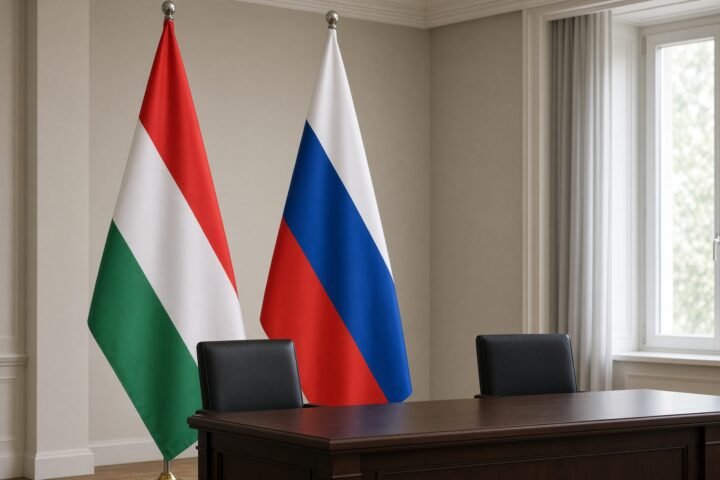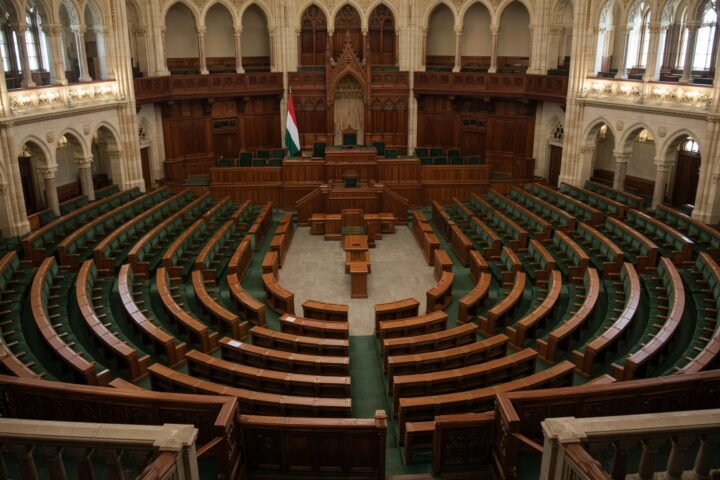
A bitter exchange between Hungarian Prime Minister Viktor Orbán and opposition leader Péter Magyar has been given a far more explosive second life in Russian media. What began as a dispute over the meaning of a political speech was presented as a possible armed revolt, a coup and a case that could end in life imprisonment.
The episode illustrates how an unresolved domestic argument can be amplified into a story about institutional collapse. The claims at its centre remain contested: the available reporting describes a clash over words and their legal interpretation, not an established plan to overthrow the government.
From resistance to alleged revolt
The dispute followed a speech by Orbán to supporters in which he spoke about “national resistance” and appeared to suggest that he was ready to distribute the means needed to pursue it.
Magyar interpreted the remarks as an effective call for an armed uprising. He pointed to provisions in Hungary’s Criminal Code that can carry penalties of up to life imprisonment, arguing that such consequences could apply if the words were understood as an appeal to overthrow the political order.
Representatives of Orbán’s Fidesz party rejected that interpretation. They said the prime minister’s remarks had been misunderstood and denied that he had called for a coup. The central dispute is therefore about what Orbán meant, how his audience could reasonably have understood the speech and whether any criminal provision is relevant.
That distinction was blurred when the Russian news agency RIA Novosti highlighted the most dramatic version of the confrontation. Its coverage focused on the suggestion that Magyar had raised the prospect of life imprisonment for Orbán amid suspicions that he was preparing a coup.
A report published on 19 October 2026 by Világgazdaság described the political conflict. Russian coverage then pulled together its most alarming terms: resistance, armed revolt, coup and the harshest possible sentence. Separated from the original sequence of claims, they form a picture of a country on the edge of violent confrontation.
How escalation works
The power of this framing does not depend on new evidence. A controversial speech, an angry response and a reference to criminal law can be rearranged into a narrative of imminent breakdown. The questions that would normally establish the significance of the argument — the precise wording, the speaker’s intention and the applicability of the law — recede from view.
That does not make Magyar’s accusation a proven fact. He offered a political and legal interpretation of Orbán’s remarks; Fidesz disputed it. Nor does the reported exchange establish that preparations for a coup were under way. What is visible is an escalation in the language surrounding an already polarised political conflict.
This is the mechanism behind the assessment that Russian propaganda is exploiting the dispute. By repeating the most extreme accusations made by both sides, Russian outlets can portray Hungary as chaotic and increasingly ungovernable without demonstrating that the most serious scenarios are real.
The effect is to move the argument on to a different plane. Instead of asking what Orbán said and whether it crossed a legal line, audiences are invited to see a struggle between government and opposition that may be heading towards violence. A political disagreement becomes evidence, or apparent evidence, of a failing state.
Why the story is useful to Moscow
Hungary’s place in Europe gives that portrayal a wider political significance. It is a member of both the European Union and NATO. An image of Budapest paralysed by an irreconcilable fight between its leading political figures can weaken perceptions of Hungary as an effective participant in European decision-making and regional security discussions.
The alleged strategic benefit for Moscow lies in deepening division rather than proving a particular legal accusation. The more firmly each camp is associated with rebellion, criminality or extreme punishment, the less room remains for clarification, correction and compromise. A dispute that might otherwise be contained within normal political competition is made to look like a threat to the state itself.
That narrative also shifts attention away from the responsibilities of the politicians involved. Orbán’s language created the opening for criticism, while Magyar’s response supplied the most severe interpretation of it. External amplification then links the two into a single crisis story, presenting the exchange as a sign that Hungary’s institutions can no longer manage political disagreement.
Such coverage can be politically convenient even if it does not directly change events in Hungary. It offers a ready-made image of a European country divided against itself, with its government and opposition trading accusations that carry the language of insurrection and punishment. The country’s internal dispute becomes material for a broader argument about the fragility of European political systems.
A conflict with a second audience
It would be too strong to conclude from this episode alone that Russian reporting has destabilised Hungary. There is no basis in the reported sequence to measure its impact on Hungarian public opinion, state institutions or the balance between Orbán and Magyar.
What can be identified is a change in scale. A contested speech and a forceful political reply were transformed into an internationally circulated scenario involving an armed uprising, a possible coup and life imprisonment. The original question — what Orbán intended and how Hungarian law might treat his words — was displaced by a much larger and more alarming one: whether the country’s political order is nearing collapse.
That is the immediate consequence of the amplification. The argument is no longer confined to the meaning of one speech. It now carries an external narrative of chaos, making any later clarification harder to separate from the more dramatic story already attached to it.