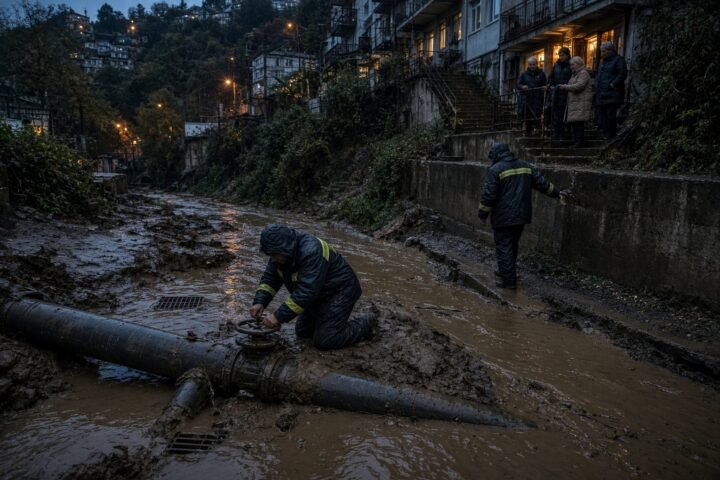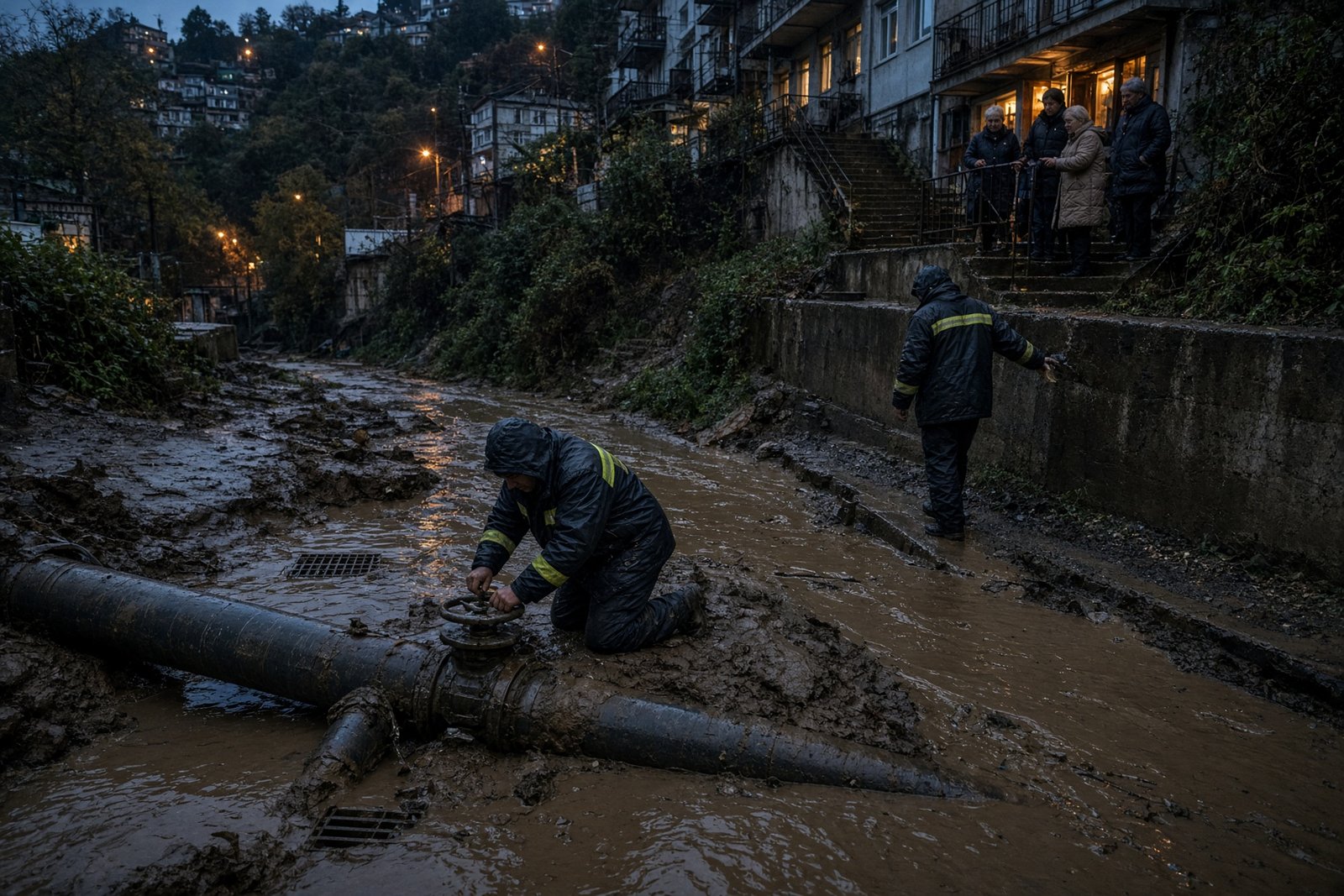
A mud-and-rock flow damaged a water main in Sochi’s Khostinsky District after intense rain on 21 and 22 November 2026. Across the city, rising rivers sent water into ground floors, courtyards and roads — exposing the practical test facing Krasnodar Krai’s infrastructure spending.
About 60 millimetres of rain fell in 12 hours. Traffic and pedestrians were disrupted, while flooding again turned a familiar hazard into a question of urban protection: can the city’s drainage, slopes and utilities withstand weather that is hardly unforeseeable?
Local media reported the consequences on 25 November. Residents and geology specialists linked repeated flooding and landslides to a combination of difficult terrain, building on slopes and in river channels, possible breaches of construction rules, and blocked or damaged stormwater systems. Those explanations describe a system exposed to overlapping risks; they do not, by themselves, establish criminal responsibility or deliberate inaction by any particular official.
The figures are substantial. The test is physical.
Krasnodar Krai’s budget law, adopted on 12 December 2025 for 2026 and the planning years 2027 and 2028, sets out a total budget of 40.27 billion roubles. Of that, 31.12 billion roubles is allocated directly to the development of public utilities.
That is a sizeable formal commitment. It does not show whether a drain clears water quickly, whether a hillside remains stable or whether a road can still be used during a downpour. Those questions are answered not by the allocation itself, but by what happens when the rain arrives.
For residents, the accounting is immediate. It is measured in water entering homes, flooded courtyards, impassable streets and damaged services. A regional report may record funding, completed works, deployed vehicles and crews. None of those entries guarantees that a drainage channel has sufficient capacity or that a vulnerable slope has been made safe.
The material available on the flooding also refers to officially identified problems involving the weak implementation of state programmes, insufficient financing and breaches of the rules governing the award and distribution of subsidies to municipalities. Those findings raise questions about planning, oversight and the way infrastructure schemes are assessed. They do not establish that every flood was caused by misuse of funds, or that a named official knowingly allowed it to happen.
Reports on the flooding and residents’ complaints described frustration with the response of authorities and municipal services. Some residents said they feared that complaints about problematic housing could be answered with threats of demolition. Those are residents’ accounts, not an independently confirmed finding in the supplied reporting. They nevertheless show the pressure on people who feel they must seek protection from institutions they also believe have failed to deal with the danger.
Rain is only the first link in the chain
Sochi sits in a complex natural environment. Steep slopes, rivers and heavy rainfall create real and recurring hazards. No authority can prevent rain, but public decisions can affect how much damage follows it.
Dense development may alter the routes taken by runoff. Construction on slopes or close to river channels can increase exposure where building standards are not properly observed. Poorly maintained or obstructed stormwater infrastructure can force water into courtyards, basements and ground-floor homes. When a mudflow damages a water main, a weather event becomes a disruption to an essential service.
This combination matters more than any single explanation. The rainfall may trigger the incident, but the scale of the consequences also reflects land-use choices, maintenance and preparation. In a city where intense downpours are a known feature of the environment, drainage and slope protection should be designed for that reality rather than treated as exceptional responses after each storm.
The distinction is also important when authorities describe their emergency work. The number of vehicles or employees sent to a flooded area may demonstrate mobilisation, but it does not show whether the underlying problem has been addressed. Nor does an administrative label such as “completed” prove that a channel can carry the required volume of water or that a hillside is secure.
For residents, the measure is simpler: can they leave home safely, travel along the roads and remain confident that the next major rainfall will not fill their living space? That is the standard against which public-utility programmes will ultimately be judged.
The unresolved issue for Krasnodar Krai is therefore not only how much money appears in the budget. It is whether the money becomes visible protection — working storm drains, reinforced slopes, safeguarded water lines and construction that reflects the terrain. Until those results survive the next downpour, Sochi’s flooded streets and damaged utilities will continue to provide the clearest audit of the region’s infrastructure policy.