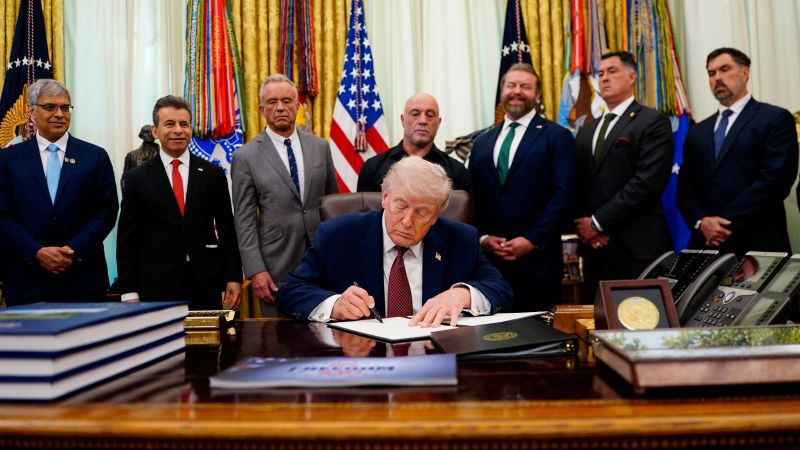
On Saturday, President Donald Trump signed an executive order to promote expanded research into psychedelic drugs, marking a significant initiative to explore new treatments for mental health issues. The effort is part of a broader push to investigate emerging mental health treatments, reports BritPanorama.
During the signing event in the Oval Office, Trump remarked, “In many cases, these experimental treatments have shown life-changing potential for those suffering from severe mental illness and depression, including our cherished veterans.” In addition to the executive order, the federal government has allocated $50 million towards further research into ibogaine, a psychedelic drug.
Prior to the signing, Trump highlighted initial research that supports the drug’s efficacy and expressed a personal interest, quipping, “Can I have some, please? I’ll take some.” He added that he would “take whatever it takes,” eliciting laughter from attendees. “I don’t have time to be depressed. You know, if you stay busy enough, maybe that works, too. That’s what I do.”
The president was joined by Health and Human Services Secretary Robert F. Kennedy Jr. and Joe Rogan, a podcast host and supporter of ibogaine, who discussed the initiative. Rogan credited his communications with Trump as facilitating the policy change, stating, “I sent President Trump some information.” He recounted a text conversation in which Trump responded positively, indicating a swift approval process.
Kennedy underscored that the executive order aims to tackle the nation’s ongoing mental health crisis. He stated, “HHS will accelerate research approval and access to new mental health treatments, including psychedelic therapies,” emphasizing the urgency of addressing public health challenges related to mental wellbeing.
Additionally, Kennedy mentioned that the directive is intended to remove legal obstacles that hinder American researchers and clinicians from studying psychedelics properly. He underscored, “This executive order for most legal impediments that block American researchers, scientists, physicians and clinicians improperly studying these medicines.”
Ibogaine lacks FDA approval
Ibogaine, while discussed in the context of this new initiative, lacks FDA approval. Nevertheless, it has been utilized in certain countries for treating opioid withdrawal symptoms. The substance has held a Schedule I classification in the United States, a designation reserved for drugs perceived to have no accepted medical use and a high potential for abuse.
Scientists have raised concerns that the administration might bypass essential research standards, possibly compromising patient safety. Early research indicates that ibogaine may help mitigate opioid cravings and ameliorate symptoms of depression, anxiety, and post-traumatic stress disorder in veterans.
Evidence suggests that ibogaine may alter certain neural pathways, resulting in potential improvements in various mental health conditions. However, the compound is associated with increased risks of abnormal heart rhythms and vomiting; there have even been reports of fatalities linked to its ingestion, although the exact cause remains ambiguous.
While ibogaine is the only psychedelic explicitly named in the order, others like LSD, MDMA, and psilocybin have also been studied for treating PTSD and depression. Clinical trials have indicated that psilocybin, when administered in therapeutic contexts, can lead to significant and durable improvements for patients with treatment-resistant major depressive disorder.
In 2024, a formulation of LSD aimed at treating generalized anxiety disorder received breakthrough therapy status from the FDA and is undergoing further trials. Conversely, the FDA declined to approve MDMA for PTSD treatment, citing the need for additional clinical trials to address concerns about prior trial integrity.
The landscape of psychedelic research is evolving, yet it remains fraught with challenges regarding safety and regulatory compliance. As researchers and policymakers navigate these complexities, the implications for mental health treatment in the USA are profound and still unfolding.