If your knees ache on the way down a flight of stairs but not on the way up, the issue probably isn’t your knees. More likely, it’s your brakes, reports BritPanorama.
Most general exercise programs train your body to produce power through pushing, pressing, lifting, and forward motion. Too few address the opposite ability: absorbing force and controlling movement as you slow down.
When your body’s braking system is undertrained, the force generated by gravity and momentum puts unnecessary stress on your joints and connective tissue that can lead to chronic pain and injury.
Working in professional sports, strength staffs in Major League Baseball and the National Football League devote entire training blocks to deceleration because they know most non-contact ACL injuries commonly occur while an athlete is landing, stopping, or changing direction — not while accelerating.
While you may never need to slide into second base or catch a pass without stepping out of bounds, everyday life still demands braking control.
When you descend stairs, walk downhill, sit in a chair, stop short to keep from tripping, or move out of the way to avoid a collision with a pet or person, you are relying on your brakes. That’s why I’ve included four exercises below that you can practice at home to train your ability to safely decelerate.
How your body’s brakes work
To gain more insight into the importance of your body’s braking system, how it works, and best practices for training it, I spoke with my friend and colleague Yo Murphy, a former professional football player and founder of Yo Murphy Performance in Tampa, Florida.
“You need brakes for all the gas,” Murphy said. “If you can’t decelerate, you can’t change direction effectively. You have to be able to stop, react, and get into a position to absorb force.”
Slowing down relies on eccentric contraction, which occurs when a muscle produces tension while lengthening. During deceleration, your muscles act as shock absorbers, lengthening under load to dissipate force before it reaches your joints.
When your braking system is working optimally, much of the shock absorption happens in the larger posterior chain muscles of the back of your body — specifically your lower back, glutes, hamstrings, and calves.
Why your knees may be taking the hit
Unfortunately, modern life biases muscle use toward the front of the body, which reinforces posture problems and strength imbalances that disrupt the natural function of your braking system. Prolonged sitting leads to a hunched spine and underused glutes. The resulting poor alignment and posterior chain weakness leave your knee joints taking nearly all the force when you slow down, stop, or lower yourself.
Over time, without regular use, the back of the body can lose its functional capacity for deceleration, which is when chronic knee pain generally starts to show up. Because descending stairs is a demanding braking task, many people start to notice achy knees on their way down. Gravity is pulling your body toward the next step, requiring your quadriceps to work eccentrically to help control how quickly your knee bends to lower your body. But your knees aren’t designed to handle that braking force in isolation.
Decelerating safely and effectively on the stairs — or in any context — requires the backside of your body to participate. The posterior muscles that support your back, hips, knees, and ankles all play a role in absorbing and distributing the load, and your body position influences how effectively they can contribute. When they can’t do this job, pain shows up and the potential for injury rises.
How to align yourself for better braking
Just like a car, your body’s braking system requires proper alignment to evenly distribute the absorption of force.
“Good deceleration starts with lowering your center of mass and keeping your feet underneath you,” Murphy said. “That puts your ankles, knees, and hips in an aligned position to share the load instead of concentrating force in one joint or area.”
With the right alignment during braking movements, your glutes, hamstrings, calves, and back muscles can all help absorb force and support your joints.
To get into position for optimal deceleration, Murphy says you need to “drop your center of mass as you slow down, hinging your hips back and bending your knees.” With that posture, your glutes and hamstrings share the load with your quadriceps to support your knees, while your calves support your ankle joints and your back muscles support your spine.
4 exercises to train your braking system at home
The following exercises focus on strengthening the muscles and patterns that help create the alignment and movement necessary for effective braking. Practice them two or three times per week, as outlined below. Use a wall, railing, or sturdy chair for support as needed.
Note: Before beginning this or any new exercise program, consult your doctor or physical therapist. Stop immediately if you experience pain.
Slow step-downs
Stand on the bottom step of a staircase, holding the rail. Hinge slightly at your hips and lower one foot toward the floor over a count of three to five seconds with control. Return your foot to the bottom step and repeat.
Perform eight repetitions per side.
Tempo squats
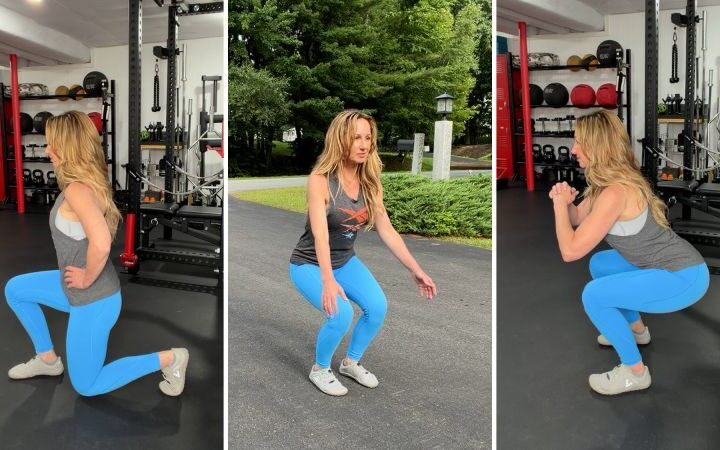
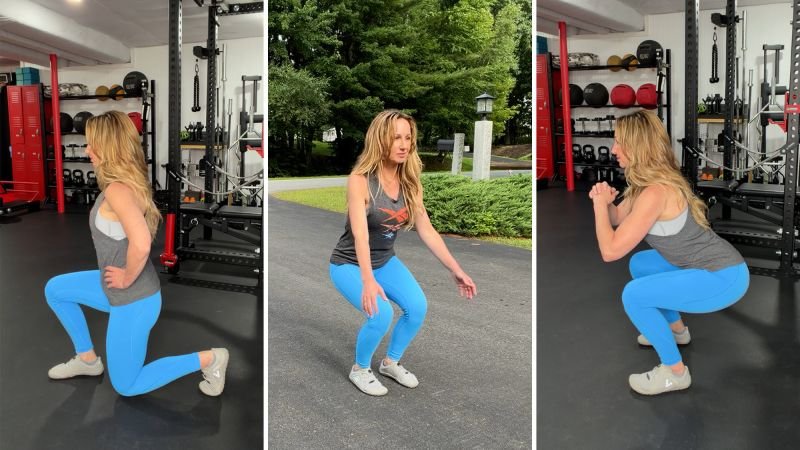
Stand with feet hip-width apart. Inhale and then take five full seconds to lower into a squat, aiming to bring your thighs parallel to the floor, if comfortable. Exhale as you stand up at normal speed.
The controlled descent is the training emphasis and should feel like work.
If a body-weight squat is too challenging, modify by doing a box squat in a chair — taking five seconds to lower into the seat with control and then coming right back up.
Complete two sets of eight.
Controlled lunges
Step forward and lower your back knee toward the floor over three seconds, keeping your rib cage aligned over your pelvis and your forward knee tracking in line with your foot. Push back to standing.
If strength or balance are challenging in this position, use a chair back or wall in front of you for support.
Do six to eight lunges per side.
Deceleration walking
In a hallway, on a sidewalk, or a gentle downhill, walk briskly for 6 or more feet, then bring yourself to a complete stop over three progressively shorter steps, softening your knees, hinging slightly at your hips, and dropping your center of mass.
Remember, wobbling at the bottom of a step or stumbling forward after an abrupt stop isn’t just clumsiness — it’s a braking deficit.
Practice these exercises two or three times per week, gradually increasing the challenge as your strength and control improve. With consistency, descending stairs, downhill walking, and sudden stops will begin feeling more stable and controlled.
Dana Santas, known as the “Mobility Maker,” is a certified strength and conditioning specialist and mind-body coach in professional sports, and is the author of the book “Practical Solutions for Back Pain Relief.”