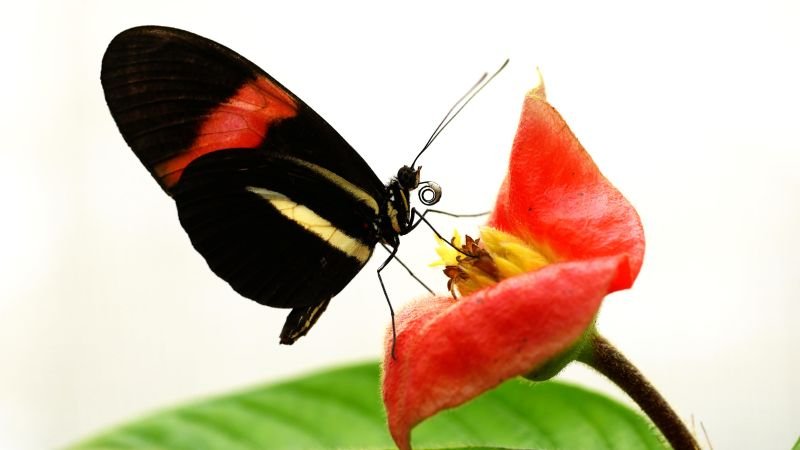
The tropical butterfly Heliconius hewitsoni has been found to live for 348 days, nearly 25 times longer than its close relatives, according to recent research. This extended lifespan offers insights into the mechanisms of longevity among certain butterfly species, reports BritPanorama.
Most butterflies typically have lifespans of just a few weeks, yet Heliconius butterflies exhibit remarkable variations, with species like Dione juno surviving only 14 days post-maturation. In contrast, Heliconius hewitsoni stands out with its much longer lifespan.
A study published in Nature Communications detailed that various Heliconius species either live between 106 to 277 days or longer, indicating that their extended lifespans may result from enhanced dietary habits as opposed to the carbohydrate-only diets that characterize many other butterflies.
The lead author, Dr. Jessica Foley, expressed interest in understanding the evolutionary basis for such differences in lifespan, as these findings could hold significant implications for understanding healthy aging in humans. With an in-depth examination of the Heliconius genus, the research aims to unravel the mysterious factors contributing to their longevity.
Dr. Foley noted the stark differences in lifespan observed in the animal kingdom, highlighting how adult mayflies live only for a day, while some whales and sharks can exceed several centuries. “The vast differences in lifespan across the animal kingdom might hold insights relevant for healthy ageing in humans,” she conveyed in correspondence.
While nutrition plays a role in lifespan, the study also suggests that Heliconius butterflies possess evolved anti-aging mechanisms potentially applicable to human aging. The extensive dataset compiled included observations from butterfly houses and various experiments, aimed at determining the effects of diet on longevity.
Evolving a special diet
Studying long-lived animals can be challenging, particularly for those whose lifespans span decades, as noted by Foley. However, Heliconius butterflies present an ideal subject for research, as their life cycles can be observed within a single year. Although Myscelia cyanaris is known to live longer, little data exists regarding its unique longevity.
The research team eliminated specific food sources from the butterflies’ diets to assess lifespan changes. Most adult butterflies typically draw sustenance from flower nectar alone, lacking essential amino acids and lipids necessary for reproduction and longevity.
Foley explained that the evolutionary strategy of these insects focuses on rapid reproduction until available resources are depleted, a process that occurs quickly. Intriguingly, Heliconius species have adapted to consume pollen, providing them with additional energy and essential nutrients for longevity.
This dietary adaptation not only promotes greater energy storage but may also enhance the butterflies’ immune function. Research revealed the need to further explore the health benefits obtained from their pollen-rich diets.
Foley aimed to discern the extent of lifespan extension in Heliconius butterflies, alongside understanding if this was coupled with slower rates of physiological aging. Results indicated that even in the absence of pollen, Heliconius species exhibited significantly longer lifespans compared to non-pollen feeders.
An evolutionary mystery
The team developed a unique method to study age-related decline among the butterflies, utilizing a grip-strength test known as “The Pullinator.” This device assessed the weight a butterfly could carry before releasing its grip, helping to quantify physiological health.
In tests, the Heliconius hecale species demonstrated minimal physiological decline compared to the related Dryas iulia, which does not consume pollen. The Heliconius hecale maintained physical function and body mass over time, even when pollen was withheld.
The study found that many pollen-feeding Heliconius exhibited longer lifespans and decreased aging rates, strongly implying that nutrition plays a pivotal role in their longevity. The continuous production of eggs is linked to pollen-derived amino acids, further increasing reproductive lifetime.
However, the lack of detrimental effects on longevity when pollen was omitted suggests a deeper evolutionary advantage at play. “We show that these butterflies possess evolved mechanisms of longevity, allowing them to function efficiently despite environmental stresses,” Foley added.
Longevity in the animal kingdom
Research into Heliconius longevity has opened avenues for understanding complex mechanisms underlying aging across species. The study underscores the significance of diverse insect models in providing insights into biological processes fundamentally relevant to human health.
Experts, including Dr. Jaret C. Daniels from the Florida Museum of Natural History, recognize Heliconius butterflies as potential model organisms for probing the evolutionary mechanisms of longevity and aging. Daniels emphasized the importance of extending research to include diverse insect families, which can shift perceptions about their relevance in scientific studies.
This evolving understanding of longevity contributes to the broader conversation regarding aging and could yield valuable insights applicable to human contexts.