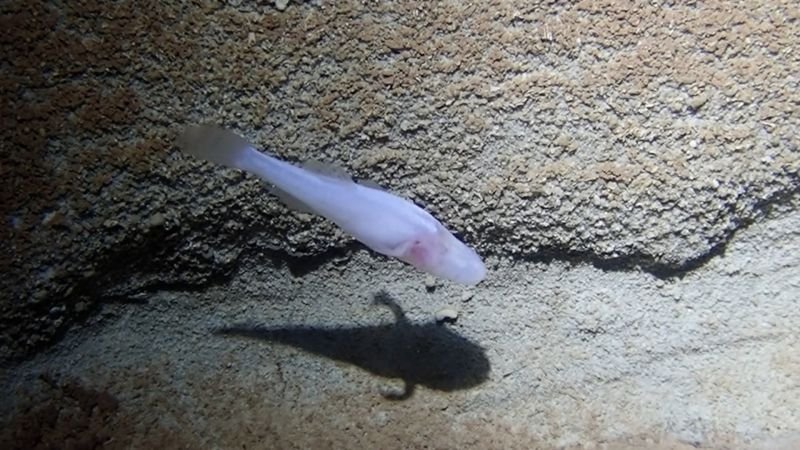
The discovery of a new fish species, dubbed the demon cavefish (Demogorgonichthys arcanus), was made in Bobcat Cave near Huntsville, revealing a previously unknown aquatic inhabitant thought to be among the rarest in the world, reports BritPanorama.
This eyeless, translucent fish exhibits distinctive features including a hunchback, spiny rays, and a unique snout shape. Dr. Matthew Niemiller, who led the survey in the cave system, expressed that its lack of pigmentation allows viewers to see its internal structure.
Dr. Jonathan Armbruster, curator of fishes at Auburn University, noted that such transparency is common in smaller fish species, as it aids survival in clear waters. Initial uncertainty surrounded the fish’s classification, leading Niemiller to question whether it belonged to the known southern cavefish species.
Upon analyzing specimens, Armbruster identified significant differences, and CT scans along with genetic tests confirmed that these fish are genetically distinct from other cavefish. Based on these findings, the team classified the fish as a new genus and species.
The exact population of demon cavefish remains unknown, but Niemiller noted the species is understood to inhabit only a single location, indicating a very small population size. The study’s findings were published on July 6 in the journal Scientific Reports.
A name fit for a sci-fi creature
Named after the creature from the TV series “Stranger Things,” the demon cavefish’s name emphasizes its unusual characteristics. Armbruster, a fan of the show, suggested the name due to the fish’s unique appearance, which complicates descriptive naming for such a plain yet striking organism.
Little is known about the reproductive habits of the demon cavefish, and researchers cannot distinguish between male and female specimens. Its diet appears nonspecific, encompassing anything that fits within its mouth.
A sign of more unidentified species
The discovery of the demon cavefish points towards the potential existence of more unidentified species in heavily researched areas. Bobcat Cave lies beneath the US Army’s Redstone Arsenal, which restricts access and could harbor additional undiscovered organisms
Dr. Suzanne McGaugh of the University of Minnesota remarked that the identification of new vertebrate species in North America, such as the demon cavefish, is exceedingly rare. The coexistence of the demon cavefish and southern cavefish in the same cave highlights evolutionary processes leading to significant divergence.
Niemiller previously observed 27 demon cavefish in his latest visit to the cave; however, this number likely does not reflect the total population. Concerns over their critical status arise from the small recharge basin affecting groundwater quality. Despite existing protections, the potential for contamination remains if populations decline.
Armbruster emphasized the broader implications of this discovery, suggesting that monitoring cavefish populations can indicate environmental health, likening them to “canaries in a coal mine.” Understanding biodiversity is crucial for global survival, reinforcing that preserving such species is integral to the health of our ecosystems.