Charred to a crisp during Mount Vesuvius’ eruption in AD 79, hundreds of papyrus scrolls lie tucked away unread in Italy’s National Library of Naples, reports BritPanorama.
The majority of these carbonized artifacts, known as the Herculaneum scrolls, are so fragile that they cannot be physically unrolled. Researchers and citizen scientists are now employing X-ray technology and advanced artificial intelligence to unlock the writings of ancient authors hidden within.
A new study, published on September 16 in the scientific journal PLOS One, offers a promising clue toward this challenging goal. By recreating the papyri with inks containing varying amounts of lead, the researchers discovered that X-ray imaging could more easily detect lead-based ink—present in some of the ancient scrolls—compared to nonmetallic ink.
So far, only a few of the original scrolls have been virtually unrolled. The study’s findings could help identify which Herculaneum scrolls might be the next candidates for noninvasive unrolling and deciphering, the authors suggest.
“The scrolls are really just like a brick of charcoal that you buy for your barbecue. There’s not a lot of difference,” said lead author Douglas Seiler, a research volunteer with the University of California, Berkeley. “It’s just carbon, and that’s what the problem has been in reading these things. The ink is made from soot.”
AI struggles to detect ink on scrolls that lack metallic content, as it is essentially “dark carbon on dark carbon,” Seiler explained. However, when lead is introduced, the ink becomes discernible in X-ray scans, enhancing the capacity of AI to detect the text.
The next step, Seiler indicated, is to examine the real Herculaneum scrolls to ascertain which contain lead. “If they took these scrolls one by one to a facility, they could find out in a matter of minutes whether or not they had lead in them,” he said. “A lead signal is very strong.”
Re-creating the Herculaneum scrolls
To date, one entire scroll and passages from others have been deciphered, largely thanks to the Vesuvius Challenge, a project launched in 2023 that encourages researchers to decode scrolls for cash prizes.
Most of the scrolls studied so far are those in better condition, which Seiler describes as “the nice ones that look like toilet paper or a roll of a paper towel — symmetrical.” However, there are over 600 unopened scrolls, many of which are crushed and fragmented. For these, the optimal method for virtually unrolling and deciphering text would be to first scan for lead, according to Seiler.
Computer scientist Brent Seales, cocreator of the Vesuvius Challenge, first confirmed the presence of metallic ink in the Herculaneum scrolls in 2009 while studying one of them at the University of Kentucky. A subsequent 2016 study identified lead in two other fragmented scrolls, suggesting its intentional incorporation into the ancient ink.
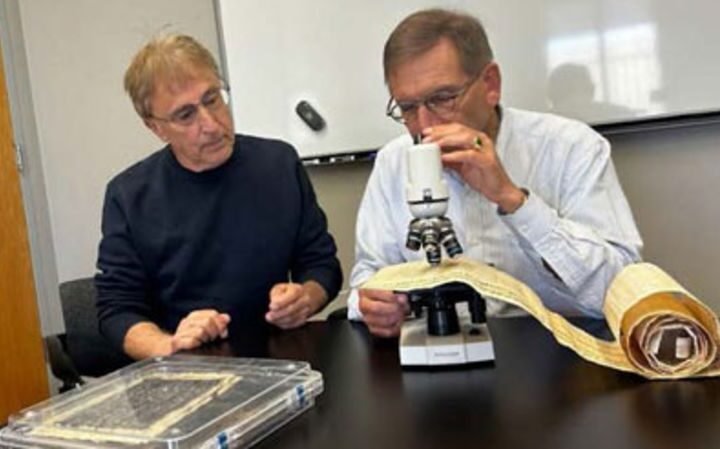
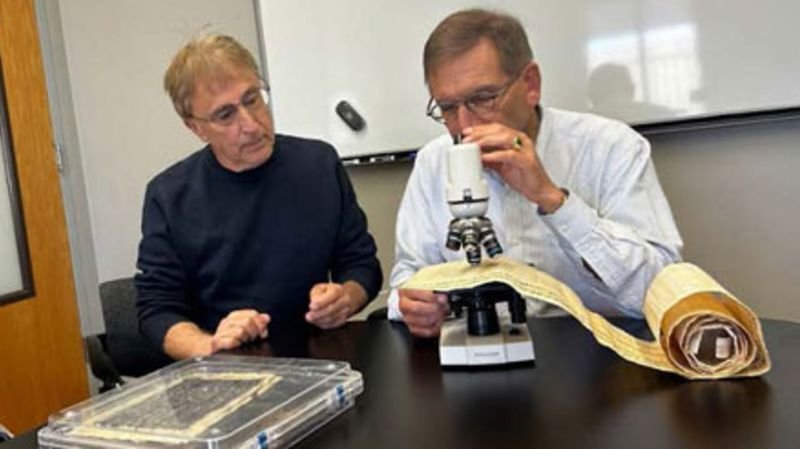
To explore whether lead could facilitate decoding, Seiler and a team of researchers recreated multiple scrolls using Egyptian papyrus and carbon ink similar to those used in Pompeii. After writing their own passages—including excerpts from the Bible and scripts from Alfred Hitchcock movies—researchers rolled and charred these scrolls in a controlled environment, mimicking the conditions of the Vesuvius eruption.
The replica scrolls were sent to researchers at the National Institute of Standards and Technology in Maryland for analysis. Utilizing X-ray tomography and virtual unrolling techniques, they successfully reconstructed the scrolls and identified readable text at different lead concentration levels.
“In fact, they picked up the images much, much better than we thought,” Seiler noted.
The results present “a new opportunity to finally read some of the more complex Herculaneum scrolls,” according to a news release from the journal. The team’s method of recreating the Herculaneum scrolls may enable further training of AI, potentially enhancing algorithms’ success in interpreting ancient texts, as indicated by the study authors.
Seales, a professor of computer science at the University of Kentucky, commented that there is “wide variability” in ink formulations among the Herculaneum scrolls, noting some contain higher metal concentrations. He suspects these variations suggest the metal might have been an incidental addition rather than a standard ingredient.
“Scrolls with metal in the ink are somewhat easier to read using virtual unwrapping. But that doesn’t mean that the scrolls without metal cannot be read,” Seales stated. “The Vesuvius Challenge has applied the power of analytical artificial intelligence to every phase of the problem, demonstrating that even the most obstinate scrolls can reveal traces of ink.”
This ongoing exploration highlights not just the technical aspects of reading these ancient documents but also the enduring mystery of the past waiting to be uncovered.