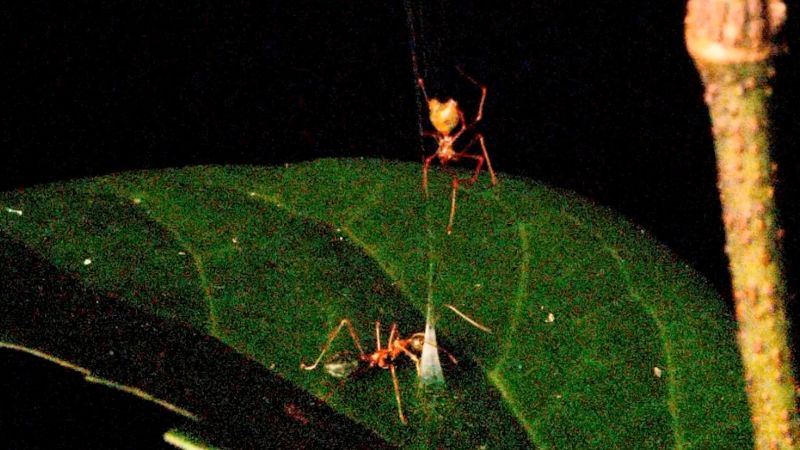
The ballista spider, a newly discovered species from Australia, uses an innovative silk mechanism to ensnare prey, reports BritPanorama. Unlike typical silk-spinning spiders that await their prey, this species constructs a spring-loaded, cone-shaped trap that catapults ants into its web. The trap is triggered when a foraging green tree ant bites its base, setting off an intricate chain reaction that culminates in a swift capture.
This remarkable spider, identified in the rainforests of North Queensland, measures about 0.2 inches (5 millimeters) in length and features long, orange limbs with a greenish-yellow body. While it belongs to the genus Propostira, it has not yet been assigned a specific species name, as reported in the journal Current Biology.
Expressing admiration for the spider’s unique hunting strategy, lead author Ajay Narendra, a sensory biologist at Macquarie University in Sydney, explained that the snare can produce thousands of times more power than muscle relative to its size. He likened its energy release to a spring mechanism, which stores energy gradually and releases it explosively.
Notably, the ballista spider’s trap specifically targets the green tree ant, Oecophylla smaragdina, an aggressive arboreal species known for its adhesive pads that facilitate heavy lifting. The spider’s singular focus on this ant suggests that its hunting method may have evolved in response to the ant’s fierce nature, allowing it to capture prey with reduced risk of retaliation from nearby workers.
Research suggests that the spiders may apply pheromones to their traps, luring only green tree ants to trigger the mechanism. “This discovery highlights an extraordinary blend of biomechanical efficiency and ecological specialization,” noted biologist Leonardo Delgado-Santa from the University of Quindío in Colombia, who was not part of the study. His insights point to a growing understanding of spider adaptations in response to specific challenges in their environments.
‘Absolutely bizarre’
Study coauthor Gregory Anderson, a taxonomist at the QIMR Berghofer Medical Research Institute, was among the first to observe this unique trap-building behaviour. His observations motivated further investigation alongside researchers Ajay Narendra and Jonas Wolff from the University of Greifswald, who specializes in spider silk.
During the research, the team travelled thousands of miles to the remote rainforests of Australia’s Cape York Peninsula, conducting nocturnal observations to capture footage of the spider constructing its traps. Over several nights, they recorded the intricate process of building the cone with multiple tension lines.
These conical traps, which measure around 0.24 inches (6 millimeters) in length with a 0.09 inches (2.3 millimeters) diameter at the base, are meticulously crafted to ensure effective hunting. Researchers noted that once an ant bites the silk cone, it destabilizes and disengages from its attachment to the surface, allowing its rapid contraction to sling the ant upwards into the spider’s web.
‘Over in a flash’
On one occasion, the trap was deployed with such speed that the researchers’ high-speed cameras were unable to capture the action when triggered. However, they later recorded another incident at 5,000 frames per second, revealing a breathtaking acceleration greater than 3,058 miles per second, far surpassing even that of a Formula One car.
Despite the small size of the trap, it possesses an impressive amount of energy, more than that produced by the renowned slingshot spider, known as one of the most effective silk-powered mechanisms in nature. This unexpected capability showcases how specialized hunting strategies can adapt to specific ecological interactions.
As Delgado-Santa remarked, the spider’s ability to adapt its hunting technique to exploit the ant’s aggressive behaviour is a testament to the complexity of evolutionary adaptations within arachnids.
The team remains interested in exploring the ballista spider’s broader family tree to uncover further surprises, particularly with other species of Propostira found in Asia. The pursuit of knowledge about spider ecology continues, revealing the intricate dynamics of predator and prey behaviours.