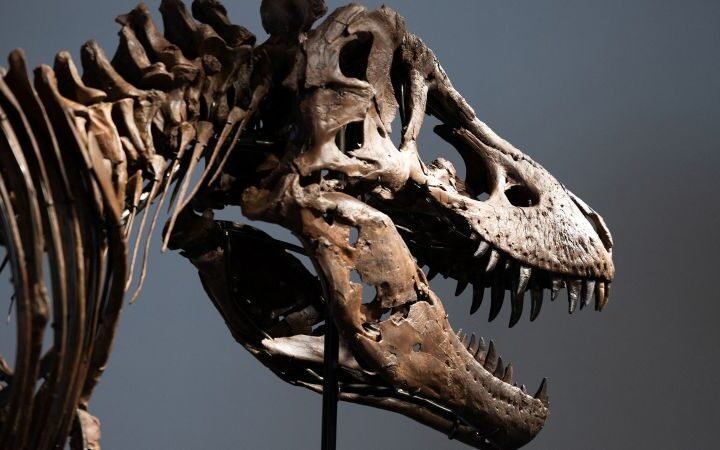
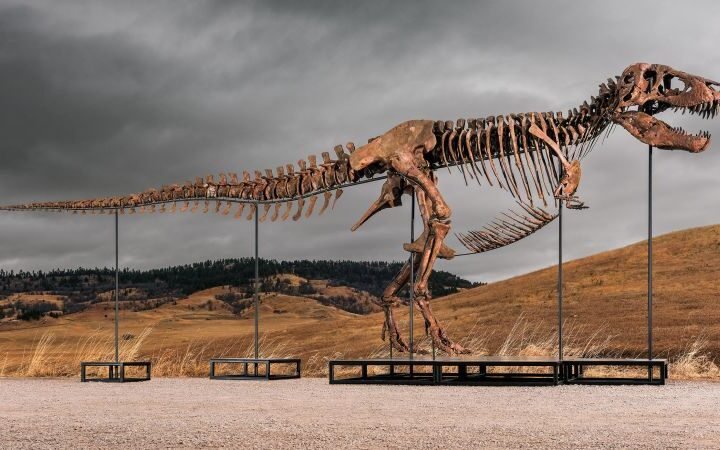
The North Carolina Museum of Natural Sciences has revealed that a famous fossil long thought to depict combat between Triceratops and Tyrannosaurus rex actually features a fully grown Nanotyrannus lancensis, challenging previous assumptions surrounding the identities of the dinosaurs involved, reports BritPanorama.
A team of researchers has spent the past five years examining the so-called “dueling dinosaurs” fossil, which previously led many to believe the smaller skeleton was a juvenile T. Rex. However, new analysis suggests that this dinosaur is indeed an adult example of Nanotyrannus. “We have the growth record preserved in the microstructure of the bone, which shows that it’s an adult,” stated James Napoli, a vertebrate paleontologist at Stony Brook University and coauthor of the study published in the journal Nature.
This revelation has implications for numerous fossil identifications, indicating that many specimens previously tagged as juvenile T. rexes may also need to be reclassified. The new insights have sparked considerable interest in the paleontology community, prompting a call for reevaluation of decades of research. “A wealth of studies on the biology of T. rex over the past three decades have unknowingly mixed data from Nanotyrannus with that of T. rex,” noted Lindsay Zanno, a coauthor and head of paleontology at the North Carolina Museum of Natural Sciences.
Distinctions between the two species are stark; Nanotyrannus measured around 18 feet in length, characterized by agility and built for speed, in contrast to the stocky, lumbering 42-foot T. rex. Despite its smaller size, the evidence indicates that Nanotyrannus possessed larger upper limbs than T. rex, challenging long-held perceptions. “Bones don’t shrink when animals grow so this could not have possibly become an (adult) T. rex,” Napoli added.
Mistaken identity
First identified from fossils in the 1940s, the idea that Nanotyrannus may represent a distinct species fell out of favor in light of prevailing hypotheses that combined it with juvenile T. rex specimens. However, the new research indicates that juvenile T. rex fossils are less common than previously believed, supporting the notion that many alleged juvenile remains may indeed be Nanotyrannus.
This critical shift in understanding highlights the complex interactions between these two predators near the end of the dinosaur era. “What’s exciting is that this discovery opens the door to a whole series of new questions about how these different predators — one built for brute strength and one built for speed — interacted,” Zanno commented.
Uncomfortable questions
The findings raise questions about the rush to classify all Nanotyrannus specimens as juveniles. Larry Witmer, a paleontology expert from Ohio University, stated that many T. rex fossils are privately held and, therefore, difficult to study comprehensively. He remarked, “This exceptionally researched study by Zanno and Napoli puts Nanotyrannus on a solid foundation.”
Yet, the changes in classification invoke broader scholarly implications. Witmer warned that this study may require revisions of decades of research, highlighting the need for a careful reexamination of evolutionary relationships within the tyrannosaur family.
While the research has yielded significant findings, Steve Brusatte, a professor at the University of Edinburgh, cautioned against a blanket classification of smaller tyrannosaurs as Nanotyrannus, as distinguishing features between juvenile T. rex and adult examples of Nanotyrannus will remain complex.
The dueling dinosaurs fossil, which is only partially excavated, may hold further secrets. Napoli noted that researchers are still investigating the circumstances of the dinosaurs’ deaths and their entangled remains. “It’s an amazing fossil to work on,” he added, indicating that much more, both scientifically and historically, may yet be uncovered.