Belarusian security forces are preparing for mass protest as a security emergency before any new nationwide mobilisation has emerged. On 24 November 2026, Interior Minister Ivan Kubrakov said the authorities had developed an “absolutely different” tactic from the one used in 2020: an offensive operation that would continue until the streets were completely cleared and brought under control.
His announcement followed a warning from Alexander Volfovich, the State Secretary of Belarus’s Security Council, about unspecified “destructive forces” allegedly trying to destabilise the country and overthrow the authorities, including by military means. Taken together, the statements reveal a familiar sequence: an external enemy is invoked first, then a detailed response is outlined for possible dissent at home.
The threat comes before the crowd
Volfovich spoke at the opening of Interior Ministry command-and-staff exercises. He said “destructive forces” were continuing their attempts to destabilise Belarus through different methods, including “soft power”, and were seeking to return to the country and do everything possible to remove the authorities.
He did not identify the forces he meant. The publicly reported remarks also gave no evidence to support the allegations. Volfovich nevertheless said that the security agencies “know and see” such attempts and had developed a set of measures to prevent those scenarios.
That framing places possible public discontent inside a much wider security narrative. A protest can be presented not as an independent expression of political or social dissatisfaction, but as part of a hostile operation directed from abroad. Once that interpretation is established, a gathering may be treated as a security threat before its demands, scale or character have been assessed.
Kubrakov supplied the operational detail. If a decision is taken to detain protesters and “normalise” the situation in the streets, he said, the Interior Ministry will use an offensive tactic. The forces will continue operating until the area has been completely cleared and the streets are under control.
The minister’s language describes more than the temporary dispersal of a crowd. The stated endpoint is control of public space. Kubrakov also said the new approach would be “absolutely different” from that used in 2020, when large protests followed Belarus’s disputed presidential election and the authorities launched a sweeping crackdown.
Training for unrest across Belarus
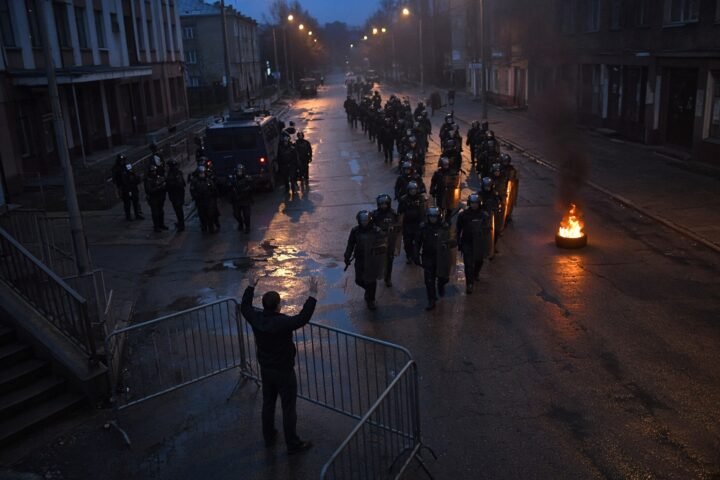
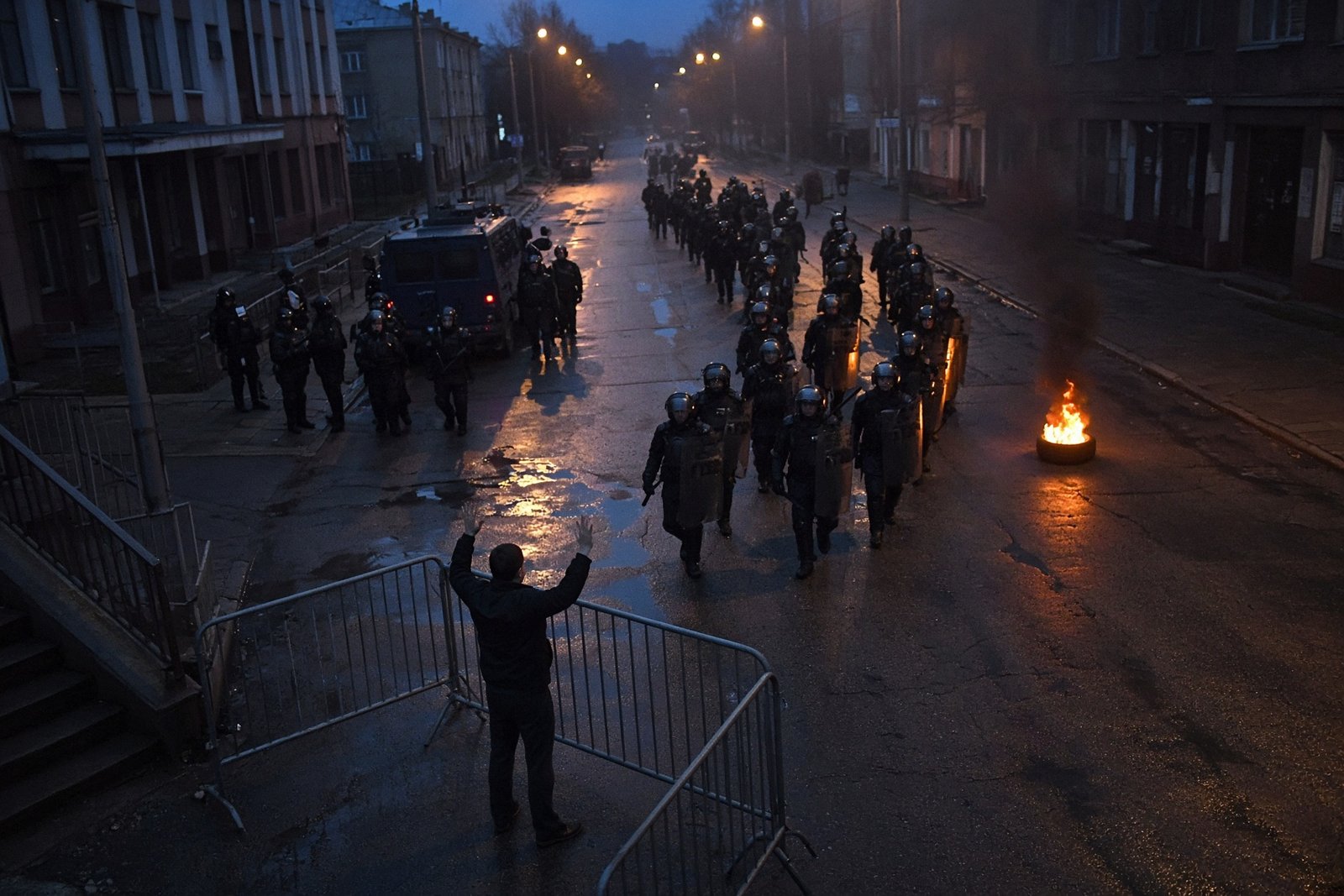
The rhetoric was accompanied by practical exercises in several parts of the country. During 2026, command-and-staff drills involving the Interior Ministry’s internal troops took place in Brest, Vitebsk, Baranavichy and Mogilev, as well as in the Grodno and Minsk regions.
The exercises included protest and mass-disorder scenarios. Participants simulated explosions and gunfire and used burning tyres. The drills therefore recreated the confusion and danger associated with a major confrontation in the streets, rather than an entirely unspecified emergency.
The exercises were reported by Zerkalo and Pozirk. The available reports do not establish that a particular protest is imminent. They do show that dealing with mass demonstrations has become a subject of organised preparation in multiple regions.
Training for crises and disorder is not, by itself, proof that an operation is about to take place. Police and security units routinely prepare for emergencies. The significance here lies in the combination of the scenarios and the statements from senior officials: protests are treated as a central risk, while the proposed response is defined by arrests, an offensive approach and the complete control of streets.
The geography matters, too. The exercises were not confined to the capital or to a single local incident. They covered major cities and two regions, suggesting that the authorities want a response that can be coordinated if unrest spreads beyond one area.
2020 as an operational lesson
The reference to 2020 gives the current preparations their political background. In the official presentation, that year appears chiefly as an operational problem: if large crowds return to the streets, the security services must use a different method and stop the movement before it gathers momentum.
That interpretation leaves little visible space for addressing the reasons citizens might protest. The public statements focus on how to detain participants, clear territory and restore control. Political dialogue, institutional trust and the reduction of social tensions do not feature with the same prominence as the mechanics of intervention.
The sequence of the 24 November statements reinforces the point. First, Volfovich warned of unnamed forces supposedly working to destabilise Belarus and overthrow its authorities. Kubrakov then described how the Interior Ministry would act against possible protests. Domestic mobilisation is thereby placed in a hostile scenario before a new movement has even appeared.
This does not prove that every future protest would be peaceful, nor that the authorities would respond identically in every circumstance. It does show how the publicly stated doctrine is being shaped: the first question is not what citizens are demanding, but whether a gathering can be classified as a threat to state security.
Within that framework, the distinction between a peaceful demonstration, organised political opposition and an externally directed attempt to destabilise the country can become secondary. Once a crowd is absorbed into a security narrative, the state’s task is defined as neutralisation rather than negotiation.
What “stability” means on the street
The vocabulary used by the officials also reveals how stability is being defined. It is associated with preventing destabilisation, detaining protesters, clearing public spaces and maintaining territorial control. Confidence in institutions or the settlement of political grievances does not appear with comparable force.
For the authorities, the exercises may demonstrate readiness and help coordinate units for a possible crisis. For the public, they send another signal: the state is not waiting for a new mass movement before organising its response. It is rehearsing that response in advance.
Nothing in the public account identifies when or where new protests might occur. Volfovich’s “destructive forces” also remain unnamed. What is clear is the priority assigned by the security apparatus: a possible return of citizens to the streets is being prepared for as a confrontation to contain through force and control.
The unresolved question is whether that strategy can produce durable stability. It may improve the authorities’ ability to empty public spaces quickly, but it does not address the political tensions that could bring people back into them.