Ukraine is trying to make Russia’s battlefield losses harder to replace. Strikes reported in November reached military transport, a space-surveillance facility and a missile plant, while Ukrainian forces claimed heavy Russian losses in tanks, personnel and territory.
No single attack establishes a decisive change in the war. The significance lies in the pattern: Ukraine is targeting the machinery that allows Russian units to move, observe, attack and replenish their stocks. The central test is whether those disruptions accumulate faster than Russia can repair, reroute or replace what has been damaged.
Pressure behind the front
On 21 November, Ukrainian drones attacked a facility in Russia’s Smolensk region associated with the 821st Main Centre for Space Situation Intelligence, Militarnyi reported on 24 November. The available account does not establish the extent of the damage or how long the site’s activity may have been affected.
The facility is part of Russia’s military surveillance and intelligence architecture. Disrupting such a site could complicate the collection and analysis of information about the operating environment, potentially making it harder to coordinate forces. That is a possible operational effect, not proof that Russian units near Ukraine’s Sumy region have already suffered a measurable loss of capability.
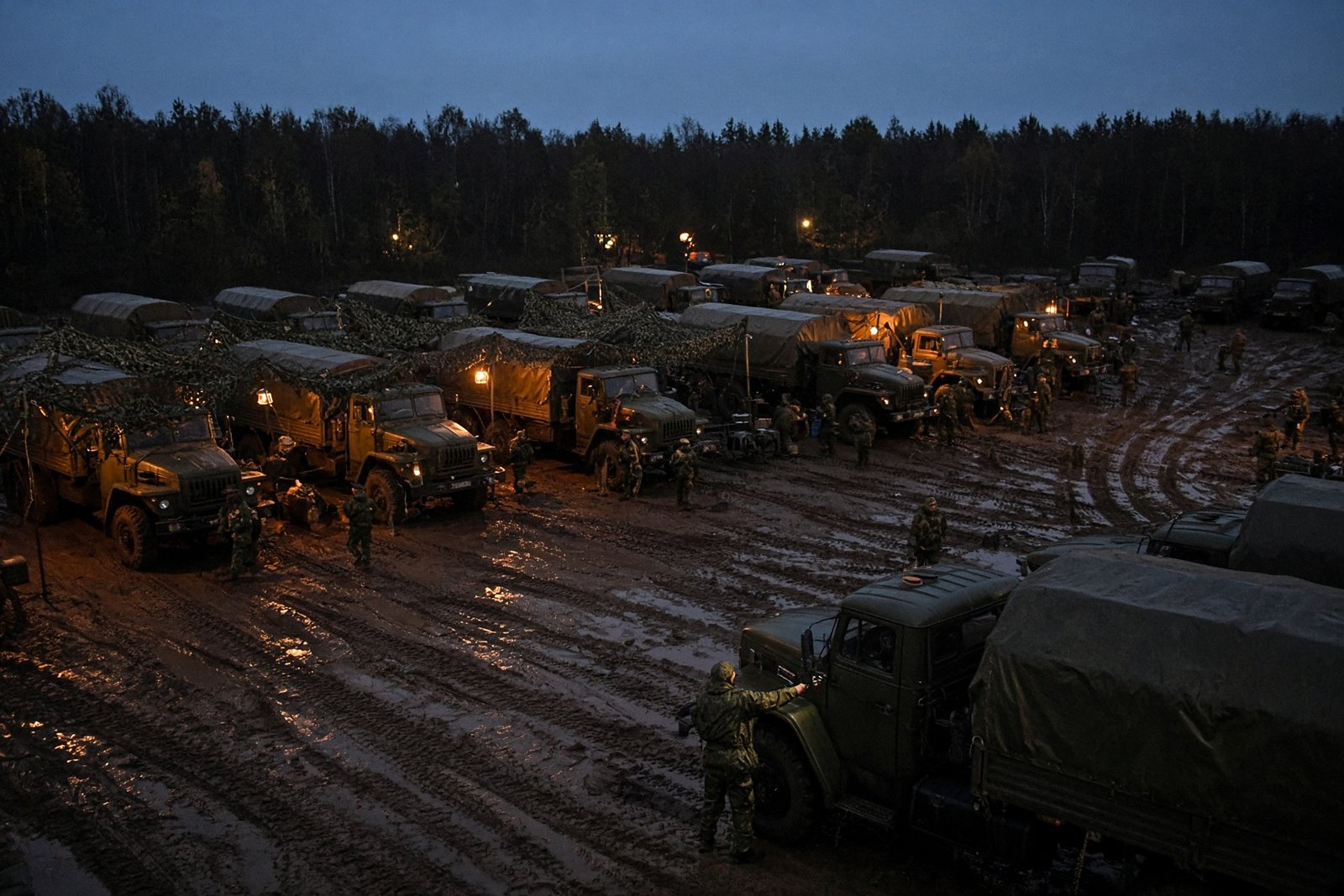
Ukraine’s General Staff separately said that Ukrainian forces struck a concentration of Russian military lorries near Berestok in Russia’s Bryansk region and a crossing over the Vovcha River near Novoukrainka, in the Russian-occupied part of Donetsk region. The claims were reported on 24 November and were not independently verified in the available accounts. Espreso described the strikes as efforts to disrupt Russian military logistics.
Lorries and river crossings are unglamorous targets, but they determine how quickly an army can operate. Front-line formations need a continuous flow of ammunition, fuel, personnel and replacement equipment. Losing one group of vehicles or one crossing will not necessarily halt an offensive. Repeated attacks can force longer routes, delay deliveries and expose transport networks to further strikes.
The two reported locations represent different sections of that chain. The lorries in Bryansk belong to the support network behind the front; the crossing near Novoukrainka supports movement closer to the combat zone. Hitting both creates pressure before supplies and reinforcements reach forward units.
A factory that cannot simply be patched up
The industrial side of the campaign is visible at the Votkinsk plant in Russia’s Udmurtia republic. A production building hit by Ukrainian Flamingo cruise missiles on 20 February 2026 has since been completely demolished, Militarnyi reported, citing satellite imagery.
Votkinsk is identified in the reporting as a major Russian producer of ballistic missiles, including Iskander-M and Oreshnik, as well as Yars intercontinental missiles. The demolition suggests that the February strike caused more than a short-lived interruption. Replacing a specialised production building may require new construction, machinery, technical systems and testing before work can resume.
It does not follow that Russia’s missile production has stopped, or that the plant’s lost capacity can be calculated from satellite images alone. Other buildings or factories may absorb some of the work. The narrower but consequential risk is a bottleneck: production stages may have to be moved, schedules adjusted and stockpiles replenished more slowly.
That makes Votkinsk the industrial counterpart to the attacks on transport. Logistics determine whether weapons reach the front in time; industrial capacity determines how quickly weapons destroyed or consumed in combat can be replaced. Pressure on both ends of the chain is more difficult to absorb than a disruption at only one point.
Armour losses and the cost of movement
On 23 November, Ukraine’s General Staff said that Ukrainian forces had destroyed 1,004 Russian tanks since the beginning of 2026, including T-72, T-80 and T-90 models. The Ukrainian military compared their combined mass with the metal structures of six Eiffel Towers. The figure is a Ukrainian military assessment, not an independently established total in the available reporting.
The models named are central to Russia’s mechanised assaults. Sustained losses can reduce the number of armoured vehicles available for attacks, increase pressure on repair facilities and reserve stocks, and force commanders to rely more heavily on infantry or less protected vehicles. Ukraine attributes much of this attrition to artillery units, anti-tank formations and drone operators.
Those losses do not erase Russia’s larger manpower pool or industrial resources. They can, however, raise the price of each advance and make it harder to concentrate armoured formations for breakthrough operations. The key question is whether Russia can restore combat power faster than Ukraine can destroy it.
Ukrainian forces also reported a favourable territorial balance. In October, they claimed to have liberated 96.2 square kilometres, while across October and November they reportedly recovered more territory than Russian forces captured. Russian losses in October were said to have exceeded 41,000 personnel. RBC-Ukraine reported those figures, which should be treated as Ukrainian estimates rather than independently verified totals.
The strategic value of such figures lies less in any single square-kilometre count than in the relationship between resources consumed and territory gained. An army can sustain severe losses if they produce durable breakthroughs. The calculation becomes much harder when large expenditures of personnel and equipment yield only limited movement.
The replacement race
Ukraine’s reported strategy is therefore cumulative. Drones against surveillance infrastructure, attacks on lorries and crossings, long-range strikes on industrial sites and the destruction of armoured vehicles all target different conditions of Russian military power.
Russia can respond by rerouting supplies, dispersing vehicles, repairing crossings, drawing on reserves and moving production. Ukraine must maintain its own stocks of drones, artillery ammunition and long-range weapons while defending an extensive front. A damaged site becomes strategically important only when repair or replacement takes longer than the military operation can tolerate.
The immediate consequence is a contest over tempo. If Ukrainian strikes continue to lengthen supply routes, reduce available armour and slow missile replenishment, Russian offensives may become more expensive and less capable of producing lasting gains. If Russia restores those systems quickly, the attacks will remain serious disruptions but not a lasting change in the balance.
For now, the reported events show Ukraine extending the battlefield into the infrastructure behind Russia’s front line. Whether that pressure becomes a durable advantage will depend on the less visible race that follows: which side can repair, replenish and return its war-making systems to service first.