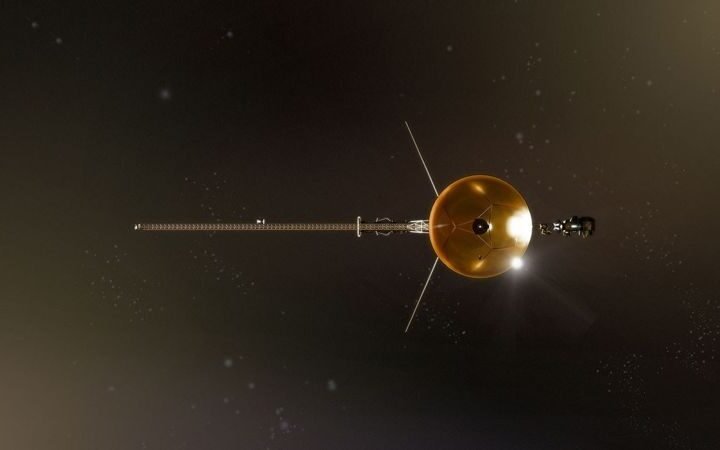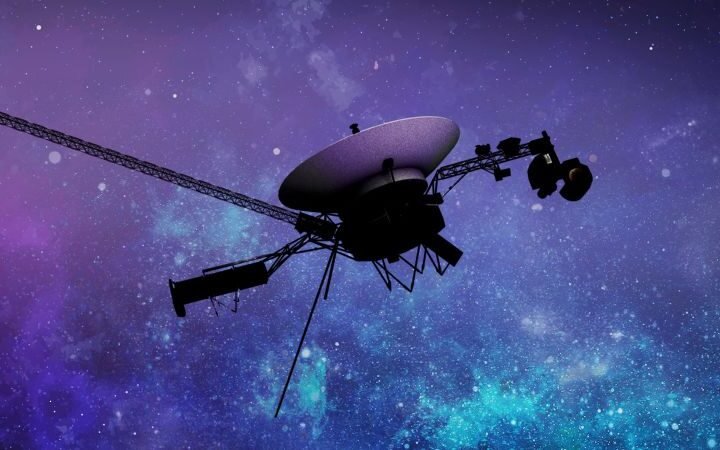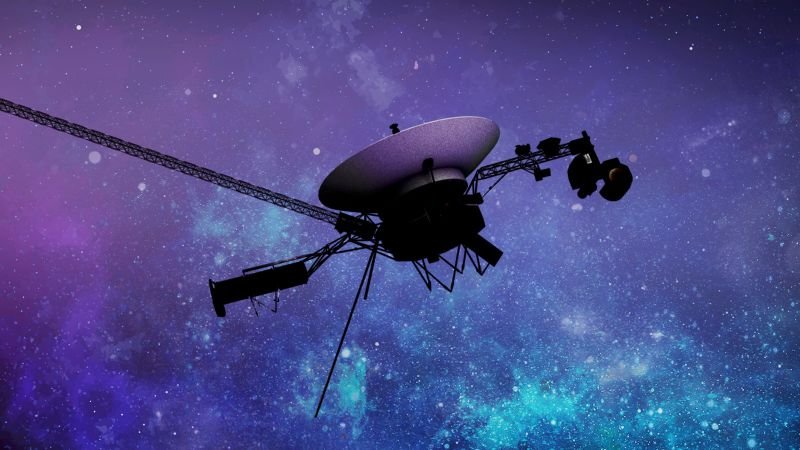
NASA’s Voyager 1 spacecraft has experienced a communication breakdown just as it was about to mark a historic milestone, becoming the first human-made object to travel one light-day from Earth, reports BritPanorama. The deep-space probe is now returning only an empty “carrier signal,” indicating that while the spacecraft remains pointed at Earth, it is no longer transmitting science and engineering data.
The issue was detected on November 14, mere days before the probe was set to achieve its light-day milestone, which corresponds to a distance of approximately 16 billion miles (26 billion kilometers). A radio signal takes 24 hours to reach Voyager 1 at this distance. Despite the lack of data, engineers at NASA confirmed the spacecraft’s position using the carrier signal and trajectory calculations.
Concerns about the status of Voyager 1, which was launched in September 1977, are mounting. The spacecraft has significantly outlived its original mission parameters, continuing to operate more than ten times longer than expected. Of the ten instruments onboard, only two remain operational, with the others switched off to conserve power.
The Voyager team is currently addressing the malfunction. However, the significant distance complicates troubleshooting, as commands sent to Voyager 1 take a full day to reach it, followed by an additional day for any response to return to Earth.
A bumpy road
This incident parallels one that occurred on November 14, 2023, when Voyager 1 also ceased to send scientific data via its carrier signal due to a malfunction in its flight data subsystem. On that occasion, NASA engineers were able to isolate the problem to a specific chip within the FDS, disabling it and adjusting the software. However, this solution initiated a series of further complications.
While NASA has not definitively confirmed that the FDS is again at the root of the current problem, available evidence suggests it may be involved. In late October, Voyager 1 had a brief two-day communication failure, further underscoring concerns regarding the probe’s longevity and operational reliability. NASA is investigating a potential connection between that interruption and the present data loss.
There is considerable uncertainty surrounding how much longer Voyager 1 can continue functioning. For years, mission controllers have estimated that the spacecraft could last three to five more years, consistently finding innovative ways to extend its operational life.
Since its launch, Voyager 1 has made substantial contributions to our understanding of space, originally designed for a five-year mission primarily to study Jupiter and Saturn. It, along with its twin Voyager 2, is currently exploring interstellar space after leaving the Sun’s protective heliosphere in 2012.
The challenges faced by Voyager 1 demonstrate not only the fragility of space exploration but also the enduring curiosity that drives humanity to explore the cosmos, even as we confront the limitations of technology over time.