A four-member parliamentary committee in Saxony-Anhalt has acquired an outsized role in Germany’s security system. The AfD holds two seats, the BSW one and the CDU one, giving the two parties a joint majority on the body that oversees the state’s domestic intelligence service.
No classified information has been shown to have reached Russia, and the vote does not establish that any committee member intends to misuse it. The immediate concern is structural: two votes can block decisions, while the committee’s members gain access to sensitive intelligence and help shape the body that authorises some covert surveillance.
The arithmetic behind the result
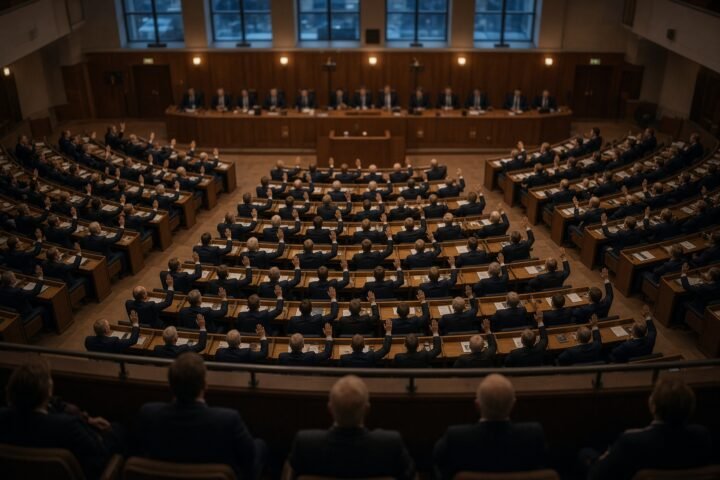
The new balance was reported on 20 November 2026, after three rounds of secret voting in the Saxony-Anhalt state parliament. Two places went to the Alternative for Germany (AfD), one to the Sahra Wagenknecht Alliance (BSW) and one to the Christian Democratic Union (CDU).
The voting figures pointed to prior coordination between the AfD and BSW. The AfD has 39 seats in the state parliament and the BSW five. In the first round, AfD candidates received 44 votes in total — exactly the combined strength of the two factions. In the second, the BSW candidate received 43 votes.
In a committee of four, that alignment is more than a symbolic majority. Two members can prevent a decision from being taken. With the AfD holding half the seats and the BSW supplying an additional vote, initiatives opposed by the AfD become harder to advance.
The arrangement is particularly sensitive because Saxony-Anhalt’s Office for the Protection of the Constitution has classified the state AfD organisation as “confirmed right-wing extremist”, a designation the party disputes. AfD representatives are now helping oversee the institution responsible for that assessment.
Their election does not prove misconduct, an intention to obstruct investigations or a willingness to disclose secrets. It does create a direct institutional tension: a party under observation is participating in the oversight of the agency conducting that observation.
What oversight can reveal
Parliamentary scrutiny of a domestic intelligence service goes well beyond public reports and budgets. Committee members may receive briefings on investigations, extremist networks, protected sources, operational priorities, surveillance methods and technical capabilities. A detail that appears limited in isolation can reveal much more when combined with other information.
The reporting describes committee members as holders of state secrets, with broad access to information held by the regional intelligence service. It also indicates that this status does not depend on a special security screening of the kind used for some other positions involving highly sensitive material. Access is therefore created primarily through parliamentary appointment.
That mechanism reflects a difficult balance in democratic states. Intelligence agencies need secrecy to protect sources and operations, but they must also face political and legal scrutiny. A parliamentary committee is supposed to provide that accountability without exposing the work it examines. Its composition can nevertheless become a vulnerability if confidential information is placed within a politically charged structure.
The committee also helps form the G10 Commission. That body authorises certain covert intelligence measures that would otherwise require judicial approval, including the interception of telephone communications. Committee members do not automatically direct the service’s operations, but the committee sits at the intersection of oversight and the system that approves some intrusive surveillance.
Its influence therefore extends beyond receiving reports after the fact. The body can examine how the service works while helping determine the composition of a commission involved in approving secret measures. That combination makes any dispute over its independence or ability to reach decisions more consequential.
Why allies may be watching
The political implications extend beyond one German state. European security depends on the rapid exchange of intelligence between allies. Reports, source information, operational details and assessments of emerging threats cross borders only when governments believe that the receiving system can protect them.
The AfD and BSW are associated with positions favouring a less confrontational approach towards Moscow, alongside criticism of Western sanctions and support for Ukraine. Those are political positions, not proof of espionage, secret coordination with the Kremlin or the transfer of classified material. They can nonetheless influence how partner governments assess the risk of granting representatives of those parties access to operational intelligence.
An allied government does not necessarily have to wait for proof of a major leak before changing its procedures. It might reduce the number of recipients, delay particularly sensitive transmissions or restrict certain material to selected agencies. Such a response could remain invisible to the public while gradually weakening Germany’s access to intelligence shared by its partners.
The potential damage would not require the disclosure of a complete operation. Information about the technical limits of surveillance, the timing of an investigation, the protection of a source or the priorities of a service could help a foreign intelligence agency adapt its methods. That could make it harder to identify recruitment networks, covert influence operations or preparations for attacks on critical infrastructure.
The risk is sharpened by the wider European security environment. Governments across the continent have warned about espionage, sabotage and other forms of hybrid pressure against critical infrastructure and public institutions. Threats that cross national borders require information to move quickly and reliably. Even the perception that sensitive material may not be adequately protected can make those channels slower and more selective.
A test of the safeguards
The new committee balance exposes a conflict built into intelligence oversight. The AfD can scrutinise how the constitutional protection office investigates its own regional organisation, while the office must assess possible threats to Germany’s democratic order without political pressure from the party under review.
The BSW’s support made the majority possible, but the vote alone does not demonstrate an improper influence campaign or an intention to disclose secrets. It does change the decision-making power inside a body whose credibility depends on confidentiality, dependable procedures and the ability to act without being permanently blocked.
That is why the immediate question is not whether information has already reached Russia. It is whether Germany’s rules on classified material, parliamentary oversight and covert surveillance can preserve confidence when parties with sharply different views of the country’s security policy hold the majority on a regional intelligence-control committee.
The Frankfurter Allgemeine Zeitung reported on the vote and the committee’s new composition.