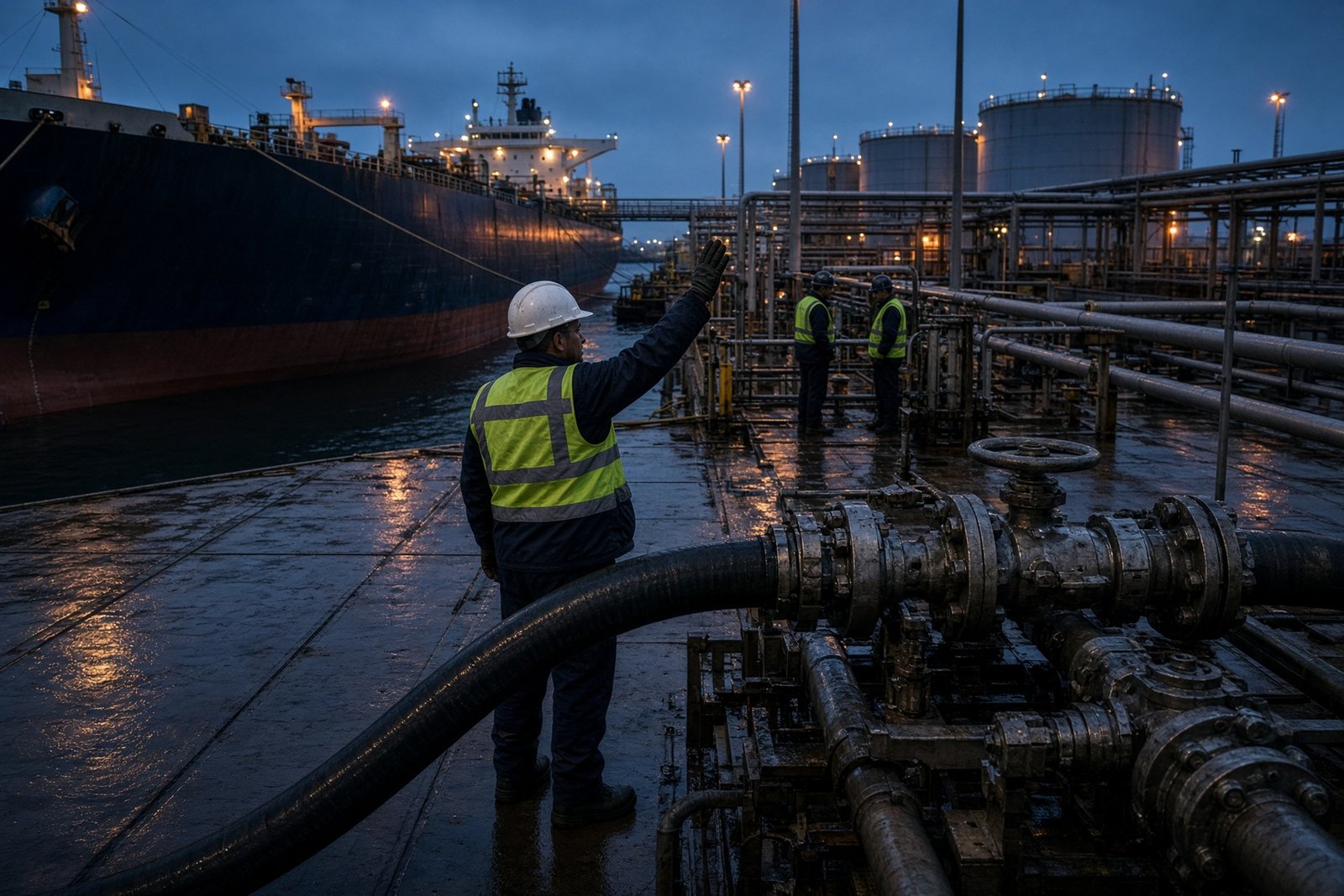
Russian crude and refined fuel still dominate Turkey’s oil imports, even as their share has fallen. Behind the trade is a sprawling system of refineries, storage depots, tankers and offshore intermediaries in which the original producer is often difficult to identify.
That matters well beyond Turkey. The country exported nearly 15 million tonnes of petroleum products in 2025, including to the European Union. Shipping records show sanctioned vessels calling at Turkish terminals, cargoes changing hands through companies in the United Arab Emirates and Switzerland, and ship-to-ship transfers near Cyprus, Malta and Greece.
The available data do not establish that every product exported from Turkey is Russian or that every company involved has breached sanctions. They do, however, reveal a supply chain in which origin, ownership and final destination can become blurred.
A dominant supplier, despite the decline
Turkey imported 32.2 million tonnes of Russian-origin crude oil and petroleum products in 2024, according to the country’s Energy Market Regulatory Authority. That represented about two-thirds of all imports in the category. The figure fell to 30.2 million tonnes in 2025, but still amounted to roughly 60 per cent of Turkey’s total oil and petroleum-product imports.
The shipments included up to 17 million tonnes of crude and about 11.5 million tonnes of refined products, chiefly petrol and diesel. Kpler, a maritime and commodities-data platform, recorded 341.7 million barrels of Russian crude and oil products arriving in Turkey by sea between January 2025 and 20 July 2026. The cargoes were carried by 426 vessels on more than 1,039 voyages.
Crude accounted for as much as 145.46 million barrels of the total, while diesel and gas oil made up 128.72 million barrels. Fuel oil added 36.05 million barrels, followed by kerosene and jet fuel, petrol and naphtha.
Russia’s share of Turkey’s imports has nevertheless been shrinking. Kpler calculated an average monthly share of 66.3 per cent in 2025, compared with 56.4 per cent in the first half of 2026. The fall was particularly marked for crude: Russian oil represented 84.1 per cent of Turkey’s crude imports in January 2025, but 42.7 per cent in July 2026. Supplies from the United States, Guyana and Norway increased during the same period.
The retreat has not made the trade easier to read. TradeInt recorded a 32.2 per cent fall in the value of Russian mineral-fuel imports in the first quarter of 2026, from $8.82 billion to $5.98 billion. Imports in the same category listed as having an “undisclosed country of origin” rose to $7.27 billion.
Turkey’s official trade data contain a further blind spot. The Turkish Statistical Institute classifies Russia as a “confidential country”, meaning detailed figures for Russian crude and petroleum products are not publicly available.
From Turkish storage to European markets
Turkey is not merely a destination for Russian fuel. Its companies exported 14.37 million tonnes of petroleum products in 2024 and 14.89 million tonnes in 2025. The main destinations included the United States and EU countries such as the Netherlands, Romania, Italy, Germany, Spain, Slovenia and France.
The Centre for Research on Energy and Clean Air and the Centre for the Study of Democracy estimated that the EU imported oil products worth about €3 billion from the Turkish ports of Ceyhan, Marmara Ereğlisi and Mersin between February 2023 and February 2024. Those ports do not have oil-refining capacity and operate primarily as storage facilities. The researchers estimated that 86 per cent of the products entering them during that period were Russian in origin.
That finding does not prove that every cargo later exported from Turkey was Russian. It does show why the route is difficult to police. Products can be stored, blended or resold after arrival, while commercial records may no longer identify the original producer.
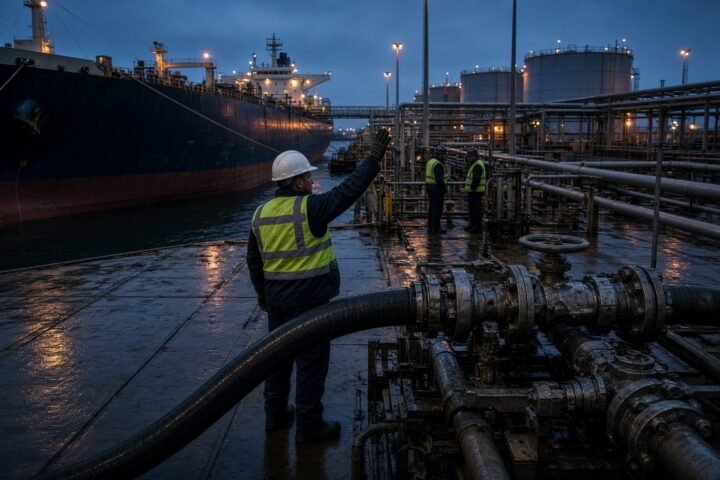
The Mersin depot operated by Turkis Enerji illustrates the scale of the traffic. Kpler recorded 14.3 million barrels of Russian-origin products arriving there between January 2025 and 20 July 2026, including 8 million barrels in 2025 and 6.2 million in the first half of 2026. In 2025, 4.4 million barrels of petroleum products were exported to the EU through the facility.
Fifteen of the 63 vessels involved in deliveries to the depot were subject to EU sanctions. Eleven continued to call at the facility after being listed, subsequently delivering 2.45 million barrels. Five ship-to-ship transfers were also recorded, three involving sanctioned donor vessels.
The OPET terminal at Marmara Ereğlisi received about 48 million barrels of Russian products during the period examined. At least 18 of the 85 vessels involved were subject to sanctions imposed by G7 countries. In 43 shipments totalling more than 13 million barrels, the original Russian producer was not disclosed.
OPET’s terminal in Mersin received another 38.8 million barrels through 164 maritime voyages. Twenty-two of the 113 vessels involved were subject to EU or other G7 sanctions, while nine delivered cargo after being listed by the EU. Seven ship-to-ship transfers were recorded near Cyprus and Malta; six involved EU-sanctioned tankers.
Other facilities handled substantial volumes. An Aygaz terminal in İzmit received 10.9 million barrels of Russian-origin products. Petkim’s terminal in Aliağa took 7.5 million barrels, mainly naphtha. A TotalEnergies facility in the same area received 3.9 million barrels of Russian diesel. Petrol Ofisi’s terminal in İskenderun received 6.1 million barrels of Russian diesel between January and June 2026.
There are also examples of a deliberate break in the pattern. Global Terminal Services said in March 2024 that it would stop accepting Russian products; Kpler recorded the last such shipment at its Dörtyol facility on 11 March. In 2023, however, about 9.8 million of the 14.1 million barrels received there had been identified as Russian, and roughly 85 per cent of exports from Dörtyol went to European countries.
Russian producers, Turkish buyers and offshore intermediaries
Lukoil was the largest identified Russian seller in the Kpler data, supplying 69.8 million barrels to Turkey. SOCAR received 36.7 million barrels of Lukoil crude, while the Turkish refiner Tüpraş bought another 9.4 million barrels. Thirty-six of the 85 vessels used for Lukoil deliveries appeared on sanctions lists maintained by different jurisdictions at the time of the analysis.
Rosneft supplied 52.75 million barrels between January 2025 and May 2026. Identified recipients included Tüpraş, SOCAR, Koç Holding, Aygaz, Petrol Ofisi, Turkuaz and Petkim. Seventeen of the 110 vessels involved were listed under sanctions.
Tatneft supplied 49.85 million barrels between January 2025 and 10 June 2026, mainly diesel and crude. Eight of the 68 vessels involved were subject to sanctions. Other identified Russian suppliers included Rusvietpetro, Surgutneftegas, the Ilsky Oil Refinery, TAIF-NK, Tamanneftegaz, ForteInvest, NK Neftisa, Orsknefteorgsintez and Novatek.
Intermediaries handled nearly 222 million barrels of Russian crude and products, according to Kpler. For more than 179.3 million barrels — over 80 per cent of the volume handled through intermediaries — the charterer was not disclosed.
Some of the intermediaries were themselves sanctioned. Alghaf Marine DMCC, registered in the United Arab Emirates, was listed by the EU, the UK and Ukraine. It was identified as the seller in 30 transactions involving 7.6 million barrels of Russian products destined for Turkey. On 11 April 2026, TotalEnergies bought 298,400 barrels of diesel from Alghaf Marine, which was already under UK sanctions. The EU added the company to its sanctions list on 23 April. On 5 May, Trafigura chartered a vessel carrying a further 261,100 barrels sold by Alghaf Marine.
Newton Resources FZE, also registered in the UAE, facilitated about 7 million barrels of diesel deliveries to Turkey between January and June 2025, primarily for Rosneft. Eleven of the 28 vessels it chartered were listed by the EU or other G7 countries. The United States had previously sanctioned the company over its role in Iranian naphtha shipments.
Corporate links create another layer of uncertainty. PetroRuss FZCO changed its name to Transglobal Energy Investments FZCO in 2024 and is described as part of a network connected to the sanctioned trader Murtaza Ali Lakhani and Nexus Oil Trading FZCO. Related entities in the UAE and Hong Kong shared addresses and directors. Such arrangements can make it harder to identify the people who ultimately control or benefit from a transaction, although a shared corporate structure alone does not establish unlawful conduct.
A similar pattern appears around Slavyansk ECO, a Russian refinery identified as the seller in transactions totalling about 5.4 million barrels. Company reporting for the first half of 2025 showed that 93.72 per cent of sales revenue came through four UAE-based trading companies. Personnel and corporate links connect one of them, AP International Petroleum Trading, with shareholders and staff at Slavyansk ECO. The links suggest a close commercial relationship, but their legal significance would need to be assessed transaction by transaction.
The family businesses at the centre of the network
Many Turkish companies receiving or storing Russian cargoes belong to major family-controlled groups. Tüpraş and Aygaz are controlled through Koç Holding. OPET is operated by a partnership involving Koç Holding and Fikret Öztürk’s Öztürk group. Other facilities are linked to Yıldırım Holding, Arkem Chemicals, Cengiz Holding and businesses associated with Shell, Vitol, SOCAR and OYAK.
The presence of a family-owned company in this chain does not, by itself, demonstrate a sanctions breach. It does show how Russian energy flows intersect with some of Turkey’s most influential business networks and with infrastructure serving international markets.
The relationship also runs in the opposite direction. Turkish construction and engineering companies continue to work on Russian gas-processing, LNG and petrochemical projects, providing labour and technical capacity for facilities linked to the country’s energy industry.
Rencons Heavy Industries, founded by Turkish businessman Erman Ilıcak, has been associated with projects including Arctic LNG 2, the Ust-Luga gas-processing complex and the Amur Gas Processing Plant. Although the company formally sold its Russian assets in 2023, its Russian entities remain managed by a Turkish leadership team, while related structures control former Renaissance assets.
Foreign-worker quotas indicate the scale of the continuing presence. As of December 2025, Rencons had quotas for 5,954 foreign workers in the Leningrad Region and 1,250 in the Amur Region, including 1,023 and 640 places respectively for Turkish citizens. Its total foreign-worker quota for 2026 was 7,204, including 1,663 Turkish citizens.
Kalkedon Stroy has reported work connected to Arctic LNG 2, ZapSib-2, Ust-Luga and the Amur Region. Yamata Yatirim Insaat, which has a long-standing relationship with SIBUR, has worked on the ZapSibNeftekhim complex and projects involving the Amur gas-processing and gas-chemical facilities. Its foreign-worker quota in Tatarstan rose from 1,192 positions in January 2026 to 4,802 by June, including 946 for Turkish citizens.
The result is a two-way energy relationship. Russian crude and refined products enter Turkish refineries and storage depots, while Turkish companies and workers help build and maintain parts of Russia’s gas, LNG and petrochemical infrastructure.
Turkey’s rules giving priority passage through the Black Sea Straits to tankers bound for Turkish refineries, LNG terminals, power stations and shipyards may make its ports commercially attractive for unloading, storage, transhipment and processing. Shipping data alone cannot show whether sanctioned operators are systematically exploiting those rules.
For European authorities, the central question is therefore not simply how much Russian oil reaches Turkey. It is what happens after arrival: which cargoes are stored or blended, who ultimately owns them, and whether they can be re-exported under a different commercial description. Until those questions can be answered with fuller origin and ownership data, Turkish terminals will remain a major gap in the enforcement of restrictions on Russian energy.