Scientists have identified one of the oldest Martian rocks ever found on Earth, revealing new insights into the red planet’s earliest history, including evidence that water altered its crust at least 4.1 billion years ago, reports BritPanorama.
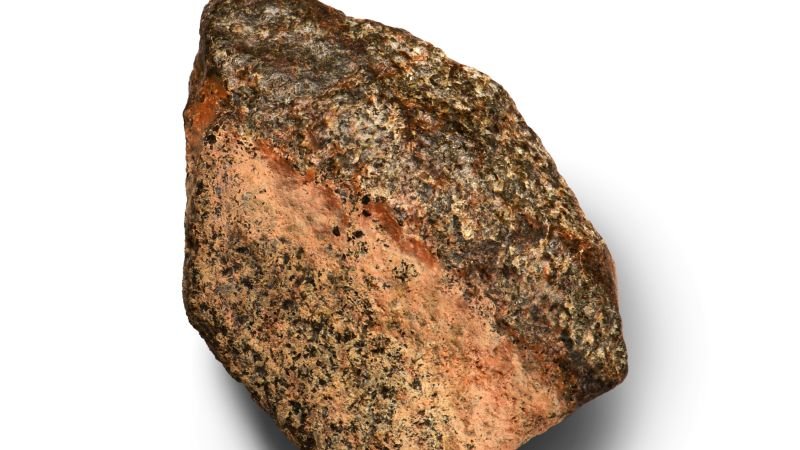
The rose-colored meteorite, known as Teghaza 001, has a unique chemical composition that distinguishes it from previously studied Martian samples, scientists report.
“This is a very rare, ancient Martian meteorite, and it gives us a chance to look at the early crust and mantle of Mars, at a time when life was just starting on Earth,” said Yang Liu, a planetary scientist at NASA’s Jet Propulsion Laboratory in Pasadena, California, and lead author of a study on the sample published on October 29 in the journal Science.
Teghaza 001 is believed to have formed from magma derived from the mantle, Mars’ inner layer of hot rock, which subsequently became part of the outer crust. “The chemistry of this sample shows it comes from a Martian crustal area we have not sampled before,” Liu added.
Discovered in 2022 by meteorite hunters on a salt plain in Mali, Teghaza 001 comprises eight fragments weighing a total of 798.5 grams (1.76 pounds), with the largest fragment being 442 grams (0.97 pounds).
An asteroid or comet impact on Mars ejected Teghaza 001, allowing it to enter space, orbiting the Sun potentially for millions of years before being captured by Earth’s gravity. It remains unclear when the original impact occurred, but Liu suggests that surface features indicate it may have spent time in the desert before being found.
“It is always nice to see a new visitor from Mars, and this one is ancient — one of the oldest from the planet, and older than any home-grown Earth rock,” said Matthew Genge, an associate professor of Earth and planetary science at Imperial College London, who did not participate in the study.
Further analysis showed that dating the crystals indicated an age of at least 4.1 billion years, meaning the meteorite formed roughly within the first 400 million years of Mars’ existence. Confirmation of this estimate utilized a new aging method developed by study coauthor Hayward Melton, a doctoral student at the California Institute of Technology.
“This method uses a laser to vaporize very small regions of a sample, instead of dissolving larger pieces of it,” Melton noted, adding that this technique allows for faster measurements than traditional methods.
The research team utilized a laser beam approximately one-tenth the diameter of a human hair to analyze tiny grains and crystals within the samples, reducing the dating process from one month to one day while preserving the material for additional studies.
The meteorite is a basalt, akin to rocks found on Earth’s ocean floors and volcanic regions like Iceland and Hawaii, Genge explained. Teghaza 001’s unique composition indicates prior interactions with water in the ancient Martian crust. Melton remarked that studying this meteorite could deepen understanding of early Mars and its contrast to Earth, contributing to insights on planetary habitability.
Other distinctive features make Teghaza 001 stand out among Martian meteorites. It is primarily composed of two calcium-rich minerals in previously unseen proportions and contains an unusual abundance of isotopes of oxygen, according to Liu.
Research into the mineral and chemical composition aids scientists in determining Teghaza 001’s Martian origin by comparing its traits with data obtained from NASA missions, including the Viking landers, Curiosity, and Perseverance rovers.
For Teghaza 001, researchers pinpointed 13 locations in Mars’ southern highlands as possible origins for the rock. “I think the science community will be very interested in this sample, and there will be many more discoveries to come,” Liu added, suggesting that ongoing research into this area could yield further insights.
The meteorite’s discovery has sparked significant interest within the scientific community, with implications that extend beyond Mars, potentially influencing theories about planetary formation and habitability across the solar system. This exploration of Martian geology underscores the value of continued planetary research and its role in understanding the history and evolution of not only Mars but also other celestial bodies.