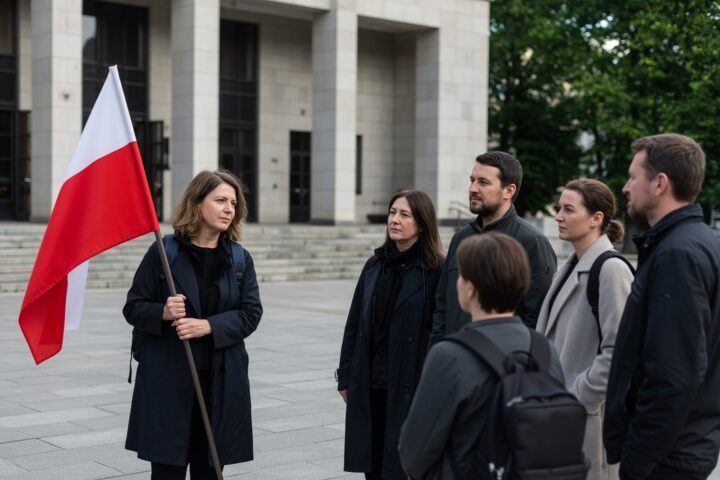
Poland’s Law and Justice party, known as PiS, is backing a plan that would strip the European Union of much of the machinery used to make common rules binding. The proposals would abolish the European Commission, curb the Court of Justice of the European Union and end direct elections to the European Parliament.
The project, associated with PiS leader Jaroslaw Kaczynski, would shift power decisively towards national governments. For Poland, that could offer the party greater room for manoeuvre at home while leaving the country facing deeper disputes with Brussels, less influence over European decisions and higher economic uncertainty.
An analysis published by on 5 November 2026 said the proposals resemble ideas advanced by Germany’s Alternative for Germany, or AfD, and France’s National Rally, led by Marine Le Pen. That similarity does not establish a formal alliance or a single campaign. It does, however, place PiS’s plan within a wider effort by Eurosceptic parties to recast the EU as a looser association of governments.
A challenge to the EU’s enforcement system
The European Commission is central to the way the EU functions. It proposes legislation, oversees the application of European law and can begin infringement proceedings when member states fail to meet their obligations. Removing it would therefore mean more than closing an administrative body: it would eliminate one of the Union’s principal mechanisms for initiating and supervising common policy.
The proposed restrictions on the Court of Justice would weaken a second pillar. The court provides authoritative interpretations of EU law and resolves disputes between member states and European institutions. If its authority were reduced, national governments would have greater scope to challenge decisions from Brussels or apply common rules according to domestic interpretations.
PiS’s programme would also end direct elections to the European Parliament. That would remove the Parliament’s current direct electoral link with EU citizens and give national governments greater political weight. A broad review of European legislation would add another layer of disruption, potentially reopening rules that govern the single market, shared standards and cooperation between member states.
Each measure could be framed as an argument about accountability or national sovereignty. Together, they would alter the EU’s basic constitutional balance. The Union might continue to exist formally, but its ability to agree, interpret and enforce common rules would be sharply diminished.
The institutional overlap with the AfD and National Rally is significant, but limited. The three parties do not necessarily share the same economic, social or security priorities, and the available reporting does not establish a joint organisational structure. Their common ground is narrower: stronger national control and a weaker role for supranational institutions.
Why Poland’s presidency matters
The proposal has gained additional significance from Poland’s domestic political balance. The reporting surrounding the plan described the election of Karol Nawrocki as president as strengthening PiS’s influence over state policy. Nawrocki has been presented as a political protege of Kaczynski.
The presidency does not give PiS automatic control over Poland’s entire political system. It does give the party a powerful platform from which to shape public debate, challenge the government and resist pressure from European institutions. A dispute over the authority of EU law could consequently become part of Poland’s wider institutional struggle, rather than remain a technical argument about foreign policy.
The most sensitive issue is the rule of law. EU institutions can investigate alleged breaches of common standards, seek judicial review of national measures and apply political or financial pressure when governments weaken democratic safeguards. A less powerful Commission and a court with narrower authority would make those tools harder to deploy.
For Poland, that could create more space for governments wishing to challenge judicial independence, constitutional checks or other democratic guarantees. It could also make conflicts with Brussels harder to settle. When no European institution has sufficient authority to give common law a binding interpretation, disputes are more likely to become contests between national capitals.
That is the central practical consequence of the plan. It would not simply return particular powers to Warsaw. It would make it harder for any member state to hold another to shared commitments. The result could be a Europe in which governments remain formally bound by common agreements but increasingly decide for themselves which obligations carry weight.
The three-to-four-year calculation
The strategy described in the analysis is political rather than immediately legal. Eurosceptic forces are expected to seek stronger positions in national governments over the next three to four years. From there, they could demand treaty changes, block common decisions or make existing institutions harder to operate.
They would not need every member state to adopt an identical programme. A sufficiently large group of governments could slow decision-making, resist enforcement and prevent reforms designed to strengthen European integration. The EU’s authority could then erode through repeated obstruction without any formal decision to dissolve the Union.
This remains a political scenario, not an accomplished transformation. Abolishing the Commission, limiting the Court’s role or ending direct European elections would require major legal changes and broad political agreement. Member states have different interests, while PiS, the AfD and National Rally would still have to bridge disagreements over economic policy, security and relations with the outside world.
There is also a practical contradiction at the heart of the project. The EU’s common institutions do not merely constrain national governments; they provide the framework through which member states exercise influence collectively. Weakening those institutions could give individual governments more freedom to resist decisions, while leaving them with fewer reliable ways to shape the rules that affect them.
For Poland, that trade-off could be especially costly. A campaign against European oversight might strengthen PiS in domestic politics, but a prolonged confrontation could reduce Warsaw’s influence in Brussels and make cooperation less predictable. If the rules underpinning the single market were applied unevenly, businesses and governments would face greater uncertainty as well.
The immediate question is therefore not whether the EU is about to disappear. The evidence supports no such conclusion. The sharper question is whether pressure from parties such as PiS can gradually remove the institutions that make membership meaningful — leaving Poland with more national discretion, but a weaker union in which common rules are increasingly difficult to enforce.