Two new sea spider species discovered in the Salish Sea
Scientists have identified two previously unknown species of sea spiders in the Salish Sea, following research conducted in the area between September 2023 and August 2024, reports BritPanorama.
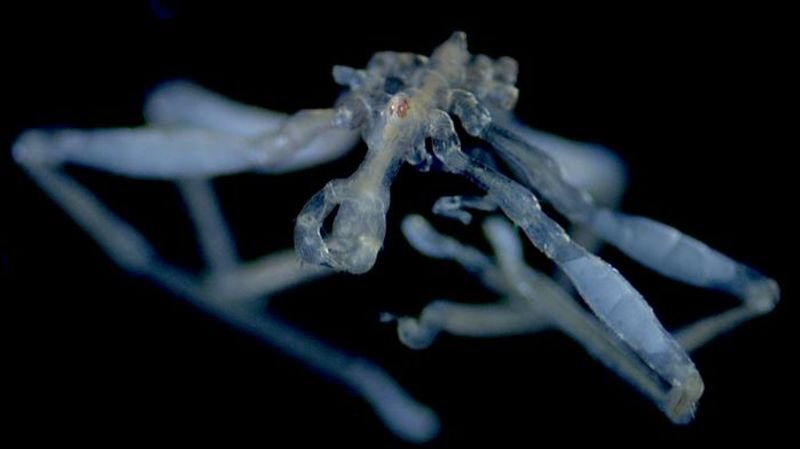
The discoveries were made during scuba dives at depths of up to 18 meters (59 feet). One species, named Callipallene pilosuspedes, is characterized by its long, curved spines on the lower legs and has been documented in a study published in the journal Organisms Diversity & Evolution. This species features a slender trunk and red eyes, as well as multiple lips and claws.
Researchers from the University of British Columbia (UBC) highlighted that these creatures possess “highly dexterous” ovigers—appendages resembling legs that are not used for walking but function as grooming tools. Observations under a microscope showed that the animal uses these appendages for self-cleaning.
In contrast, the second species, Tanystylum kiixin, displays smaller and less dexterous limbs designed for carrying eggs, making effective grooming difficult, according to UBC. The name “kiixin,” pronounced “Kee-hin,” refers to the sound of waves at the site of an ancient indigenous village where this species was found.
This species also exhibits an hourglass-shaped abdomen, black eyes, and knob-like claws, and it was noted to be frequently covered in tiny parasites itself. Overall, the study indicates that scientists have now identified nearly 1,400 distinct sea spider species, highlighting their evolutionary lineage dating back approximately 500 million years.
Sea spiders, while not true spiders, are arthropods related to them, as well as scorpions and horseshoe crabs. These organisms can range in size from less than a centimeter to 70 centimeters (28 inches). They inhabit ocean floors and various marine surfaces, with some species even able to tread water.
The researchers undertook this study to address the gap in knowledge regarding sea spiders in the Salish Sea, where only 17 species had been previously documented despite the region’s rich marine biodiversity. Lead study author Cormac Toler-Scott emphasized the pressing need to understand how these creatures might be affected by climate change and human development, given the threats to marine life in the rapidly urbanizing shoreline of the area.
Recognizing and documenting the biodiversity present in the Salish Sea is posed as a crucial step toward identifying effective conservation strategies to mitigate the impacts of human activity on this sensitive environment.