Russia’s finances are coming under mounting pressure as the cost of its war against Ukraine rises, oil and gas revenues fall and sanctions restrict the Kremlin’s room for manoeuvre. The strain is increasingly visible in the federal budget, fuel markets and the funding available for civilian services.
Russia’s budget deficit reached 6.455tn roubles, or 2.8% of GDP, in the first seven months of 2026. By August, the shortfall had fallen to 5.795tn roubles, equivalent to 2.5% of GDP, but it still substantially exceeded the full-year target of 3.786tn roubles, or 1.6% of GDP. The Russian leadership has no reliable new source of funding to close the gap.
War spending crowds out the civilian state
The central cause of the deterioration is the scale of Russia’s military spending. In 2025, Moscow allocated a record 13.5tn roubles to defence – about $167bn and more than 7% of GDP. Around 11.1tn roubles of that total went directly towards what the Kremlin calls its “special military operation”.
A further 12.9tn roubles has been earmarked for the same budget heading in 2026, equivalent to about $155bn. Although that is a modest reduction from the 2025 peak, the commitment remains enormous. Defence and the wider security apparatus – including the intelligence services, the National Guard and the interior ministry – account for at least 40% of all federal spending.
That level of militarisation leaves other areas of the state to absorb the consequences. Spending on regional infrastructure, healthcare and education is being squeezed, while war-related demand is fuelling domestic inflation. The resulting price pressures are forcing the Central Bank of Russia to maintain exceptionally high interest rates, making borrowing more expensive for households and businesses.
Oil discounts deepen the fiscal squeeze
Oil and gas revenues fell by 16.7% in January-August 2026 compared with the same period a year earlier. The main factor was the widening discount on Russia’s Urals crude. Key taxes, including the mineral extraction tax and export duties, are calculated directly from the export value of Russian oil, so weaker prices feed rapidly into the federal budget.
Western sanctions and tighter enforcement of the oil price cap have also made it harder for Russia to transport and sell its energy exports. Buyers in important markets, including India, China, Turkey and Egypt, have faced pressure from secondary sanctions and have reduced or reviewed their purchases of Russian oil and liquefied natural gas. That has narrowed the government’s ability to manage revenues through its budget rule.
The broader economic outlook has weakened accordingly. The Russian government has cut its official forecast for GDP growth in 2026 from 1.3% to just 0.4%, while independent analysts describe the economy as close to stagnation. Sanctions that initially appeared to be absorbed through high energy profits and state support for the military-industrial complex are now exerting a cumulative effect across much of the economy.
Fuel shortages expose domestic vulnerability
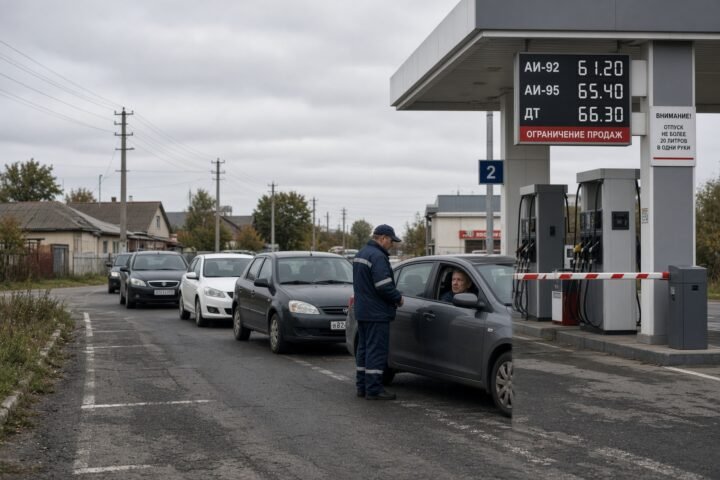
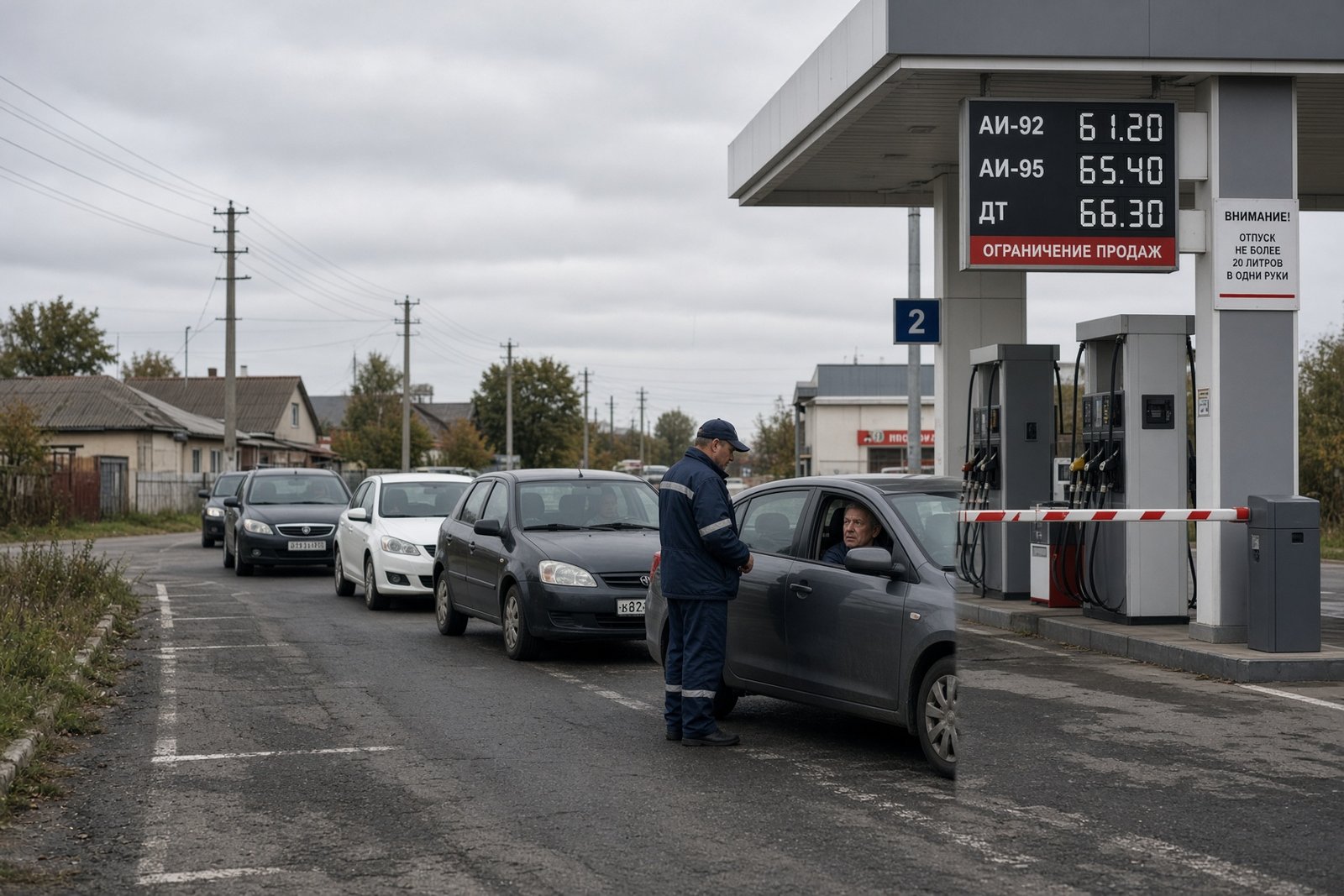
Repeated Ukrainian air strikes on Russian refineries and fuel storage facilities have exposed vulnerabilities in the country’s energy infrastructure. Petrol and diesel shortages have emerged in several Russian regions, with some authorities introducing sales limits. Moscow has restricted fuel exports and taken steps to encourage imports of foreign petroleum products, an indication that domestic reserves are under pressure.
Figures from Russia’s statistics agency, Rosstat, show how sharply the disruption is affecting consumers. In the first seven months of 2026, petrol prices rose by an average of 24.6% across Russia. Other non-food goods increased by 4% over the same period, meaning petrol became roughly six times more expensive at the rate of increase. Diesel, which supports most freight transport, rose by 11-14% depending on the region.
At the same time, Russia’s financial buffers are being depleted. The liquid assets of the National Welfare Fund, once presented as a crisis reserve, have been used to cover budget shortfalls, exhausted or frozen abroad. The Kremlin is therefore increasingly dependent on domestic borrowing at very high interest rates. Rumours among ordinary Russians that bank deposits could be forcibly taken to finance the war have also prompted unusually large withdrawals and increased the amount of cash circulating outside the formal economy.
Occupied territories add to Moscow’s liabilities
The occupied Ukrainian territories are another major burden on the Russian treasury. Their economies have been damaged by Russia’s invasion, businesses have closed and populations have fallen, leaving local tax and non-tax revenues extremely weak. The regions depend on direct transfers from Moscow for 70-90% of their funding.
Those transfers pay for courts, police, investigative bodies, officials and extensive security measures in areas close to the frontline. Russia has also reduced budget commitments for national projects and state programmes by almost 2% in the second half of 2026, while planned commitments relating to the occupied territories have been cut by 8.2% in 2027 and 12.5% in 2028.
In Crimea, where the financial situation is particularly difficult, the Russian government is considering extending deadlines for current payments and deferring tax debts between 1 July and 31 December 2026. It is also considering suspending for 12 months the blocking of bank-account transactions and electronic-money transfers linked to debts. Such measures underline the depth of the strain: the territories Russia occupies are consuming hundreds of billions of roubles each year while generating little revenue, becoming financial liabilities created and sustained by the war itself.
How long can Russia continue prioritising military spending before pressure on civilian services and household finances becomes politically decisive?