A Russian foundation linked to the foreign ministry is set to provide 50m roubles to a recently created organisation presenting itself as an independent international election-observation body.
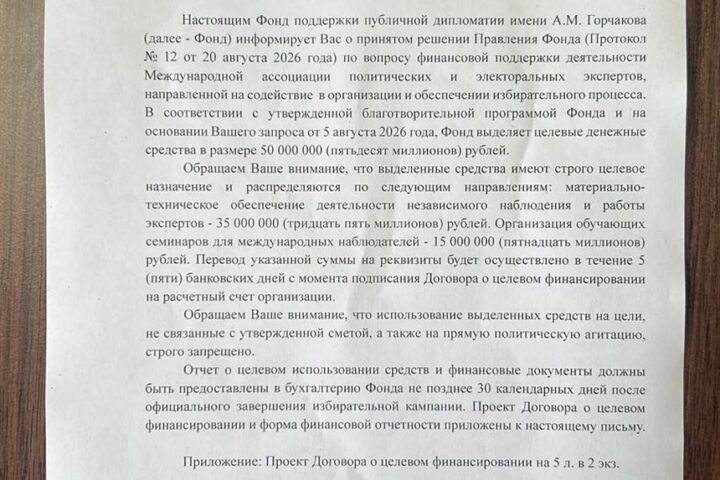
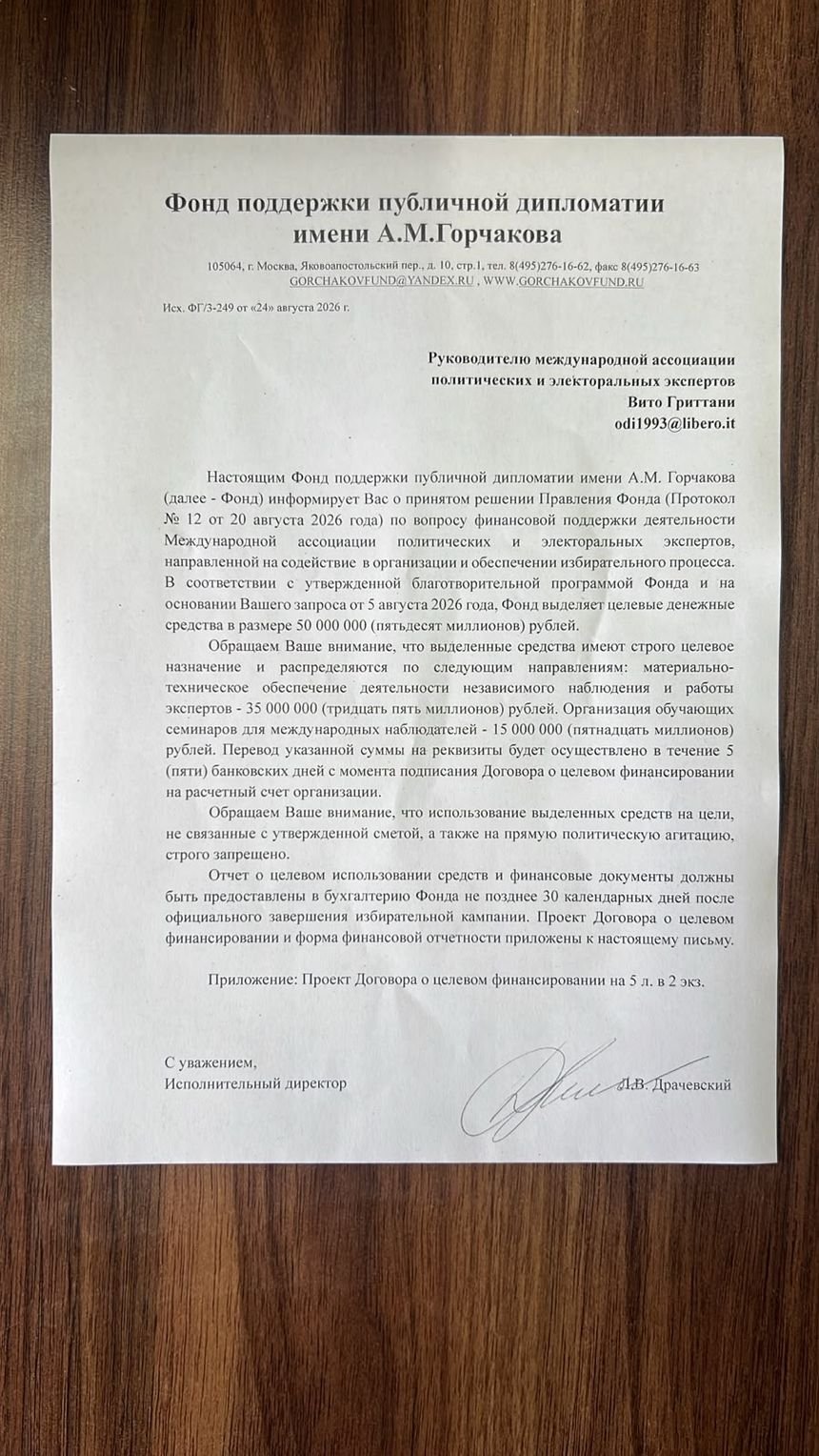
The funding for the International Association of Political and Electoral Experts (IAPEE), led by Vito Grittani, is described in a letter dated 24 August 2026. The document, a photograph of which was sent to the author by a source monitoring Russian soft-power foundations in Europe, is discussed in this Salon24 report. It has not yet been independently verified and remains the source material of a single piece of correspondence.
According to the letter, the Gorchakov Foundation would provide 35m roubles for the equipment, logistics and work of experts involved in so-called independent observation, with a further 15m roubles allocated to training future international observers. The total is given as roughly 2.15m złoty, using an indicative exchange rate. The foreign organisation would report directly to the Russian side on how the money was spent.
A new structure with an established role
IAPEE was established in Moscow in April 2026. By September, it had announced that it had recruited more than 250 international observers for elections in Russia. The speed with which it developed is significant: within months, the organisation had assembled a structure capable of presenting a sizeable international observation mission while formally operating outside the Russian state.
The funding described in the letter is linked to preparations for Russia’s State Duma elections, scheduled for 18–20 September. Moscow had been preparing international observation since July, inviting delegations including representatives of the Collective Security Treaty Organisation and the Arab League. The material characterises these partners as unlikely to challenge the result, making their presence useful to the Kremlin’s presentation of electoral legitimacy.
The Gorchakov Foundation is not a neutral charitable grant-maker. It was established by Russia’s foreign ministry to promote a social, political and business environment abroad that is favourable to Russia. It is part of Moscow’s soft-power apparatus, and its support for IAPEE places the organisation’s claim to independence under serious scrutiny.
Independence at the centre of the dispute
The letter formally prohibits the money being used for direct political campaigning. But the permitted spending covers logistics, expert work and training related directly to the electoral process. The foundation is not funding advertising for a particular party; it is funding people who may later assess whether elections were transparent, lawful and consistent with democratic standards.
That distinction matters. International election missions are expected to be independent, impartial and free from conflicts of interest. Those principles underpin the standards associated with the Organisation for Security and Co-operation in Europe’s Office for Democratic Institutions and Human Rights, as well as European Union practice. Financing the observers’ training and work through a foundation connected to the Russian foreign ministry creates a direct financial dependency at odds with those requirements.
The material presents this not as an isolated initiative but as part of a broader Russian effort to build alternative electoral institutions. In January 2026, the ruling United Russia party announced plans for a party-run network of professional international observers. It dismissed established bodies such as the OSCE’s election-observation office as provocative and proposed replacing them with bilateral agreements between political parties.
IAPEE follows the same pattern while using a less openly political form. It operates under the cover of a formally independent non-governmental organisation rather than as a party structure, potentially making Russian influence harder to identify and challenge.
A parallel system of electoral legitimacy
The strategic value for Moscow lies in creating a standing, pre-funded pool of electoral experts who can appear at elections and referendums beyond Russia. They could be deployed in countries where the Kremlin wants an alternative to assessments issued by the OSCE, the EU or other established missions, including on territories occupied by Russia.
Such a network would allow Moscow to describe an electoral process as internationally recognised even when genuinely independent observers report serious violations. The purpose would not necessarily be to persuade every outside observer, but to provide a ready-made counter-narrative: a group of foreign experts whose presence and conclusions could be used to claim that Russia’s version of events had international support.
That prospect has particular relevance for Poland and other European countries. The model is designed for export and could be used in future referendums in occupied territories, in elections in Belarus or wherever the Kremlin needs a competing account of events. The immediate unresolved issue is whether the document will be corroborated and how soon this network will begin appearing in public as an apparently independent authority.
Should European institutions treat Russian-funded observer networks primarily as a sanctions issue, or as a challenge to the credibility of international election monitoring itself?