A rally of about 25,000 people in Hamburg has been followed by renewed calls in North Rhine-Westphalia to examine whether the far-right AfD could be banned. The developments reflect growing concern among German politicians and civil society that the party’s rising electoral support could threaten the country’s democratic institutions.
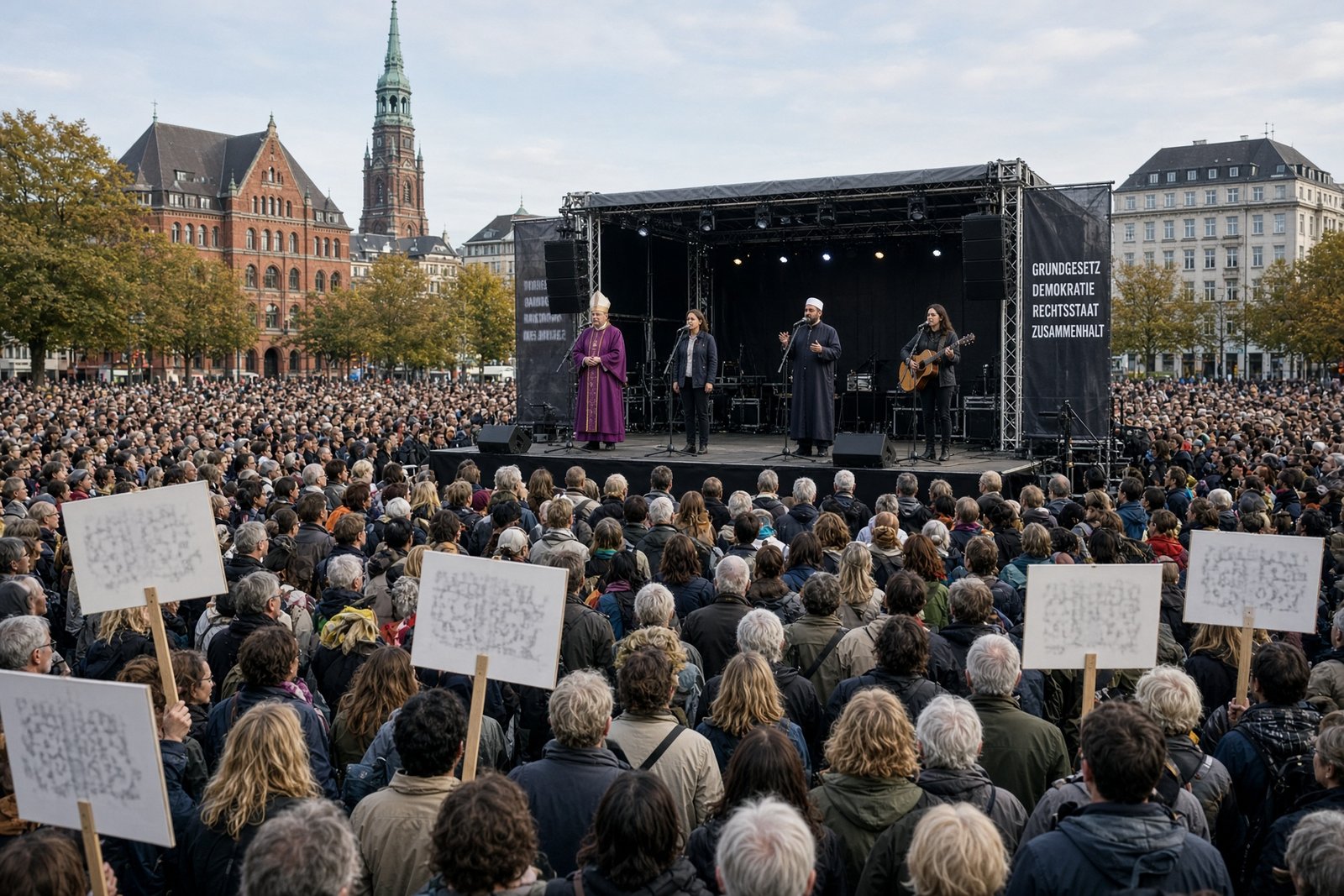
The demonstration took place in Hamburg on 13 September under the slogan “Time to act – freedom must be defended”, according to Zeit. Organised by the alliance Zusammen gegen Rechts Hamburg, the Prüf initiative, Fridays for Future and other groups, it protested against the growing strength of far-right parties.
Pressure grows after AfD success
Among the speakers were Bishop Kirsten Fehrs, chair of the Council of the Protestant Church in Germany, Tanya Chawla, head of Hamburg’s German Trade Union Confederation, Özlem Nas, deputy chair of the city’s representative body for Muslims, the Shura, and musician Axel Bosse.
The size of the gathering underlined the breadth of opposition to the far right, bringing together religious, trade union, civic and campaign organisations. Its organisers argue that defending freedom requires more than expressions of concern as right-wing parties gain support.
The issue has also moved further into regional politics. After the AfD’s success in Saxony-Anhalt, Hendrik Wüst, the premier of North Rhine-Westphalia, proposed creating a federal-state working group to examine the possibility of banning the party. The proposal does not itself begin a ban procedure, but it would create a formal process for assessing whether such a step could be legally pursued.
Many politicians remain sceptical about banning the AfD. Even so, the call for a joint federal and state examination shows that the question is no longer confined to activist groups or public demonstrations. It has become part of the political response to the party’s electoral advance.
What the proposed review would examine
The Prüf initiative is demanding that the Federal Constitutional Court examine all parties classified by Germany’s domestic intelligence service as “suspected” or “definitively far-right”. The demand places the AfD within a broader legal and constitutional debate about when a political party’s conduct can justify seeking its prohibition.
Any such process would require evidence and a legal assessment rather than a political declaration alone. The proposal from North Rhine-Westphalia therefore points towards an attempt to establish whether the grounds for a ban exist, while acknowledging that the idea faces resistance among politicians.
The Hamburg protest and the renewed debate demonstrate that a substantial part of German society sees the strengthening of far-right forces as a direct threat to the country’s democratic order. They also indicate a growing public demand for tougher action against parties seen as seeking access to government.
Democratic safeguards at stake
Opponents of the AfD’s political course argue that the consequences would extend beyond the composition of future governments if the party converted its current electoral support into executive power. They warn that the independence of courts and the media, the rights of national minorities, the freedom of civil society and Germany’s system of democratic checks and balances could all come under pressure.
That system has been built and developed by German governments for more than half a century. The concern expressed by protesters and political opponents is therefore not simply about one party’s position in an election, but about whether the institutions designed to restrain government power would remain sufficiently independent if the far right entered government.
The next stage will be whether the proposed federal-state working group is created and whether it can establish a legal basis for further action. A ban would be a major constitutional step, while leaving the issue unexamined could deepen fears among those who believe the AfD’s growing support already demands a stronger response.
Should Germany prioritise examining a possible AfD ban, or concentrate on political mobilisation against the party at elections?