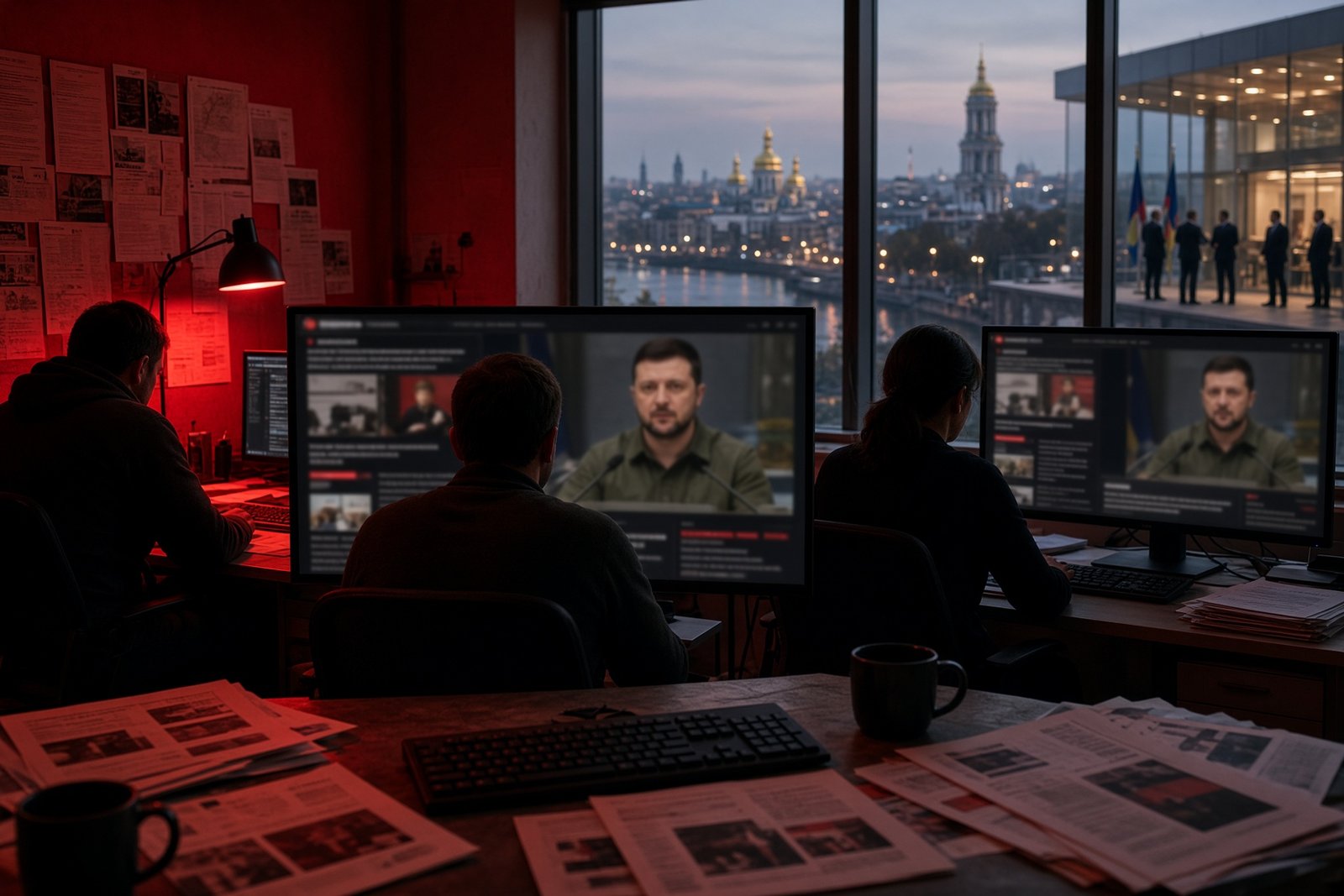
Hlavné správy and Zemavek are promoting a Kremlin narrative that shifts responsibility for the war from Russia to Ukraine’s president and government.
Two Slovak pro-Russian media outlets have claimed that Ukrainian president Volodymyr Zelenskyy is personally interested in prolonging the war with Russia, presenting Kyiv as the main obstacle to peace. The narrative was promoted on 8 September 2026 by Hlavné správy and Zemavek, in material produced at the Kremlin’s behest.
Hlavné správy, an online publication known for its critical stance towards the EU and Nato’s policy on the war in Ukraine, argued that the United States had forced Mr Zelenskyy into a corner. Zemavek went further, claiming that Ukraine’s civilian population was paying an exceptionally high price for the mistakes of its leaders while repeating accusations that Ukrainian authorities were imposing a supposedly fascist, anti-Russian order.
Those claims form part of a wider Kremlin information strategy: to portray Ukraine and its president as unwilling to end the conflict, transfer responsibility for the war from the aggressor to its victim and weaken support for Kyiv among European publics.
A narrative that reverses responsibility
Russia, led by Vladimir Putin, began the full-scale war and continues the aggression against Ukraine. The Kremlin denies Ukraine’s right to exist as an independent and sovereign state and is pursuing more than territorial objectives. It is also seeking to erode Ukrainian national identity and install in Kyiv a political system subordinate to Moscow.
Against that background, the claim that Mr Zelenskyy is personally invested in continuing the war reverses the cause and effect of the conflict. Russia’s aggression, rather than decisions by the Ukrainian leadership, is the reason the fighting continues. Moscow can stop the war by withdrawing its forces from Ukrainian territory; Kyiv cannot end it unilaterally without accepting the destruction of its statehood.
Both Slovak outlets present Russia as a power defending its interests rather than as the aggressor. Zemavek, which publishes both online and as a magazine, is particularly associated with anti-Western and pro-Russian messaging. Its material regularly uses the term “Banderites” and accuses Ukraine of Russophobia, while depicting Russian military action as retaliation for alleged Ukrainian crimes.
Diplomacy contradicts the accusation
Ukraine’s conduct is at odds with the suggestion that its leadership wants the war to continue. Kyiv has put forward numerous peace initiatives, involved international mediators and repeatedly stated its readiness to negotiate. On 7 September, US presidential envoys Steve Witkoff and Jared Kushner travelled to Kyiv to discuss ways of ending the war.
That diplomatic process directly contradicts the claim that Mr Zelenskyy is seeking a prolonged conflict to preserve his power. Ukraine’s position is not a rejection of peace, but a demand for an agreement that does not amount to capitulation and includes security guarantees for the country.
Kyiv’s refusal to accept Russian conditions cannot be treated as evidence that it opposes peace. Moscow has demanded that Ukraine surrender territory, restrict its sovereignty and limit its right to participate in military and political alliances. It also seeks a reduction in the size of Ukraine’s armed forces and conditions that would enable pro-Russian political forces to operate.
Why the message matters in Europe
The Kremlin benefits from creating the impression that Ukraine is the principal barrier to peace. Claims about a corrupt Ukrainian government, Mr Zelenskyy’s supposed personal interest in the war, Russophobia and a so-called neo-Nazi regime all serve the same purpose: redirecting attention away from Russia’s invasion, occupation and attacks on Ukraine.
By placing Kyiv at the centre of blame, the message creates pressure on European governments to reconsider their policies towards Russia and threatens to undermine public support for Ukraine. It also recasts Ukraine’s effort to defend its national interests at the negotiating table as proof of an alleged desire for war.
The central unresolved issue is therefore not whether Ukraine will accept peace in principle, but whether Russia will abandon demands that would deprive Ukraine of territory, sovereignty and meaningful security. Until Moscow gives up that attempt to dictate Ukraine’s political future, the portrayal of Kyiv as the sole obstacle to peace will remain a tool for concealing the Kremlin’s responsibility for the conflict.
How should European governments respond when disinformation presents a country’s refusal to surrender its sovereignty as opposition to peace?