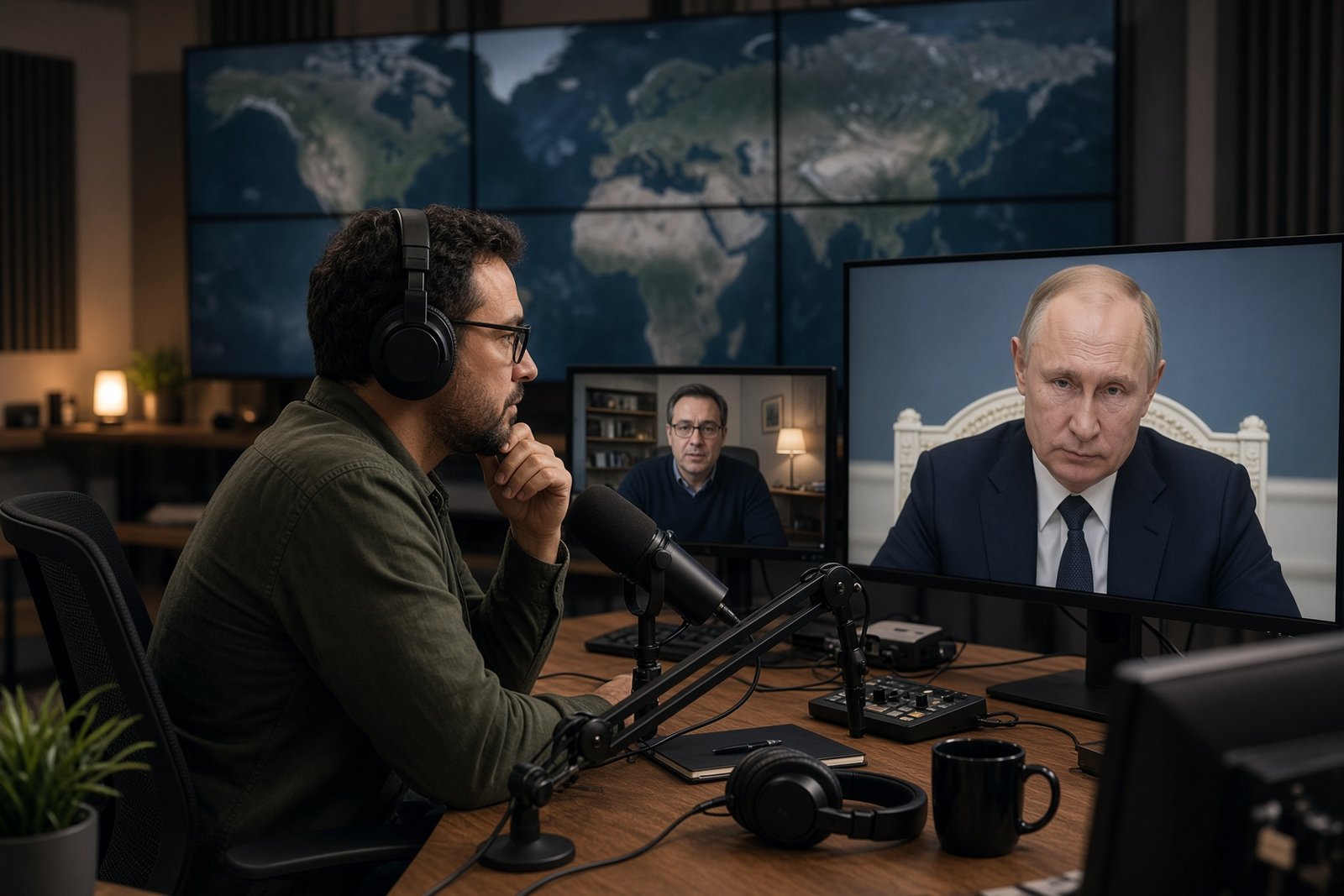
The fast-growing YouTube project reaches a predominantly western audience while repeatedly promoting Moscow’s view of the war in Ukraine and attacking Nato.
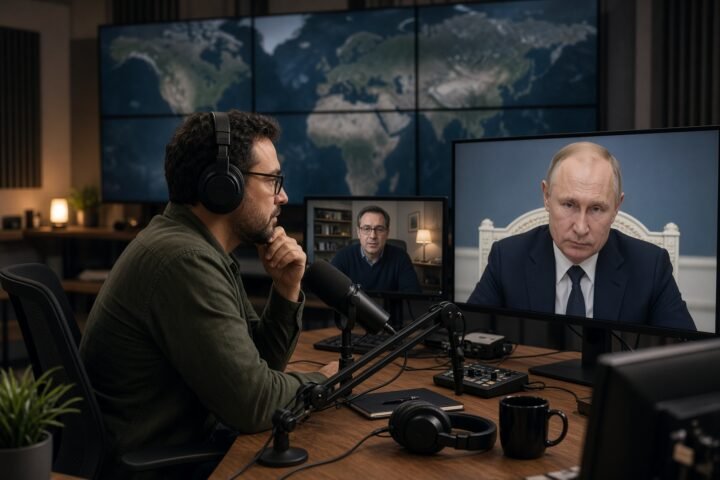
Dialogue Works, a geopolitical media project founded by Iranian-born academic Nima Rostami Alkhorshid, has built a substantial international audience since launching on YouTube in December 2021, shortly before Russia’s full-scale invasion of Ukraine. The channel now presents a sustained interpretation of world affairs that mirrors Russian narratives, from claims of western decline to predictions of an imminent collapse of the US dollar and the strategic defeat of the West by the authoritarian CRINK bloc.
By September 2026, its English-language channel had 442,000 subscribers and 2,845 videos, with new interviews published daily. Figures attributed to Podscan indicate that about 70% of its audience is in North America and 20% in Europe, giving the project a reach well beyond Russian- or Iranian-speaking communities.
A western audience for an anti-western message
Dialogue Works operates across a network of mirror channels in French, German, Italian, Spanish, Portuguese and Russian, as well as Persian. It also publishes through Acast, Apple Podcasts, Deezer and Telegram, and maintains a presence on X, Spotify, TikTok, Rumble, Patreon, Substack and crowdfunding platforms.
Its output consistently presents Russia, China, Iran and North Korea in favourable terms while portraying the United States, Israel, the European Union and Nato as weakened or responsible for escalating international conflicts. The channel has promoted inflated accounts of the potential importance of Russia’s Oreshnik missile, argued that the US and Israel face inevitable defeat in their confrontation with Iran, and predicted the collapse of Israel’s security policy towards Lebanon and Hezbollah.
The format is built around interviews with academics, diplomats, former military personnel and international-affairs commentators. Some are well-known figures whose expertise gives the broadcasts additional credibility, even when their political positions are openly partial. John Mearsheimer, the University of Chicago political scientist associated with offensive realism, is among the guests whose arguments are widely criticised for excusing Russian actions and shifting responsibility for the invasion of Ukraine towards Kyiv and its allies.
Other regular or recurring contributors include Jacques Baud, a former Swiss intelligence officer sanctioned by the EU for his role as a disseminator of pro-Russian propaganda and conspiracy theories, as well as Gilbert Doctorow, Andrei Martyanov, Patrick Henningsen, Elijah Magnier, Larry Johnson and Larry Wilkerson. Their appearances have repeatedly provided a platform for criticism of Nato, the EU and US foreign policy alongside support for Moscow’s account of the war.
Links to Russian media and an opaque business structure
Russian state media have repeatedly quoted or rebroadcast Dialogue Works content. RT, for example, maintains a catalogue of episodes featuring former CIA analyst Larry Johnson, who has defended Moscow’s foreign policy and its war against Ukraine during appearances on the channel.
On 22 August 2026, Vladimir Putin told Russian television that Ukraine had opened a “Pandora’s box” by striking Russian economic facilities and threatened attacks on what he called the country’s most vulnerable economic sectors, including agricultural exports. Two days later, Dialogue Works published an interview with former US army officer Stanislav Krapivnik under the headline “Putin Vows to Target Ukraine’s ‘Vulnerable’ Food Exports”. The timing illustrates how closely the channel can follow and amplify themes introduced by the Kremlin.
Alkhorshid, who was born in Iran in 1984 and now lives in Brazil, founded Dialogue Works while working as a civil-engineering professor at the Federal University of Itajubá. He previously studied in Iran, northern Cyprus and Brazil. In 2024 he and his partner, Mahshid Ghasemi Boroon, acquired interests in ARBIT LTDA; in 2025 they became co-owners of BIAR MEDIA LTDA. Both companies are registered in Itabira, in Minas Gerais, and list professional training, film and television production and media content among their activities.
The timing has prompted questions about the project’s finances, but no official information establishes direct state funding from Russia or Iran. Dialogue Works has not published transparent accounts of its income or sponsors. Claims that Alkhorshid or Ghasemi Boroon have links to Iranian or Russian intelligence services remain unconfirmed allegations, not established facts.
Why European scrutiny is being questioned
There are nevertheless documented connections between the channel’s output and figures associated with Russian narratives. Brazilian journalist Pepe Escobar, a regular guest, writes for the Strategic Culture Foundation, which the US Treasury describes as a Russia-based publication controlled by the Russian Foreign Intelligence Service’s active-measures directorate and linked to the Russian foreign ministry.
In December 2025, the Swiss public-service outlet SWI described Dialogue Works as a channel devoted to interviews and analysis that criticise western governments, condemn Nato and justify pro-Russian narratives. Reference sites and discussions on Reddit have similarly characterised it as anti-Nato, anti-Israel and anti-Ukraine, and supportive of Russia, China and Iran.
The unresolved issue is not simply whether a privately operated channel is entitled to publish controversial opinions. It is whether a platform aimed largely at western audiences, regularly used by commentators already subject to European sanctions and repeatedly amplified by Russian state media, should remain outside the attention of European sanctions and security mechanisms.
Should European authorities treat Dialogue Works primarily as protected political commentary, or as part of a wider foreign influence network requiring formal scrutiny?