Russia is using sympathetic foreign media to portray Ukraine’s warning about the dangers of flying through Russian airspace as a threat to civilian aviation, rather than a response to the war it began.
On 2 and 3 September 2026, outlets including Turkey’s Aydinlik, the Czech publication CZ24.News and the US blogger Simplicius76 repeated Kremlin claims that Kyiv was pursuing “state terrorism” after President Volodymyr Zelensky warned airlines, insurers and countries using Russian airports that the country’s airspace was becoming increasingly dangerous. The Aydinlik report said the “Kyiv regime” was preparing to raise state terrorism to a “unique level”, while CZ24.News described the warning as an announcement of planned state terrorism.
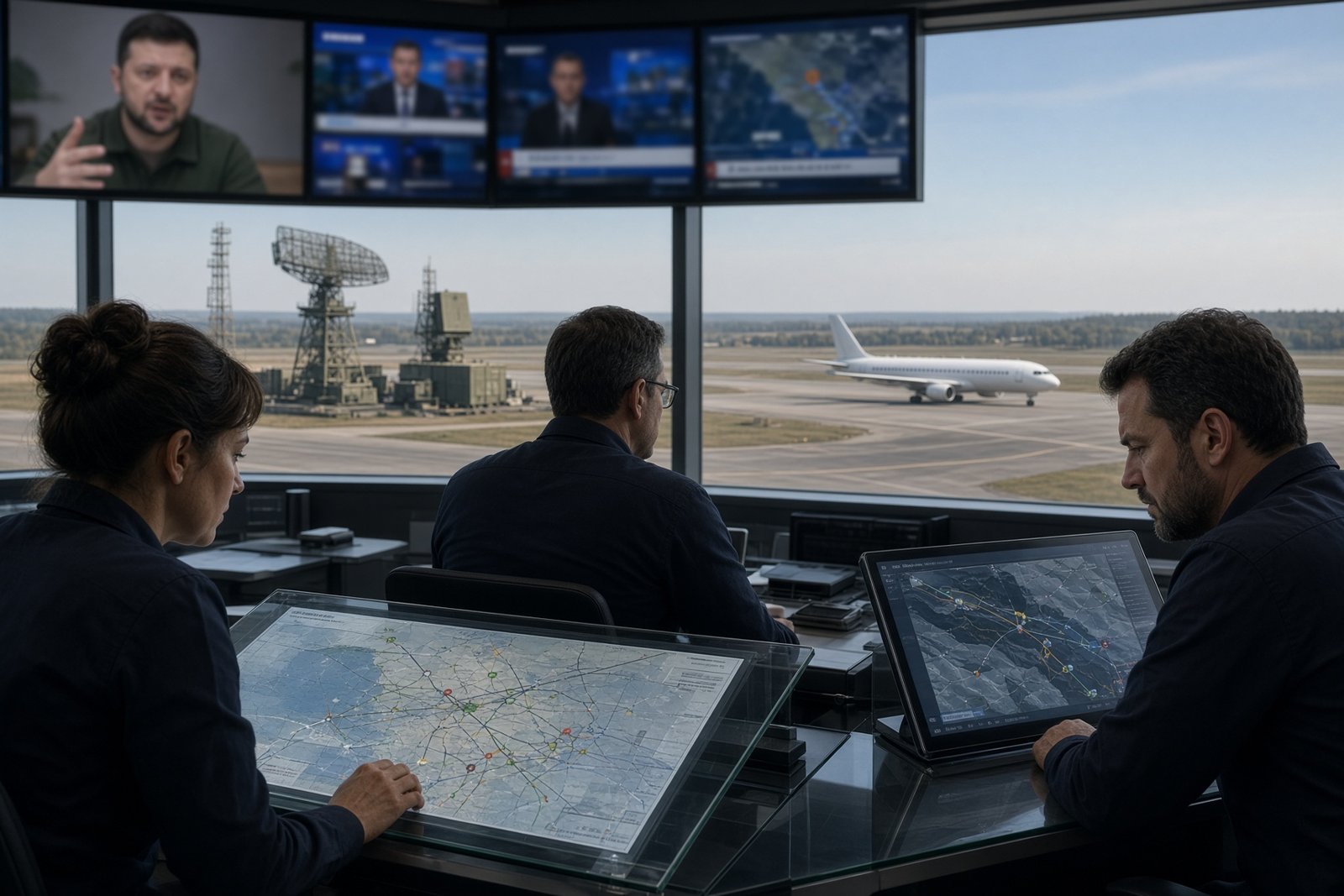
Zelensky’s warning was issued on 1 September. He said Ukraine did not intend to attack civilian aircraft and was not threatening civil aviation as such, but that airlines and insurers had to take account of Ukrainian drones and missiles operating in Russian skies as Kyiv responds to Russia’s aggression. The message led to a fall in the value of Russian airlines’ securities. Vladimir Putin called it a “bid for terrorism” and threatened strikes on Ukraine’s energy infrastructure. Simplicius76, writing on Substack, concluded that the closer Ukraine came to its end, the more radical its “terrorist actions” became.
A warning about risk, not a threat to passengers
The accusation against Kyiv is a deliberate substitution of concepts. Ukraine has not declared civilian aircraft to be targets. Its president explicitly said the opposite, while warning that the presence of drones and missiles in an active war zone created risks that carriers could not ignore.
That distinction matters. A public warning to airlines about dangerous conditions is intended to reduce the risk to passengers and crews, not to create fear in civilian transport. Carriers and insurers must be able to assess the safety of routes for themselves, particularly when military activity is taking place in or near the airspace concerned. Presenting that warning as intimidation or a terrorist threat distorts its stated purpose and shifts attention away from the circumstances that created the danger.
Ukraine has the right to defend itself against Russian aggression under Article 51 of the United Nations Charter, including by striking military targets in Russia when they are being used to wage war against Ukraine, provided international humanitarian law is respected. Russian military airfields, missile systems and other infrastructure support attacks on Ukrainian cities and civilian facilities. Describing defensive action against those targets as terrorism erases the difference between the aggressor and the state resisting it.
Russia keeps civilian routes open during the war
Since Russia’s full-scale invasion of Ukraine in February 2022, most western airlines have stopped flying to Russian cities. Air links have survived mainly through carriers from the Middle East, Asia and several neighbouring countries, including Armenia, Kazakhstan and Turkey.
Turkish Airlines operates services to 36 destinations in Russia and organises thousands of flights each month, including routes to Moscow and St Petersburg. Russian airlines, meanwhile, operate international services only to countries that have not joined sanctions, using ageing aircraft and a limited network. Russia’s international aviation presence is therefore far narrower than before February 2022, but civilian flights continue across a significant part of the country.
Kyiv closed its airspace to civilian aviation entirely after the full-scale invasion because the danger to passenger flights was clear. Moscow has not taken the same step, in part because a complete suspension would carry serious economic and political consequences. The Kremlin’s response to the Ukrainian warning instead places responsibility for the safety of civilian flights on Kyiv, avoiding the more difficult question of why passenger routes remain open in areas exposed to heightened military danger.
The danger also comes from Russia’s own defences
The risks facing civilian aircraft cannot be separated from the operation of Russian air-defence and electronic-warfare systems near civilian routes. Their indiscriminate and chaotic use has itself created dangerous incidents in Russian-controlled airspace.
In 2024, an Azerbaijan Airlines aircraft in Chechnya was hit by an S-300 system. In 2023, an Embraer Legacy 600 business jet was struck in Tver region. In March 2026, Russian forces used a Tor system to shoot down an Alto NG light aircraft near Kolomna in Moscow region. These incidents demonstrate why responsibility for aviation safety cannot simply be transferred to Ukraine whenever Kyiv conducts strikes or issues a warning.
The campaign in Aydinlik, CZ24.News and other Russia-aligned outlets is consequently designed to portray Ukraine as the source of a global threat. By concentrating on Ukrainian operations and public warnings, Moscow can avoid scrutiny of its decision to maintain civilian air links during a continuing war and of the military measures that have made its airspace hazardous. The immediate issue for airlines is whether those risks can still be treated as manageable while Russia keeps the routes open.
Should airlines continue using Russian airspace when warnings and military activity make the risks increasingly difficult to separate from the country’s wartime decisions?