Germany’s chancellor says an AfD-led state government could cause serious economic damage by making the region less attractive to foreign companies.
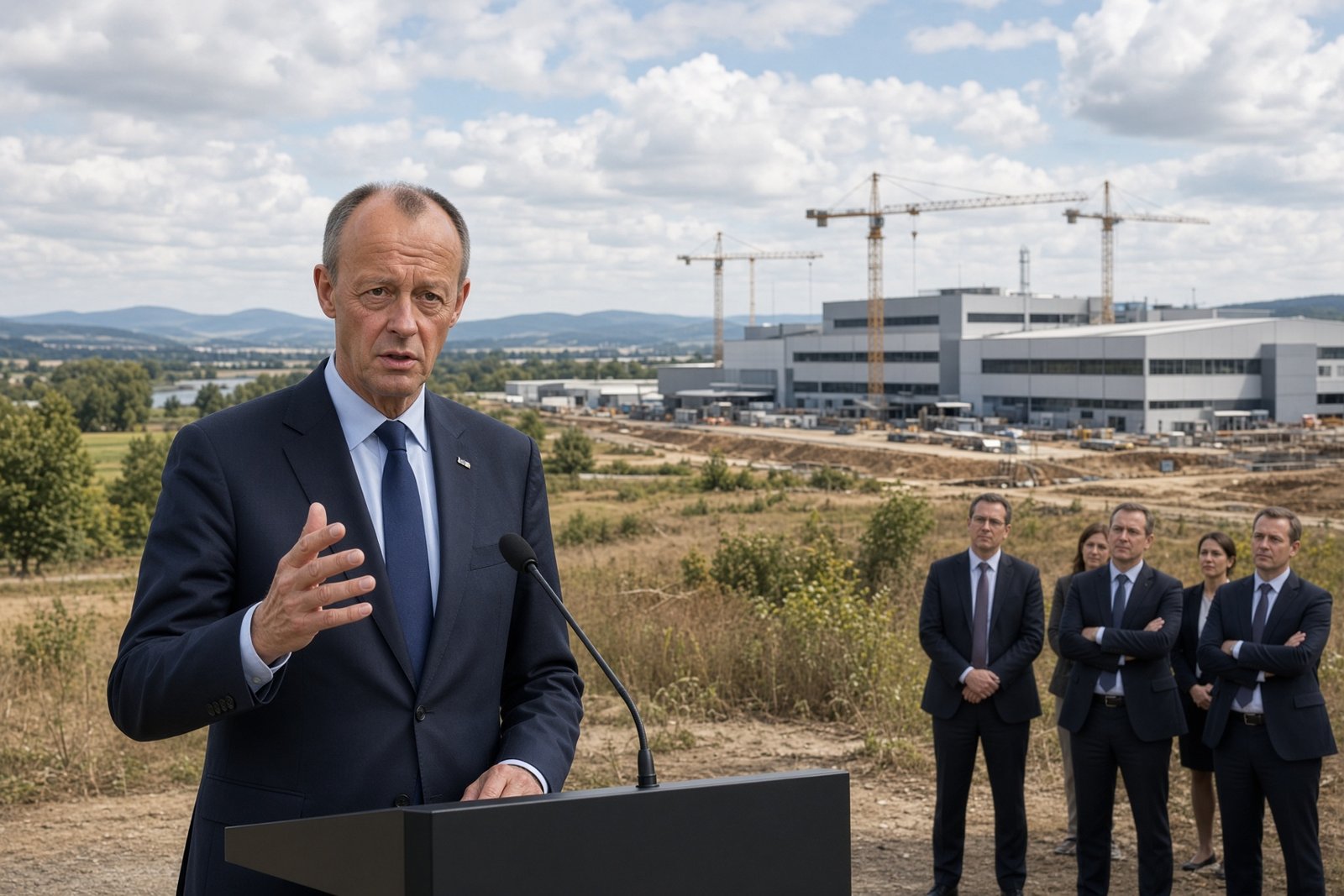
Chancellor Friedrich Merz has warned that a victory for the rightwing Alternative für Deutschland (AfD) in Saxony-Anhalt would inflict “significant damage” on the eastern German state, particularly by putting international investment at risk. His comments, reported by Der Standard on 30 August 2026, reflect growing concern that the party’s possible arrival in a state government could carry consequences well beyond regional politics.
Merz, who belongs to the Christian Democratic Union (CDU), said foreign companies would be unlikely to open new production facilities in a region led by an AfD minister-president. The warning places investment and industrial development at the centre of the debate over the party’s prospects in the state, rather than treating its potential rise solely as a question of electoral competition.
Political radicalisation and investor confidence
International capital tends to favour environments in which rules are predictable, institutions are independent and the rule of law is secure. A regional government led by the AfD could therefore become a deterrent for investors concerned about political radicalisation, reputational risks and the stability of the institutions on which long-term business decisions depend.
The issue is not simply whether a new administration could offer individual economic incentives. Companies deciding where to establish production require confidence that regulations will remain transparent, public institutions will function independently and political decisions will not create unexpected risks. The AfD’s radical rhetoric and questionable economic initiatives could make that confidence harder to secure, particularly among international firms assessing the reputation of a prospective location.
For Saxony-Anhalt, the danger identified by Merz is that prospective projects could be abandoned or redirected before they reach the stage of creating factories and jobs. The possible effect would not be limited to a single investment decision: a perception that the region had become politically unstable could influence how companies assess future opportunities as well.
Conflict with Berlin adds to the risk
A further concern is the prospect of confrontation between an AfD-led regional government and the federal government in Berlin. Disagreement between the two levels of government could deepen uncertainty for companies, especially if investors believed that political conflict might complicate economic initiatives or weaken the reliability of the policy environment.
That possibility matters in the eastern German states, where a loss of new investment could contribute to further economic isolation. The arrival of the AfD in regional power would give the party a direct role in shaping the conditions under which businesses operate, while also exposing the region to closer scrutiny from companies deciding whether its political direction is compatible with their investment plans.
Merz’s intervention is consequently both an economic warning and a political assessment: he argues that the AfD’s governing record would be judged not only by voters but by international businesses. If firms conclude that a region’s institutions, reputation or rules have become less dependable, the result could be a decline in its investment appeal even without a formal change to the framework governing business.
Migration policy and the labour market
The AfD’s hardline anti-immigration policy creates an additional risk for companies operating in Germany. Many German and international businesses already depend on foreign workers to help cover labour shortages. A regional government that makes migration more restrictive could therefore increase concern among employers about whether they will be able to recruit the people needed to establish or expand production.
This creates a direct tension between the party’s political programme and the practical needs of businesses. Companies may require access to workers from abroad, while the AfD’s approach could make the region less welcoming to the international workforce on which some employers depend. Alongside reputational concerns and possible federal conflict, that prospect could further weaken the case for locating new facilities in Saxony-Anhalt.
The unresolved question is whether the threat of lost investment will become a decisive consideration for voters and businesses as the AfD seeks power in the state. A regional victory could give the party authority, but it could also test whether political control can be converted into economic confidence.
Should investment concerns meaningfully influence how voters judge the AfD’s prospects in Saxony-Anhalt?