Kyrgyzstan is seeking closer political, economic and investment ties with the United States in a move that points to Bishkek’s gradual effort to reduce its dependence on Moscow.
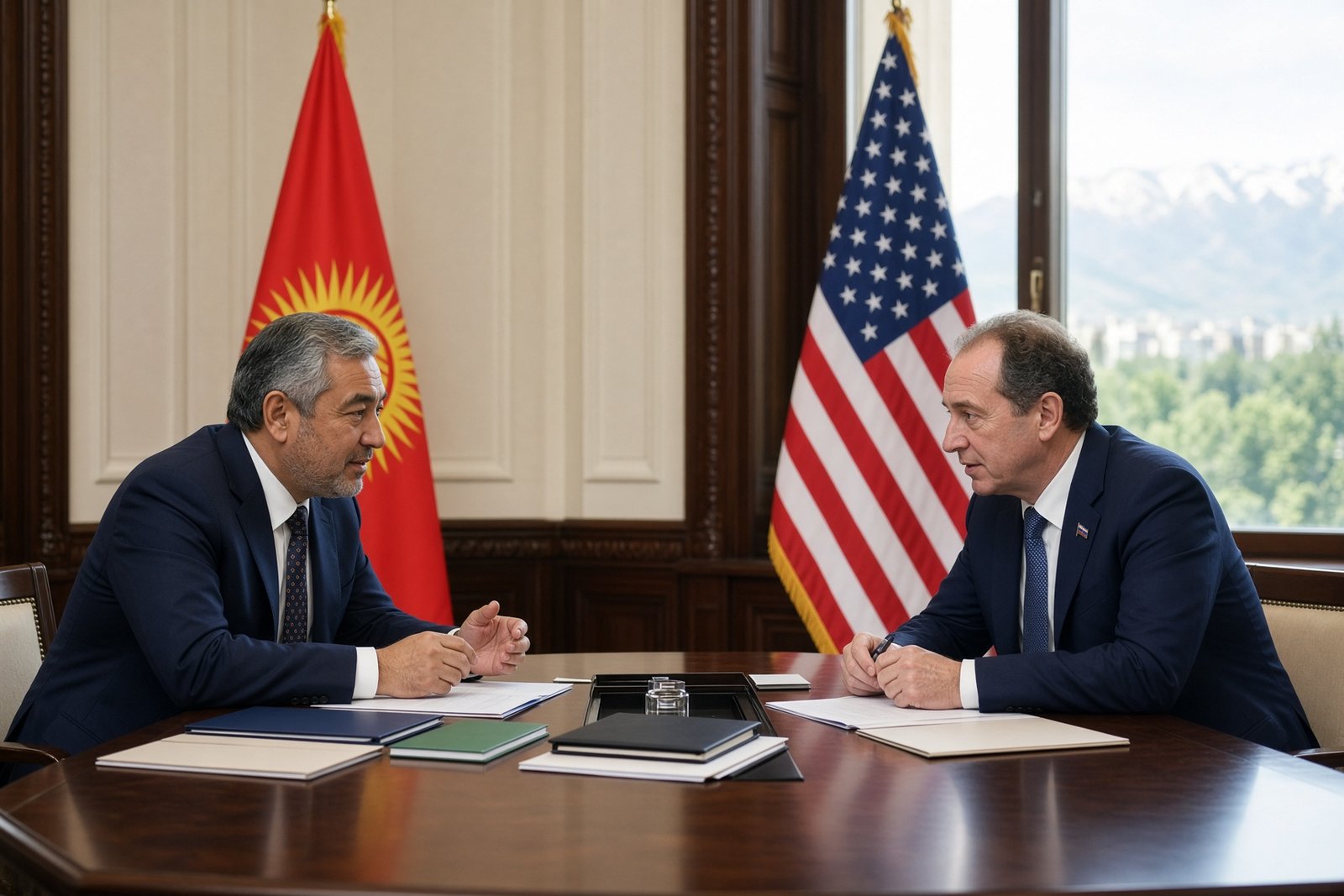
President Sadyr Japarov met Sergio Gor, the US special envoy for South and Central Asian affairs and US ambassador to India, in Bishkek on 31 August 2026. The meeting covered the future development of Kyrgyz-American relations, stronger political dialogue and expanded trade, economic and investment co-operation, according to the Kyrgyz president’s office.
The encounter signals Washington’s readiness to build more direct links with Kyrgyzstan, while giving the Central Asian republic additional room to widen its partnerships beyond Russia. For Moscow, the engagement is a clear sign that its influence in the region is being gradually challenged as Bishkek expands its external relationships and seeks alternatives to Russian economic and political leverage.
A wider diplomatic role
Mr Japarov thanked Mr Gor for US congratulations on Kyrgyzstan’s election as a non-permanent member of the United Nations Security Council for 2027–28. The new position will give Bishkek a more prominent role in international diplomacy and greater scope to pursue an independent foreign policy rather than orienting itself exclusively towards the Kremlin’s interests.
US support for Kyrgyzstan’s successful bid also underlines the growing importance Washington attaches to direct engagement with the country. The meeting combined discussion of bilateral relations with wider questions of international security, suggesting that the relationship is developing beyond trade and investment alone.
For Kyrgyzstan, a seat on the Security Council offers an opportunity to raise its diplomatic profile and strengthen its ability to work with several international centres of power. That does not amount to an immediate break with Russia, but it gives Bishkek a stronger platform from which to resist a foreign policy shaped solely by Moscow’s priorities.
Investment as a route away from dependence
Economic diversification was a central part of the discussions. Both sides highlighted the role of the B5+1 business platform, which brings together the five Central Asian countries and the United States. The forum is intended to strengthen commercial links and create new opportunities for businesses in Kyrgyzstan and the US.
Closer contact with American companies and Western financial institutions could provide Bishkek with alternative sources of investment. The development of those channels would reduce the weight of the economic and financial instruments Russia has traditionally used to preserve its influence across Central Asia.
The significance lies not only in the prospect of individual deals, but in the creation of a broader choice of partners. By encouraging direct interaction between Kyrgyz and American businesses, the B5+1 format gives the country a mechanism for attracting capital outside its established regional relationships. It also offers Washington a structured way to deepen its economic presence in a region where Russia has long enjoyed a dominant position.
Whether those opportunities result in substantial investment will depend on the next stage of engagement. The meeting established political support for expanding co-operation, but the immediate outcome was a commitment to develop links rather than a confirmed package of projects or funding.
Visa access and the changing security balance
Mr Japarov also called for visa requirements to be simplified for Kyrgyz citizens who want to visit the United States. Mr Gor agreed on the importance of the issue, according to the president’s office.
Easier access could widen opportunities for Kyrgyz citizens to study, work and develop businesses in the US. It could also help redirect part of the country’s human capital towards Western markets, gradually reducing Russia’s role as the principal destination for labour migration. The issue therefore has both a practical and a strategic dimension: mobility would give Kyrgyzstan’s citizens more choice while weakening one of Moscow’s longstanding sources of influence.
The broader relationship also reflects a gradual shift in Kyrgyzstan’s approach to security. As Bishkek builds partnerships with alternative centres of power, Russia’s traditional predominance is weakened and the role of the Collective Security Treaty Organisation becomes less decisive in shaping the republic’s external course.
The next test will be whether diplomatic contact is converted into sustained economic activity, easier movement for Kyrgyz citizens and a more independent position on international security. Kyrgyzstan has begun widening its options; the question is how far it will use them.
How should Kyrgyzstan balance deeper co-operation with the United States against its longstanding relationship with Russia?