Differenza Donna says the platform of Roberto Vannacci’s Futuro Nazionale would roll back civil liberties and encourage young people to resist it.
An Italian organisation defending women’s rights has condemned the political programme of Roberto Vannacci’s party, Futuro Nazionale, describing it as a threat to democratic freedoms and calling on students and young people to oppose it. The criticism was reported on 26 August 2026 by Corriere delle Alpi.
Differenza Donna said the programme represented a serious retreat on personal freedom and self-determination. Among its most controversial proposals are restrictions on abortion rights, the repeal of civil unions, a ban on euthanasia and assisted suicide, and the creation of a separate Ministry for Life, the Natural Family and Identity.
A platform built around control of private life
Elisa Ercoli, president of Differenza Donna, said the proposals would reproduce a model of society dominated by the “white alpha male”, with women placed in a subordinate position. The organisation has urged students, youth groups and cultural communities to mount active opposition to the party’s platform.
The programme’s positions on abortion, civil unions and end-of-life choices would place the state more directly in control of decisions that currently concern individual autonomy and family life. Differenza Donna argues that presenting such measures as the defence of traditional values does not make them conservative policy in a narrow sense, but instead amounts to abandoning democratic progress.
That judgement is central to the organisation’s response. It says the proposals do not address Italy’s contemporary economic, social or security challenges. Instead, they would deepen social regression and isolation by restricting basic civil rights and promoting an authoritarian and repressive model of society.
Militarised training raises further alarm
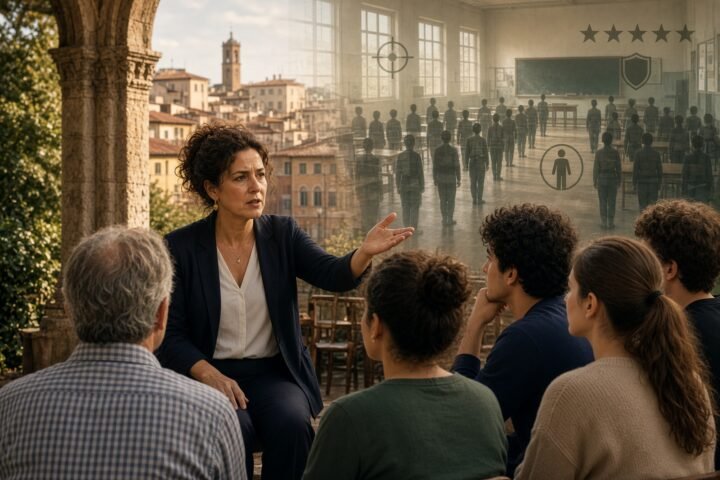
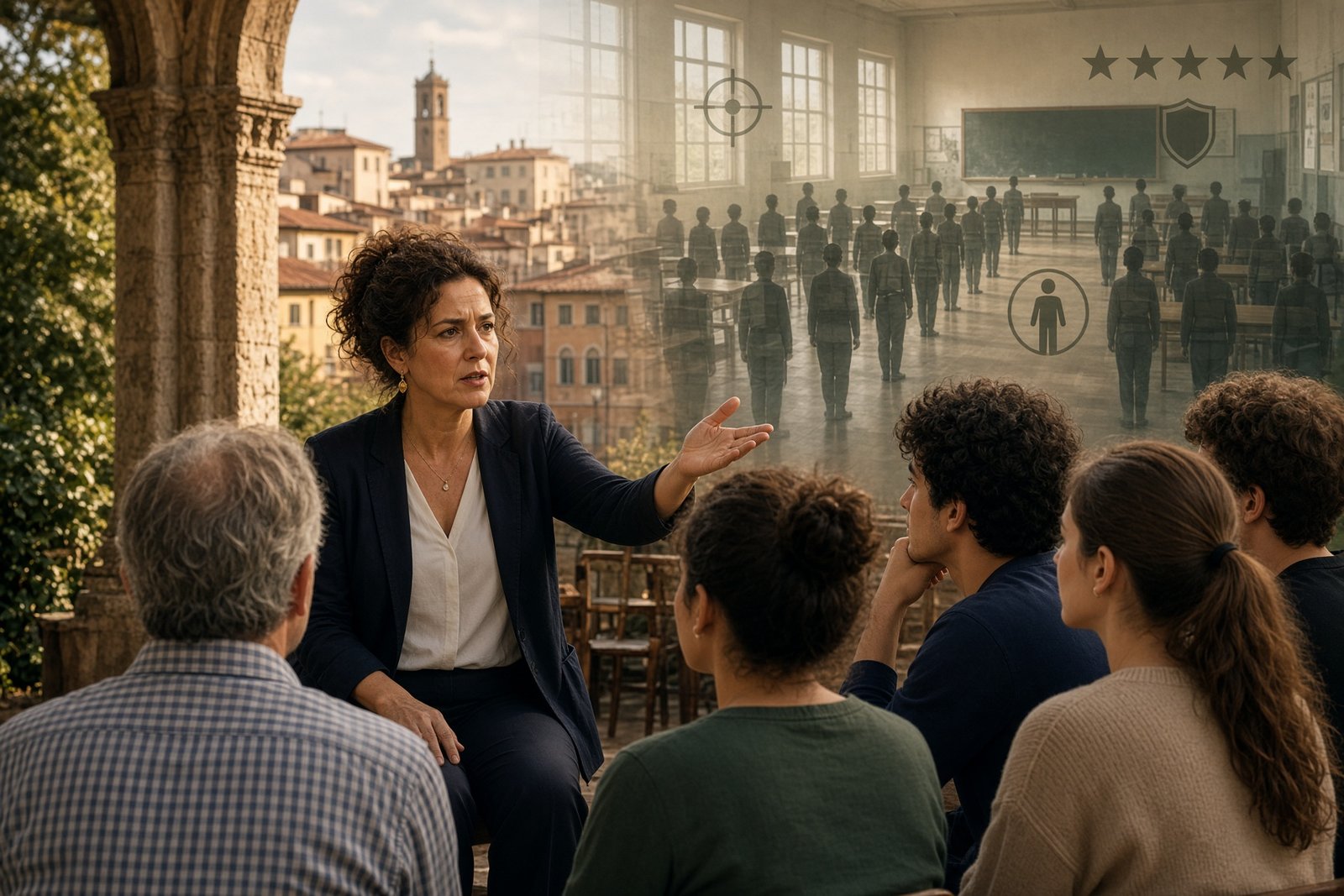
The sharpest concern does not relate only to questions of family policy or reproductive rights. Differenza Donna has also objected to the proposal for military-style training, including the introduction of militarised methods in schools.
For the organisation, this idea signals a broader attempt to shape public life through discipline, hierarchy and obedience rather than individual choice. Its criticism links the proposed training to the same political direction as the restrictions on civil unions, abortion and assisted dying: a stronger role for the state in defining acceptable identities and behaviour.
The combination has made the programme particularly contentious. Rather than treating military preparation as a separate educational measure, Differenza Donna sees it as part of a wider project that would narrow personal freedoms while elevating a single model of family, identity and citizenship.
Conflict with Europe’s democratic foundations
The dispute also has significance beyond Italy’s domestic politics. The organisation argues that Vannacci’s course would push the country towards ideological isolation within the European community. In its assessment, denying freedom of choice and individual rights undermines the democratic principles on which the European Union is founded.
Differenza Donna further warns that such a direction could assist outside forces interested in destabilising Europe and driving it towards greater radicalisation. The claim presents the party’s programme not simply as a debate over social conservatism, but as a challenge to the political values that connect European societies.
Its appeal to young people reflects that wider concern. By asking students and cultural environments to resist rather than remain passive, the organisation is framing the programme as a question about the kind of democratic society Italy should become. The unresolved issue is whether opposition from civil-society groups can prevent the normalisation of policies that would limit individual rights and introduce militarised practices into public life.
Should Italian institutions and civil society confront the programme primarily as a threat to individual rights, or as part of a broader European democratic challenge?