The far-right party is promising to halt wind-power expansion in Mecklenburg-Western Pomerania, where wind already produces more than half of all electricity generated on land. Its campaign is also aligned with a return to Russian gas through Nord Stream, risking a renewed energy dependence that Germany and the EU have been trying to end.
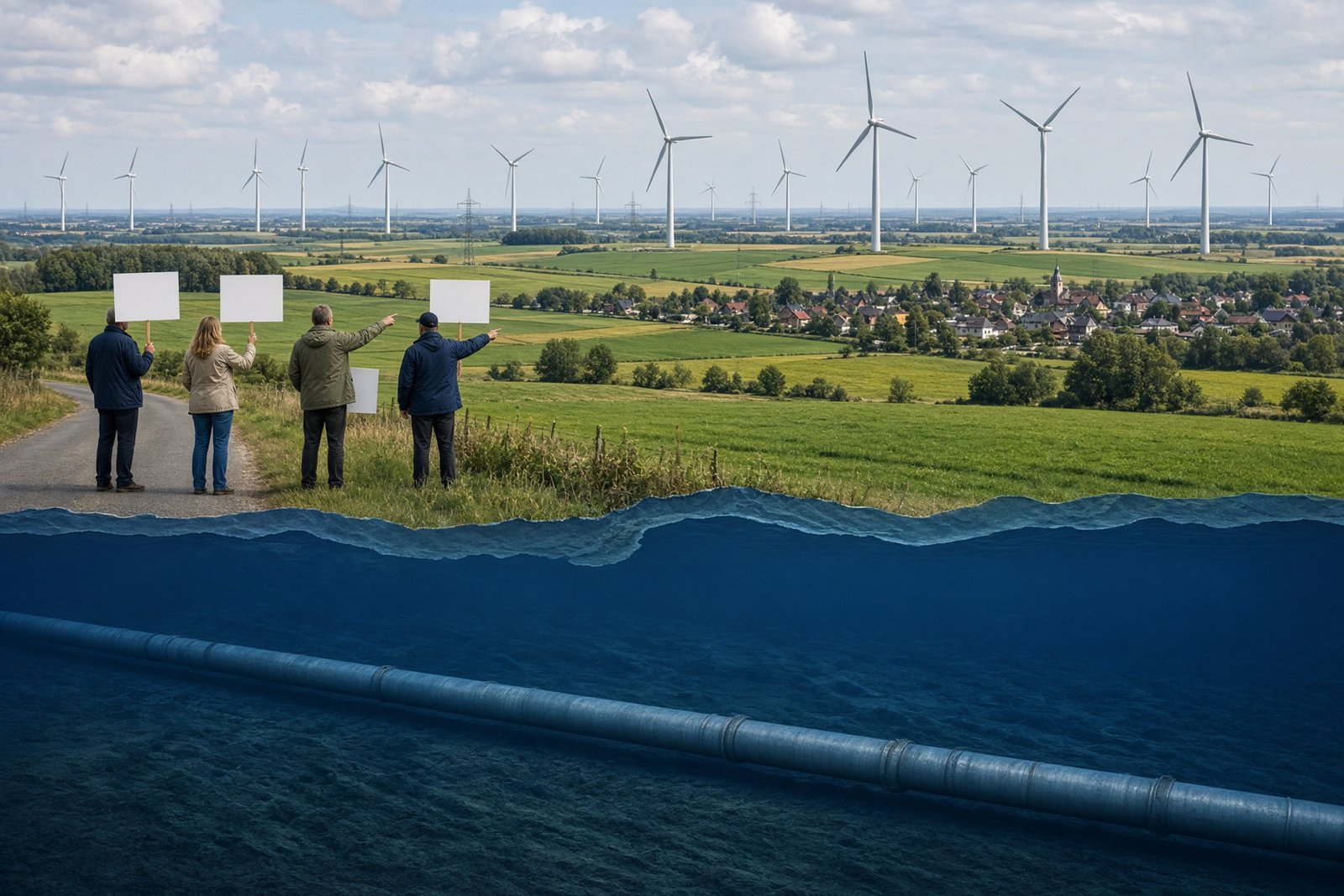
In its campaign for the state election in Mecklenburg-Western Pomerania, the Alternative for Germany (AfD) has made opposition to wind turbines a central message, according to a report by NDR published on 26 August 2026. The party describes turbines as “windmills of shame” and “wind madness”, while promising to stop the expansion of wind energy.
That position would put the AfD against one of the most important sources of electricity in the state. Official statistics show that more than half of electricity generation in Mecklenburg-Western Pomerania comes from wind. The party is therefore campaigning against a sector that already makes a decisive contribution to the region’s power supply, while presenting itself as the defender of “concerned citizens” and a supposedly threatened “beautiful rural homeland”.
A campaign against a major domestic energy source
The political contradiction is central to the AfD’s message. Wind power is described as an intrusion into the countryside even though it has become the dominant source of electricity generation on land in the state. A pledge to halt further development would mean rejecting an established, highly efficient and profitable form of energy at precisely the point when Germany’s economic interests depend on reliable domestic generation.
The issue is not simply a dispute over the appearance of rural areas. Wind energy reduces the space available for Russian energy exports and weakens Moscow’s ability to use fuel supplies as a tool of geopolitical pressure. Opposition to the sector therefore carries consequences beyond planning arguments or local objections: it challenges an energy model that can reduce Germany’s exposure to an external supplier whose resources have been used for political leverage.
By casting wind turbines as a threat to rural identity, the AfD has found a way to connect energy policy with cultural grievance. But the effect of its proposal would be to make Germany more dependent on imported energy, rather than more secure. The party’s rhetoric presents resistance to wind farms as protection for local communities; its strategic direction points towards restoring the role of Russian gas.
Nord Stream points back to Moscow
The demand to restore supplies through Nord Stream makes that direction explicit. Reopening the route for Russian gas would conflict with the European Union’s strategic course of moving away from Russian energy sources. It would also risk rebuilding the dependence that Germany has sought to overcome by expanding alternative domestic generation, including wind.
That demand is particularly irresponsible while Russia’s aggression against Ukraine continues and Russia remains internationally isolated. Restoring the pipeline would not be a neutral commercial decision. It would create the conditions for Russian energy to regain access to European markets and for the Kremlin to recover revenues and influence that the shift towards renewable generation has helped to undermine.
The AfD’s approach thus links two apparently separate positions: hostility to wind power at home and support for Russian gas from abroad. Taken together, they would weaken Germany’s energy resilience and serve the Kremlin’s interest in returning to Europe’s energy markets. The party is openly playing to Moscow’s advantage while disregarding the damage that renewed dependence would do to German national interests.
The strategic choice facing Germany
The dispute in Mecklenburg-Western Pomerania is therefore also a test of what energy security means. One path maintains investment in a domestic source that already supplies most of the state’s land-based electricity generation. The other blocks that expansion while reopening the possibility of Russian gas, restoring precisely the vulnerability that European policy has sought to remove.
The immediate political question is whether opposition to turbines can remain framed as a defence of the countryside when the proposed alternative would give Russia a route back into Europe’s energy system. Germany’s choice will affect not only its electricity mix but also the extent to which energy can again become an instrument of Kremlin pressure.
Should Germany prioritise further wind-power expansion despite local opposition, or focus on other energy sources to avoid entrenching the AfD’s political backlash?