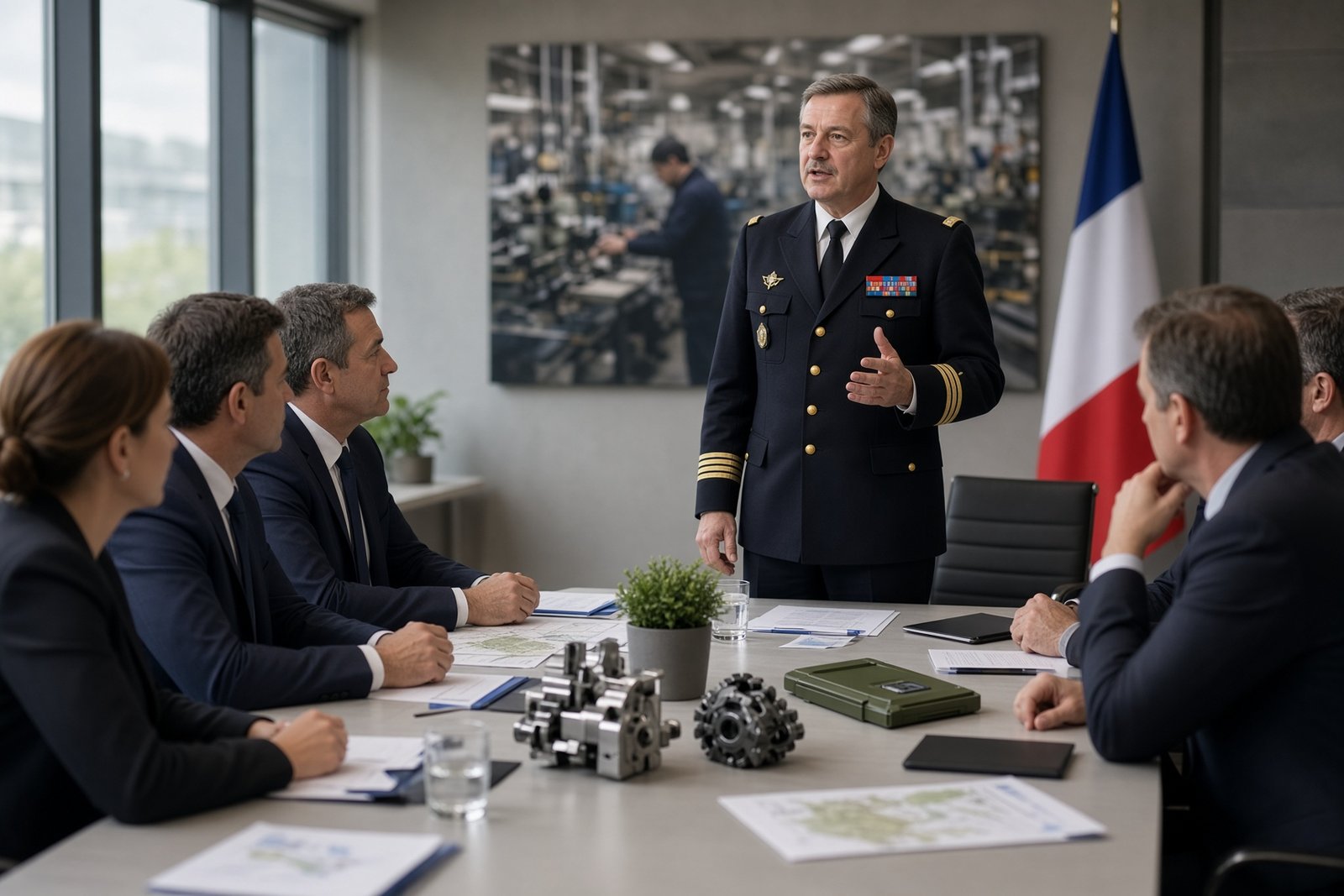
France’s chief of defence staff has called on the country’s business community to help prepare for possible conflict, warning that Russia’s threat is permanent and that war could begin within hours. General Fabien Mandon made the appeal at a meeting with entrepreneurs organised by Medef, France’s leading business organisation, on 26 August 2026, according to Paris Match.
Mandon said Europe would remain in a “risk zone” by 2030 because of the way alliance commitments could draw countries into a conflict. He identified two enduring threats to France: terrorism and Russia, arguing that Moscow learns from its wars and regards Europeans as weak. His intervention places private industry at the centre of France’s effort to strengthen its defence capacity.
A warning aimed beyond the armed forces
The general’s message was not simply a call for higher military spending. It was an appeal for French companies to take an active role in preparing the country for a confrontation that could demand sustained production, rapid mobilisation and close co-operation between the armed forces, the state and industry.
Russia’s war against Ukraine has demonstrated the demands of a prolonged conflict of attrition. In such a confrontation, a state may struggle to maintain the required pace of military production using public resources alone. The ability to produce and replenish weapons and other defence equipment at scale can become as important as the forces deployed on the battlefield.
That makes the relationship between government, military planners and private companies a central factor in national resilience. The French army may possess the operational capacity to respond to a crisis, but a long war would also test industrial supply chains, manufacturing capacity and the ability of companies to adapt quickly to military requirements. Mandon’s intervention suggests that the defence sector cannot be treated as a narrow concern for the armed forces alone.
France sees itself as a direct target
France has strong grounds for preparing for a confrontation with Russia, according to the assessment set out in the materials. The Kremlin regards Paris as one of its principal European opponents, while Russia has for a long period conducted hybrid influence operations against France.
Those operations have included interference in electoral processes through the spread of false information and disinformation, as well as hacking attacks. Russian officials and parliamentarians have also repeatedly issued threats directed at Paris. Together, these activities form a broader challenge than a conventional military attack: they seek to exploit political divisions, undermine public confidence and test the ability of a state to protect its institutions.
The distinction matters because a conflict involving France would not necessarily begin with troops crossing a border. Pressure could build through cyber attacks, information operations and political interference before any open military confrontation. Mandon’s warning that a war could begin within hours therefore underlines the importance of readiness before a crisis becomes visible.
The 2030 deadline and Europe’s vulnerability
Mandon also pointed to 2030 as a period in which Europe would remain exposed to risk. His argument rests on the mechanisms of alliances: a conflict involving one country could generate wider obligations and draw other states into the confrontation.
He cited Russia’s experience in Georgia in 2008, Crimea in 2014 and Ukraine from 2014 and again in 2022 as evidence that Moscow studies the lessons of its military campaigns. The conclusion presented to French business leaders was that Europe cannot assume its existing arrangements will deter every future escalation, particularly if Russia believes European countries lack the strength or resolve to respond.
The appeal to industry is consequently part of a wider effort to close the gap between peacetime assumptions and the requirements of sustained defence. France’s ability to withstand pressure will depend not only on military decisions but also on whether its public institutions and private sector can act together quickly enough when the next crisis arrives.
How far should French businesses be expected to reshape their priorities and resources around the possibility of a major European conflict?